Sunday, January 17, 2016

Freedom for Imprisoned American Journalist!

I don't know if you've been following it, but Washington Post journalist Jason Razaian, who was arrested and jailed in 2014 by the Iranian government for basically doing his job, has been freed after 544 days of captivity.

Back in 2014, he was accused of being a spy and was thrown into the Evan Prison, the worst prison in Iran.

This morning we read this in The Washington Post:

VIENNA — The United States and Iran moved into a new era of international relations Saturday, with the implementation of a landmark agreement on Iran’s nuclear program on a drama-filled day that also saw the release of imprisoned Washington Post reporter Jason Rezaian and four other Americans.


It is indeed a happy day for Razaian and his family and the other four Americans.

“Friends and colleagues at The Washington Post are elated by the wonderful news that Jason Rezaian has been released from Evin Prison and has safely left the country with his wife, Yeganeh Salehi,” said Frederick J. Ryan Jr., publisher of The Post. “We are enormously grateful to all who played a role in securing his release. Our deep appreciation also goes to the many government leaders, journalists, human rights advocates and others around the world who have spoken out on Jason’s behalf and against the harsh confinement that was so wrongly imposed upon him,” he said.

We so rarely get good news. This is such a welcome news story!


Tuesday, December 29, 2015

New Year's Resolution: Quit Smoking!


Change is always possible.
She says that to her husband one night
At dinner.
He looks up from a puddle of
thick yellow polenta on his plate.
He blinks.
Sure it is, he mumbles.

She brings her goblet of wine
to her lips
in her two hands.
Steadying her eyes on his,
She sips.
The air around them turns warmer.
Almost like the table is burning.
Almost like the sun has gotten closer.
Or more focused.

You don’t say.
She nods a little as if to make her words
Stand out.  Sharp.  Like the sauce that covers the polenta.
A red splash.  Spicy.
The sauce he doesn’t eat
because it gives him such heartburn.
He scoops the corn mush up onto his spoon,
And for a while he busies himself
bringing the spoon back and forth to his mouth.

I wonder sometimes, he says,
mashing the polenta over his tongue,
enjoying the warm comfort of it.
What does it all add up to?
He swallows.  And why we are here. 
Sometimes I just wanna know.
Why?

She shrugs.  Her lids go slightly lower.
I might wonder that too, she says in a hush.
But then I just know.
In meditation
I go
To the place I know
Matters.

She stares into
the polenta he fixed
the polenta that
sits there now
as round as yellow
as a noon day sun

a hard fact:
life isn’t easy.
It’s a study in unhappiness
where change is always possible
but as unlikely as it is
necessary.

She inhales now.  She gets up and
crosses the room
her bare feet slapping the wood floor.
She searches a kitchen drawer for her cigarettes.
She comes back to the table.
Bends one knee.  Sits on her foot.

She lights one of the cigarettes
She has promised she wasn’t
going to smoke anymore.

On her plate
sits the polenta
she hates
with that splash of sauce
he ladled out of a jar,
he thought she might enjoy.

You might try meditation

she says, the cigarette dangling
from her lip.
He looks up smiles. Shrugs.
She waits for him to say
Something he doesn’t say.
She stands and
carries her plate
to the sink where she forks
the yellow mess on the plate right into the garbage.
She runs the cold water in the sink.  A fleck of bright ash
Falls into the water, goes out.

I’ll do those up, he calls out to her.
No matter, she says. I have time. 
She reaches for the apron.
Ties it behind her waist.
And sets the cigarette in the charred seashell
she uses as an ashtray.
She sets her hands into the sink.
And he carries his plate to her.
And he burps.
And she thinks,
Change is always possible.
I think.
  

Thursday, December 17, 2015

POCO HAS A BOYFRIEND NAMED BURT!!

My darling puppy, Poco, who turned two years old this week, has a new friend named Burt (he lives with his owner Nancy across the street in Lenox, MA where we are now living.)

The two dogs are almost exactly the same size, and they have similar temperaments. Poco is black and white and Burt is completely black. They are both adorable and lovable and sweet and friendly and furry and well, just exceptional in every possible way. :)

And when they run side by side they look like they are velcroed together!


So now when I say to Poco, "Do you want to play with Burt?" (which is almost every day) she jumps up and heads straight for the front door.


Sunday, December 13, 2015

Everything is a Miracle

It was Einstein who said
either nothing is a miracle,
or everything is -- 
a jagged mountain range
lilacs in bloom,
a peacock unfurled,
sun on your arm,
the touch of a stranger.
Be surprised 
by nothing at all,
or by everything that is.

--Maryanne Hannan, a poet living in Upstate New York

Tuesday, December 08, 2015

Ronen, the Future Rock Star

This is how my grandson spends much of his time.

Sunday, December 06, 2015

Welcome all guests

This being human is a guest house.
Every morning a new arrival.

A joy, a depression, a meanness,
some momentary awareness comes
As an unexpected visitor.

Welcome and entertain them all!
Even if they're a crowd of sorrows,
who violently sweep your house
empty of its furniture,
still treat each guest honorably.
He may be clearing you out
for some new delight.

from "The Guest House" by Rumi, translated by Coleman Barks

Special thanks to my friend Sharon Flitterman-King for presenting me this poem on my birthday!


Wednesday, November 25, 2015

November Morning


Sunlight on the back lawn.

Crisp brown leaves.

November light.

I want to put it all down in words, no I want to crush it against my chest no I want to inhale it all and freeze the moment. I want I want I want I want I

Calm down.

Gaze serenely out the window.

Breathe in.

Hold your breath a moment.

Breathe out.

Watch the thoughts that take over.

Smile.

Sunlight bathing the tall trees.

Blue sky. 

Beautiful November morning.

Breathe.

Friday, November 13, 2015

The Miracle that is Modern Technology

It all started with two cups of curried rice.

My husband -- an extraordinary cook -- mistakenly made two cups of rice instead of one. He'd added turmeric so the rice was bright yellow.

When we finished our tofu and broccoli, we wondered what to do with all the leftover rice.

"Can you freeze cooked rice?" he asked me.

"I'm not sure, you better look it up," I answered.

That's when the magic happened. He turned to his cell phone and switched on Google, the person we refer to as "the talking lady."

"Can you freeze cooked rice?" he asked.

It couldn't have been more than 10 seconds later that Google cheerfully announced that you could indeed freeze cooked rice, even if you were only saving it for one day. "Freezing the cooked rice will keep it from sticking," Google said.

I was at the sink washing dishes. "I can't believe this," I said. "What kind of world do we live in when we can get answers to so many questions in the matter of seconds?" It felt like magic to me.

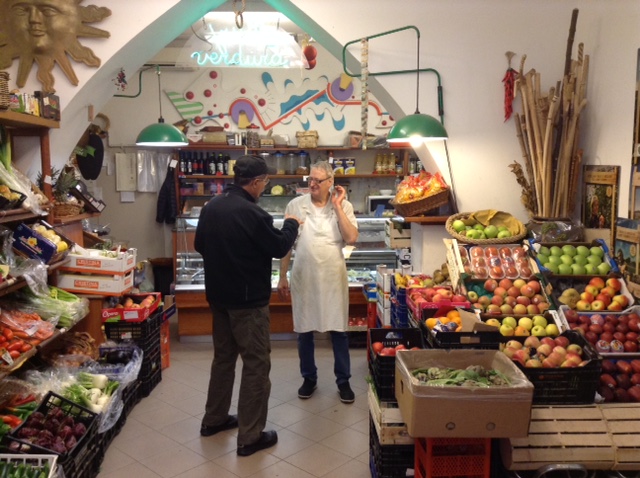
And then this morning I had the same magical feeling. I got up before dawn to meditate and chant. I checked email and there was a message from my sister-in-law Fawn. She and my brother are enjoying an adventure in Italy and Fawn had taken a photo of a fabulous fruit and veggie store. She attached a photo of my brother chatting it up with the owner of the little store.

She had emailed us just an hour before (5:15 a.m. our time, 1:15 in the afternoon in Italy.) The email gave me a run of goosebumps. Here was the modern version of a postcard, arriving instantly  --instead of the way it used to be, when the postcards arrived a week or two after you were home from your trip.

What an amazing world. We have problems up the gazoo, but meanwhile, we have technology that is bringing minds and machines closer and closer together. Can you imagine if someone from the 1800s could see what we have become? Can you imagine someone from the 1950s, or the 60s, or even the 90s? Or even 2005.

I taught a journalism class at Georgetown in 2009. I called it "Journalism Upside Down." In other words, how were blogging and the Internet causing chaos within traditional media outlets. Newspapers were dropping like flies while blogs were flourishing like kudzu.

Imagine this: a student came to class one night and shared an exciting news event involving TWITTER. Senator Claire McCaskill had actually TWEETED (strange word we thought, kind of birdlike) from the Senate floor. We all marveled at this new "social media."

I asked the J-school grad students to consider this question: "Is it possible that at some point in the future we will get serious news from Twitter or Facebook or blogs?" It seemed rather far-fetched at the time, but we took up the question anyway.

And here we are today in a world where cell phone videos instantly make major headlines. Where social media is the breath of life to every political and social cause; where millions of people sign thousands of petitions by email every day; where viral messaging can bring the world's spotlight on horrifying police brutality. Or institutional racism.

The other day, I marveled when I saw a short video filmed as students protested institutional racism at the University of Missouri. The protests brought down Missouri's president. Once again students were showing how powerful social media can be. The protests, according to CNN, "took shape after the student government president took to Facebook in September to complain about bigotry and slurs."

That's what social media can do in the modern age. It is thriving as so many traditional news organizations are withering away.

I had another aha moment when that short video showed protesting students trying to block the reporters and photographers from covering the protest. "Give us some space," the students screamed. "Leave us alone." 

Here I was seeing something I never thought I would see: protesters who weren't dying for media attention! Remember all those 1960s marches on Washington -- protesters did everything they could to hook the press. (Remember how the press always played down the number of protesters?) 

Yesterday's New York Times featured a debate about why young people -- particularly young people of color -- distrust the news media. 

Today we live in a world where social media makes every single human being with a cell phone a reporter or a photographer or a videographer (those iPhone 6 cameras are amazing!) No longer is news gathering restricted to a select group of media elites. Nowadays every individual's voice can be heard en masse. 

Technology has done wonders for democracy.

Who knows were this speed of light technology goes next? I'm fascinated to find out. 

Saturday, October 31, 2015

REMEMBERING MOM

My mother, Clementa "Dena" Ricci, died on October 17th, a week after she was diagnosed with pancreatic cancer. 

I was eating a bowl of apple sauce Sunday night when it hit me: I will never eat another one of mom’s unbelievable apple pies again. Or her blueberry pies. Or her carrot cake. And there will never be another pot roast dinner like the ones mom used to turn out regularly: meat done to perfection, tender and thin sliced, all smothered in onions and carrots. Oh, and an additional three or four vegetables just to round out the meal.

All of us know Mom’s amazing talent with food. All of us kids remember walking up the driveway after school smelling warm bread. All of us know her fried pizza dough, her raisin meatballs and her crispy cream puffs with that melt in your mouth cream filling. It was those cream puffs that sealed the deal between her and my dad. He just had to marry this gorgeous girl who also happened to make cream puffs that were out of this world.
It was hard to give my mom a compliment though. You’d tell her she looked pretty and she would say, “ah le mortigi shegi,” in Italian, “ah the blind people go crazy over me.”
She tickled us with all of her many Italian sayings, we loved them so much that we made a scrapbook out of them – they had the accumulated wisdom of many past generations of Italians.
Things mom loved: babies, brides, broccolilabe and scharoll; (escarole.)
She loved the Virgin Mary, and while she was dying on Friday, we held hands and said the Hail Mary together.
Mom loved making omelets with mint, and tomatoes with eggs, favorites of Michelina, her own mother. Mom loved making all sorts of yeast breads including the eggs in the bread basket for Easter, and the extraordinary panettone she made at Christmas. Thankfully, she taught all of us girls to make it. Mom loved a spic and span house and worked tirelessly to make it gleam. She loved setting the table for breakfast at night before she went to bed.
She loved antiques, and as my sister Holly wrote in her wonderful obituary, ‘“Dee” excelled at stained glass, needlework, and word puzzles, she loved cooking shows and “poking around junk shops, collecting antique furniture, glassware and crockery.”
After mom’s eyesight failed and she couldn’t see the words, she still had an amazing talent for coming up with the right answers to those word puzzles.
Of course mom’s greatest love was for her partner of 66 years, my Dad. They had an incredible marriage and it inspired us to want the same.
I have had a lot teachers in my life teaching me important things, but my first and most important teacher has always been my Mom, because she taught me how to love with her whole heart. Mom had the biggest heart in the world and she shared it with all of her family and friends she loved so fiercely and freely.
And so, Mom is gone in one sense, yes, but in another, she will never die, because her love brought us all here together today and sits with us now. Mom’s enduring gift to us is to know how to love from the bottom to the top of our hearts.
Mom always had a really tough time saying good bye. The day she was diagnosed, mom was crying and she looked in my eyes and said, “I remember making pipe curls in your hair for school and then you would go off and we would wave and wave goodbye.”
As an adult, leaving 152 Sampson Pkway, mom would stand on the porch. We would wave, and then I would peep the horn three times and drive off, mom waving the whole way.
Mom, we don’t say good bye today, we don’t have to because you will be with us all every single day for the rest of our lives. God Bless you Mom, we love you like crazy!


Wednesday, October 07, 2015

RELYING ON DIVINE ENERGY TO LOCATE OUR WELL!

Maybe you already know what a dowser does.

I had heard of them, I had a vague notion of what they were. But last week, when it got time to dig the well for our new home in Massachusetts, I had a chance to see for myself what a dowser does. I am here to tell you that it is an amazing process.  It makes you understand that there are people out there who can detect planetary energy in the physical world.

There are hundreds, maybe even thousands of dowsers: highly sensitive -- or psychically gifted -- people who use divining rods to find water. So says Wikipedia: "Dowsing is a type of divination employed in attempts to locate ground water, buried metals or ores, gemstones, oil, gravesite, and many other objects and materials without the use of scientific apparatus." Read Wikipedia's fascinating history of dowsing -- it's hundreds of years old. It was used in the Vietnam War by Marines trying to detect weapons and tunnels. At some point in history, dowsers were thought to be Satanic.

Meet Craig Elliott,
the dowser who searched our land for water. We met on a sunny October morning, me toting my dog Poco. Craig took us up to the building site (there is no driveway yet) in his four-wheel drive truck. He proceeded to take his instruments out of the back of the truck.

The first instrument has two brass handles, attached to two long pieces of stiff wire.

He began to walk the hillside, holding tight to the handles of his diving rod. The two wires remained parallel to each other for quite a while and then whammo --  the wires went crazy and started swinging left and right, crossing each other back and forth.

He smiled. "It looks like we found water," he said. I just stood there. He never moved his hands. The wires seemed to have a life of their own.

The way Craig describes it, the wires are the antenna and he is the instrument, sensing the water beneath the earth.

"Can I try it?" I asked and he was happy to hand the instrument over to me. I held onto the brass handles and walked back and forth. Nothing happened.

"Don't feel bad," Craig said. "Nine out of ten people cannot do this."

The second instrument is made of white plastic, and is V-shaped. Craig says this instrument used to be made of whalebone but no more.

He sets each branch of the device against his closed eyelids. Then, he scrunches up his face and turns red and to himself, begins to ask what the rate of water flow will be.

He asks himself, "Is it one gallon per minute, is it two gallons per minute and so on." And when the white wishbone points downward, he gets his answer.

Craig -- a third generation dowser -- says he has performed more than 700 divinations, and he has been wrong (meaning there was no water where he said it was) only 23 times.

We will see whether he is right about our water! He says the driller will find water 150 feet down, and the rate of flow will be nine gallons per minute (which is a terrific well!) The person who recommended we use Craig is the engineer who is designing our septic system.

Craig
says his dad was even better at it than he is. He could find objects of all kinds.

And there are dowsers who don't even need instruments. One woman that Craig met at the annual dowser's convention in Vermont uses just her hand to sense the presence of water.

Well, so, the well will be dug within a few weeks. And I will be back to let you know if Craig is right!