The more I wrote in Italian, the more excited I got about the language, and about how it was opening me up to new feelings. Italian was infusing my life with vigor; it felt sometimes like the words, and their rolling sound, were filling me with passion and energy!
Each morning after I finished meditating, I sat down with my journal and used the translator program to write all kinds of phrases and sentences that appealed to me.
“Each moment is a gift.”
Ogni momento é un regalo.
“Life is a precious flower.”
La vita é un fiore prezioso.
“May you enjoy all the small and the large miracles today.”
Potresti goderti tutti i piccoli e grande miracoli oggi.
I felt a kind of thrill when I spoke the sentences out loud. I just loved the way they sounded. Using Babbel, I tested my accent -- I spoke Italian into a microphone, and if I had the right accent, the program would ring a little bell!
One morning out of the blue I recalled one of Dee’s (my mom Dena’s nickname) favorite sayings. "Li cascado lu caso sober le maccheroni." Translation:
The cheese fell right on the macaroni!
Meaning, things worked out perfectly well for me!
My mother said that to me frequently after I left for college. I suppose she was right. After all, I was attending an Ivy League school on an academic scholarship. But when I met and married my husband Richard in 1978, she said it more than ever. My in-laws were fairly well off, and they were in the gourmet catering business, so my wedding – which we announced only five weeks before it happened – was quite an elaborate affair.
There was another saying my mother used to say to me: “Hey, tu se fortunata!” – Hey, you are so fortunate!
Honestly, though, I had never really considered myself fortunate!
Looking back, it is fair to say that I spent most of my life in a low level of depression.
My first dip into depression occurred during my sophomore year in college. In March of 1972, my high school boyfriend (who was a freshman at Harvard) and I parted ways in a rather romantic, sweet way: he and I sat in Harvard Square long into the night. He, being a musician, serenaded me with his beautiful blonde Martin guitar! We hadn't fallen out of love; we were simply recognizing that we needed space in order to live our lives fully at college.
Well, so, back at Brown that spring, I found myself nosediving quickly into a state of torpor. I wandered around Providence feeling lost. Lonely. Unable to focus. I tried going to the counseling center, but they couldn't seem to remember my name from one visit to the next.
And then, a rather remarkable physician, Dr. Horace Martin**, who was my lab instructor in microbiology, reached out to me. He called me up to his desk after class one day and began talking to me. As we left the classroom, he told me about his family -- he had seven children. And soon enough, he asked me to come over for dinner. So that night, I accompanied him home to eat spaghtetti and meatballs.
He and his wife were incredibly sweet; after dinner, they insisted that I stay overnight.
I guess I must have worn my depression all over my face! What I didn't learn until later was that Dr. Martin had suffered from depression himself. He was keenly aware of the signs and he had recognized them in me because he knew them so well himself!
The next morning Dr. Martin drove me back to campus and when he dropped me off, he told me to play my guitar. He also gave me a very simple piece of advice that I have remembered for more than 50 years!
"Remember to do something really nice for yourself every single day," he said. "Even if it's just treating yourself to a candy bar."
I think back to my Mom's saying: “Claudia, tu se fortunata!” And I realize that Mom was right. God knows what would have happened to me if Dr. Martin hadn't reached out to offer his incredible kindness!
I recovered from the depression in 1972. I was again, very fortunate! I was invited to spend that summer in Norway, living with a lovely young woman named Liv Bremer, who had been the foreign exchange student in my high school. Liv and I had bonded, and now, she really wanted me to come to Norway, and miraculously, even though I had very little money, I did! She found me a job in a "margarinfabrik," a margerine factory where I wore a white coat, a white net on my hair and a pair of white clogs. I packed huge slabs of margerine, and also, on a separate machine, peanut butter.
Liv and her friends and I trekked all over Norway's gorgeous landscape, from the remarkable fjords in the south to the beautiful mountains and bay of Bergen up north.
I was so smitten with Norway that I actually wrote the Dean of Students at Brown in August of 1972 and asked him if I could spend the semester at the University of Oslo. It's hard to believe, but I really thought that I would be able to take chemistry in Norwegian!
Thankfully, reason prevailed and I returned to Brown feeling excited about my junior year!
I had managed to steer through my first serious episode of depression. Miraculously, I would go through most of my adult life before it did flare up in a big way.
Looking back, however, I realize that I lived most of my life under the shadow of a low level of depression. That feeling of being frozen. That inability to experience deep joy on a moment-by-moment, day-by-day basis.
It's quite apparent to me when I look back at photos. My husband and I would always bemoan the fact that I couldn't seem to smile.
He on the other hand had a knockout of a smile.
"Honey, just smile from your heart," he would say, aiming the camera at me.
Over and over again, I would try. Over and over and over again, I would fail.
Honestly, I didn't understand what it meant to smile from my heart until I finally embraced my ancestry, deep in my soul!
And I didn't embrace my ancestry until I allowed the Italian language to pour out of me!
**The kindness that Dr. Martin showed me back in 1972 cannot be overstated! I hope readers will click on the link to the story I wrote about him and his wife Florence, both of whom deserve metals for their deep and abiding humanity!
Saturday, January 27, 2024
Wednesday, January 24, 2024
CHAPTER FOUR: "More, more, more -- Ancora, ancora, ancora italiano, Per Piacere!"
Over the next few days, whenever I started to feel anxious, I simply turned to the translator.
I typed in whatever I was feeling, and boom, instantly the sentences in English appeared in Italian.
Over and over again I wrote, “Don’t be afraid!”
Non aver paura!
Non aver paura!
Non aver paura!
“Feel the life inside your body.”
Senti la vita dentro il tuo corpo.
One morning, however, something happened when I started typing. Without warning, without my being aware that I was even typing the word, out came:
“BREATHE!”
Respirare!
That word, breathe, stopped me cold. Instantly, it jogged an incredibly vivid memory. I was a little girl again, only about four years old, and I was standing beside my mother’s bed.
I can see her shiny black hair lying in soft curls on her shoulders. My mother is so beautiful, but today she is hunched over a couple of pillows and she is wheezing and sweating and struggling to breathe, as she so often was when I was a young child. I am watching her with mounting anxiety. I am so terrified that my mother is going to die.
I get up from the computer. I am crying. I put on my emerald jacket and my purple boots and ignoring Poco, I hurry out the door. The temperature has dropped and the wind is wickedly cold. I walk out into the meadow, with no gloves or a hat, heading for the willow trees. Overhead is a cloudy sky. I cannot shake the image of my mother bent over those soft white pillows. I close my eyes and breathe in and out, forcing myself to slow my breathing way down. Then I go back inside.
I can’t decide whether to go back to the computer. So I make myself a cup of turmeric and tension tamer tea. I add honey and milk and carry the tea to the sofa. I sit there staring out at the meadow. At that moment Poco starts barking furiously.
Curious, I stand up. I gasp! I count SEVEN young deer prancing and dancing across the meadow. I feel a rush of love and gratitude for the deer. Suddenly I feel overwhelming love rise up inside me!
That's when it hits me: I remember Mom saying how deeply afraid she was during those asthma attacks! I remember Mom telling me that her worst fear in those days was that she would die and we kids would find her, dead, in her bed.
Mom had three young kids and no one to help her. My dad was in school, in another city, training for a better job. He was away most of the time.
My father's mother, who lived nearby, could have helped her, but she was working in the clock factory, and she didn't have time.
Eventually, my mother's mother, Grandma Mish, came to the rescue. She had one of her sons drive her to Bristol, where we lived. Grandma Mish packed us up and moved Mom and the three of us kids to her house in Canton, Connecticut, where we lived for six months or more with her and Grandpa Claude (yes, I was named for him.)
Thinking about Mom now, I can feel just how terrified she was!
Thank God for my blessed grandparents, who came to her -- and our -- rescue!
As I was only three or four, I'm really vague on how long it was. My older brother Rich*, however, has perfect recall: he remembers attending first grade at the Canton Elementary School, where Grandpa Claude was the custodian. Rich was more than happy to escape Saint Anthony's School, where the nuns were unbelievably mean to us! More on those wicked nuns -- Grandpa Claude called them black "crows!"-- (in his dialect, "cornudi nidi!") later on!
Meanwhile, the deer are gone now.
And somehow, I feel like my own terror has passed. I sit here, glad to be alive.
*****
*My brother Rich recalls with great joy the Canton Elementary School, where he went as a little boy. "All the floors were really shiny and it smelled good, and that was because Grandpa Claude did a good job as a custodian!" Saint Anthony's School, which he refers to as the "prison," didn't smell so good.
"I remember going down the hall to visit Grandpa in his little room, the place where he kept his cleaning supplies. He ate lunch there. I remember that he had a bottle of wine, it was small, like a salad dressing bottle. He had a glass or two of wine at lunch at the school."
I typed in whatever I was feeling, and boom, instantly the sentences in English appeared in Italian.
Over and over again I wrote, “Don’t be afraid!”
Non aver paura!
Non aver paura!
Non aver paura!
“Feel the life inside your body.”
Senti la vita dentro il tuo corpo.
One morning, however, something happened when I started typing. Without warning, without my being aware that I was even typing the word, out came:
“BREATHE!”
Respirare!
That word, breathe, stopped me cold. Instantly, it jogged an incredibly vivid memory. I was a little girl again, only about four years old, and I was standing beside my mother’s bed.
I can see her shiny black hair lying in soft curls on her shoulders. My mother is so beautiful, but today she is hunched over a couple of pillows and she is wheezing and sweating and struggling to breathe, as she so often was when I was a young child. I am watching her with mounting anxiety. I am so terrified that my mother is going to die.
I get up from the computer. I am crying. I put on my emerald jacket and my purple boots and ignoring Poco, I hurry out the door. The temperature has dropped and the wind is wickedly cold. I walk out into the meadow, with no gloves or a hat, heading for the willow trees. Overhead is a cloudy sky. I cannot shake the image of my mother bent over those soft white pillows. I close my eyes and breathe in and out, forcing myself to slow my breathing way down. Then I go back inside.
I can’t decide whether to go back to the computer. So I make myself a cup of turmeric and tension tamer tea. I add honey and milk and carry the tea to the sofa. I sit there staring out at the meadow. At that moment Poco starts barking furiously.
Curious, I stand up. I gasp! I count SEVEN young deer prancing and dancing across the meadow. I feel a rush of love and gratitude for the deer. Suddenly I feel overwhelming love rise up inside me!
That's when it hits me: I remember Mom saying how deeply afraid she was during those asthma attacks! I remember Mom telling me that her worst fear in those days was that she would die and we kids would find her, dead, in her bed.
Mom had three young kids and no one to help her. My dad was in school, in another city, training for a better job. He was away most of the time.
My father's mother, who lived nearby, could have helped her, but she was working in the clock factory, and she didn't have time.
Eventually, my mother's mother, Grandma Mish, came to the rescue. She had one of her sons drive her to Bristol, where we lived. Grandma Mish packed us up and moved Mom and the three of us kids to her house in Canton, Connecticut, where we lived for six months or more with her and Grandpa Claude (yes, I was named for him.)
Thinking about Mom now, I can feel just how terrified she was!
Thank God for my blessed grandparents, who came to her -- and our -- rescue!
As I was only three or four, I'm really vague on how long it was. My older brother Rich*, however, has perfect recall: he remembers attending first grade at the Canton Elementary School, where Grandpa Claude was the custodian. Rich was more than happy to escape Saint Anthony's School, where the nuns were unbelievably mean to us! More on those wicked nuns -- Grandpa Claude called them black "crows!"-- (in his dialect, "cornudi nidi!") later on!
Meanwhile, the deer are gone now.
And somehow, I feel like my own terror has passed. I sit here, glad to be alive.
*****
*My brother Rich recalls with great joy the Canton Elementary School, where he went as a little boy. "All the floors were really shiny and it smelled good, and that was because Grandpa Claude did a good job as a custodian!" Saint Anthony's School, which he refers to as the "prison," didn't smell so good.
"I remember going down the hall to visit Grandpa in his little room, the place where he kept his cleaning supplies. He ate lunch there. I remember that he had a bottle of wine, it was small, like a salad dressing bottle. He had a glass or two of wine at lunch at the school."
Monday, January 22, 2024
CHAPTER THREE: "How Italian Comes Alive Inside Me!"
Looking back now, I know that I never would have connected to my Mom or to my bis bis nonna Filomena, or to any of my other ancestors if I hadn't started "speaking" Italian.
Italian has been inside me for as long as I have been alive.
My Mom was fluent, and she always spoke to her parents in Italian. So often when I was growing up, the three of them would be conversing and I would be sitting with them at the dining room table, listening to Mom and Grandma Mish and Grandpa Claude. I was absorbing words and sayings without realizing it. While I couldn't speak Italian, I could understand much of what I heard growing up.
In high school, I studied Spanish and French for four years. Italian wasn't offered. But in college, when I could have immersed myself in the language and in Italian history, I wasn't the least bit interested.
It wasn't until I fell into that endlessly frozen pit back in 2020 that I turned to Italian to rescue me.
And the strangest thing? I had no warning, and absolutely no idea that it was happening!
One morning, early in February of 2020, just a month or so before the GP descended, I found myself staring out into the meadow, which was blank with fog. I sat in the living room, on the sofa, feeling blank myself. Completely empty. Confused and lonely.
I thought it might help if I wrote about what I was feeling. But every time I opened my laptop, I just stared at the screen. My breath felt frozen inside me. My heart felt like a dark stone.
I felt lonely and scared. And the worst part of it was, I wasn’t sure why I was feeling so desperate.
At some point I started crying. A few minutes later, without really thinking about what I was doing, I opened Google translator on my laptop and set it to translate from English to Italian. And then I started typing:
“Try saying it in Italian." Instantly that became:
Prova a dirlo in italiano.
I spoke the words out loud. Once. Twice. Three times. I really liked the way the Italian sounded coming out of my mouth. Better yet, I liked the way the vibration felt as the sumptuous words resonated throughout my chest.
It was as if somebody had turned on a warm faucet inside me.
I sat there, translating every sentence that came to mind. And the sentences came fast and furiously.
“I am so afraid of being frozen.”
Ho cosi paura di essere congelato.
“I want to melt the ice inside me.”
Voglio sciogliere il ghiaccio dentro di me.
“Let go of the fear and feel the love!”
Lascia andare la paura e senti l’amore!
“Why am I so afraid?”
Perche ho cosi paura?
I was no closer to understanding why I was so frightened. But there was something about the soft round sounds of the Italian -- I couldn't get enough of them. They were just so... comforting.
And affirming.
The melodic words made my chest feel alive, like it was filled with a thick garden of pale green ferns and palms, with orchids growing here and there; at the center of this garden was a beautiful fountain sprouting sparkling blue water.
Saying the Italian words out loud made me feel like I was speaking something very true and special to me, something that was peculiarly warm, and beating incessantly inside my heart.
For days I wrote the translations down in my journal. I wrote the English sentences in red pen. And then I wrote the Italian sentences in green pen. Soon I enrolled in an on-line Italian class. A Babbel class, in which I started...
Babbling in Italian!!!
The desire to speak the language of my grandparents had taken over!
How come, I wondered, had it taken me until I was 68 years old to want to speak Italian? And why was it, now that I was locked in a frozen pit with no way out, that I couldn't seem to get enough Italian?
And while the answers to those questions were really very simple, and should have been obvious to me, it would be almost four years before I figured them out!
****** That first morning when I began "speaking" in my native tongue, I lost track of time. I was writing down sentences for God knows how long.
Finally I got up from the computer. I walked into the living room. Poco was resting in her fluffy little chair, the way she always does at this time of the morning.
“Let’s go Miss Poco,” I whispered to her as I attached the leash to her halter. I opened the door to the meadow.
Together, we strode out across the brown tufts of grass. A layer of fog still sat on the far hillsides. There were no birds. Where were the birds? Where did they go? And why was there no snow?
Every so often we stopped. I inhaled. The air was so fresh and clean. I held my breath. We walked to the very edge of the tall tufted marsh grasses.
It started to rain, a spiffy little sprinkle. Here it was February and it was 44 degrees out.
I turned to face the house. My husband was on the back porch, sitting on a bench. He waved to me and I waved back.
I continued standing in the field, inhaling the cool moist air.
Soon, Poco and I headed back to the house. Suddenly there was so much I wanted to say. But now, I wanted to say it solo in italiano.
Oh. And it was right about that moment that I began writing a fictional story. A story about a character I called Leah!
Italian has been inside me for as long as I have been alive.
My Mom was fluent, and she always spoke to her parents in Italian. So often when I was growing up, the three of them would be conversing and I would be sitting with them at the dining room table, listening to Mom and Grandma Mish and Grandpa Claude. I was absorbing words and sayings without realizing it. While I couldn't speak Italian, I could understand much of what I heard growing up.
In high school, I studied Spanish and French for four years. Italian wasn't offered. But in college, when I could have immersed myself in the language and in Italian history, I wasn't the least bit interested.
It wasn't until I fell into that endlessly frozen pit back in 2020 that I turned to Italian to rescue me.
And the strangest thing? I had no warning, and absolutely no idea that it was happening!
One morning, early in February of 2020, just a month or so before the GP descended, I found myself staring out into the meadow, which was blank with fog. I sat in the living room, on the sofa, feeling blank myself. Completely empty. Confused and lonely.
I thought it might help if I wrote about what I was feeling. But every time I opened my laptop, I just stared at the screen. My breath felt frozen inside me. My heart felt like a dark stone.
I felt lonely and scared. And the worst part of it was, I wasn’t sure why I was feeling so desperate.
At some point I started crying. A few minutes later, without really thinking about what I was doing, I opened Google translator on my laptop and set it to translate from English to Italian. And then I started typing:
“Try saying it in Italian." Instantly that became:
Prova a dirlo in italiano.
I spoke the words out loud. Once. Twice. Three times. I really liked the way the Italian sounded coming out of my mouth. Better yet, I liked the way the vibration felt as the sumptuous words resonated throughout my chest.
It was as if somebody had turned on a warm faucet inside me.
I sat there, translating every sentence that came to mind. And the sentences came fast and furiously.
“I am so afraid of being frozen.”
Ho cosi paura di essere congelato.
“I want to melt the ice inside me.”
Voglio sciogliere il ghiaccio dentro di me.
“Let go of the fear and feel the love!”
Lascia andare la paura e senti l’amore!
“Why am I so afraid?”
Perche ho cosi paura?
I was no closer to understanding why I was so frightened. But there was something about the soft round sounds of the Italian -- I couldn't get enough of them. They were just so... comforting.
And affirming.
The melodic words made my chest feel alive, like it was filled with a thick garden of pale green ferns and palms, with orchids growing here and there; at the center of this garden was a beautiful fountain sprouting sparkling blue water.
Saying the Italian words out loud made me feel like I was speaking something very true and special to me, something that was peculiarly warm, and beating incessantly inside my heart.
For days I wrote the translations down in my journal. I wrote the English sentences in red pen. And then I wrote the Italian sentences in green pen. Soon I enrolled in an on-line Italian class. A Babbel class, in which I started...
Babbling in Italian!!!
The desire to speak the language of my grandparents had taken over!
How come, I wondered, had it taken me until I was 68 years old to want to speak Italian? And why was it, now that I was locked in a frozen pit with no way out, that I couldn't seem to get enough Italian?
And while the answers to those questions were really very simple, and should have been obvious to me, it would be almost four years before I figured them out!
****** That first morning when I began "speaking" in my native tongue, I lost track of time. I was writing down sentences for God knows how long.
Finally I got up from the computer. I walked into the living room. Poco was resting in her fluffy little chair, the way she always does at this time of the morning.
“Let’s go Miss Poco,” I whispered to her as I attached the leash to her halter. I opened the door to the meadow.
Together, we strode out across the brown tufts of grass. A layer of fog still sat on the far hillsides. There were no birds. Where were the birds? Where did they go? And why was there no snow?
Every so often we stopped. I inhaled. The air was so fresh and clean. I held my breath. We walked to the very edge of the tall tufted marsh grasses.
It started to rain, a spiffy little sprinkle. Here it was February and it was 44 degrees out.
I turned to face the house. My husband was on the back porch, sitting on a bench. He waved to me and I waved back.
I continued standing in the field, inhaling the cool moist air.
Soon, Poco and I headed back to the house. Suddenly there was so much I wanted to say. But now, I wanted to say it solo in italiano.
Oh. And it was right about that moment that I began writing a fictional story. A story about a character I called Leah!
Tuesday, January 16, 2024
CHAPTER TWO: My Healing Begins as Mom Reaches Out to Me From the Great Beyond!
In that last crazy chapter, the one I called "All Things Must Pass and All Things Stay the Same," I mentioned several times that I was suffering from a meterological crisis four years ago, that is, I was emotionally blocked. I felt as frozen as my crusty white lawn.
I know that I threw a lot of you for a loop with that chapter, telling stories about Leah and Gina. Talking about climate degradation. Lecturing you the reader about Einstein. About TIME and CHANGE and CALCULUS. Apologies for all that.
So this time, I'm going to keep it simple.
I'm going to tell you about how my healing began, on the day when Mom came to me, when I first began to open my heart to the possibility of miracles.
It was SHABBAT, Saturday, MARCH 21, 2020, the very first Saturday of the GREAT PANDEMIC. When I refer to the GREAT PANDEMIC from here on, I will refer to it only as the GP.
I was sitting that day with my laptop at the desk that Mom left me years back. It is an especially handsome oak desk, and the seat of the chair looks like something Mom might have done herself, a tapestry of navy blue with colorful flowers.
I have no explanation for what happened next. But I am convinced that for the first time (but not the last) my mom, Dena Rotondo Ricci, reached out to me from the GREAT BEYOND, which I will refer to from here on as the GB, although that might be easily confused with the GP, the GREAT PANDEMIC. I believe Mom made herself known to me during that stressful time in order to offer her reassurance that everything would turn out alright.
It is only now, with the benefit of hindsight, that I can look back and say, yes, this was definitely DAY ONE of what is/was my healing, the melting of my deeply frozen self!
On that Saturday, the end of the first official week of the GP, that damn COVID 19 virus had closed everything down, including, of course, our synagogue. It being Saturday, and me being quite shaken and upset about the GP, I decided to Zoom into a Shabbat morning service at another temple in town. I even donned my purple prayer shawl.
To say the service was chaotic does not begin to describe what was happening that Shabbat morning on the zoom. How boring and disorganized it was. And when everyone tried singing together, oh dear LORD, what a disaster!
So I sat back. I muted the Zoom. Sunshine was pouring through the window of my studio/study, falling gently on my keyboard. I was enjoying sitting at Mom's desk, because most of the time I write in the living room, sitting as I am today on the sofa!
I began scrolling through Word files, just because, and suddenly I came upon a file called “Oh Spring!” which originally contained a poem that I had written a few weeks earlier for a local magazine, called "Edible Berkshires."
I decided to reread the poem, as I knew that I might have to find another home for it because the editor had told me he wasn't going to be able to publish the spring issue of the magazine, because of, what else, the gd GP!
So I opened the file. HUH? Somehow the poem had disappeared! Instead, the file contained THE BIRTHDAY LETTER that I had written to my mother seven years earlier on
March 30, 2013, her 87th birthday.
How could this be, I asked myself. How could one file suddenly replace another? This was impossible, and certainly this had never ever happened to me before.
So odd. So strange. But then something even more strange happened.
As I was sitting there puzzling over the disappearance of my poem, my husband walked into my study. "Going to the grocery store honey so wish me luck," he said. This would be the first time during the GP that he had tried to shop for food.
I turned to him. "Hey honey, would you mind buying me a small purple orchid?" I begged. Not that I needed another orchid. My kitchen counter had seven orchids already. But hey, the GP was a huge downer. I knew an orchid would boost my quarantined spirits.
He chuckled. "Hey, I have all I can do to buy food in these COVID times. Darling, you can do without another orchid."
With that, he turned and left. I then turned back to read THE BIRTHDAY LETTER that I had written to my dear Mom seven years earlier.
Imagine my shock when I read this:
"Dear Mom,
"Today is your 87th birthday. When you turn 87, there aren't a whole lot of birthday presents one can buy. You want health and happiness for yourself and all of those you love.
"Well, so, you love ORCHIDS! The one I bought you a year ago, all the blossoms have disappeared, and recently Dad said, ‘let's get rid of that plant, it's just three bare sticks.’"
"But no, Mom, despite your vision issues, you saw something tiny and green budding there on one of those bare branches. And yes, something wonderful did happen -- four or five new pink blossoms appeared!"
I stopped reading for a moment. I sat there in shock. I had just asked my husband for an orchid moments before and then I opened the letter to Mom and BOOM, it was filled with
ORCHIDS!
The letter continued:
"So eager are you to visit your sunroom each morning. And each week, on Tuesday, you put two ice cubes into the pot and not a drop more water.
"You are just adorable caring for your orchids.
"So today, your day, it wasn't difficult to know what to buy you: another orchid, of course!
"HAPPY BIRTHDAY MOM!
"We Love You So Much,
"Claudia"
I sat there staring, trying to comprehend what had just happened. Here was a coincidence of major proportion. Mom had reached out and brought me the orchids from her birthday letter, in order to offer me comfort and reassurance at a deeply stressful time.
Coincidences were/are not new to me. I had/have been witnessing them in my life for quite a long TIME. So many that my husband had coined them
COINKYDINKIES!
The more formal term for this kind of event is
SYNCHRONICITY,
a concept introduced in the late 1920s by psychologist CARL JUNG. He formally introduced the term in a paper he published in the year -- coincidentally -- that I was born, 1952.
OK. Speaking of SYNCHRONICITY, something just happened which is very very strange indeed.
JUST JUST NOW AS I WAS WRITING AND REVISING THIS CHAPTER IN ANTICIPATION OF POSTING IT IN THE BLOG TODAY, I stopped writing for a moment, just to check my gmail and
the very first email that popped up was one that began:
"Coincidence /ko-in-si-dens,/noun A sequence of events that although accidental seems to have been planned or arranged."
HUH? How weird is that?
What I want to say about synchronicity and coincidence, and that day MOM APPEARED VIA THE ORCHIDS and all the other COINKYDINKIES I have experienced IS THIS: When you are open to the concept of SYNCHRONCITY and the infinite wisdom of the Universe and Divine Consciousness,
COINCIDENCES SEEM TO HAPPEN ALL THE TIME.
Part of what has helped heal me over the past four years is my willingness to embrace this idea. I finally OPENED MY HEART AND MIND COMPLETELY AND TOTALLY TO COINKYDINKIES and to the possibility of miracles like my mom reaching out to me. It takes faith and even, courage to believe in coinkydinkies AND in the idea that loved ones will contact us from the GB.
Oh, by the way, something that is in itself
STILL ANOTHER COINKYDINKY is the fact that
my Dad
always
used to call
my mom, whose name was Dena,
DINKY.
Back to that morning, MARCH 21, 2020,
that first weekend of the GP, I wrote this in my journal:
“So OK Mom I guess you have sent me a sign. I see that now. I accept it. I think I am beginning to understand what [my therapist] Mary is trying to tell me, that life is full of mystery and miracles. And that we must embrace them. Also, I realize that Mary may be right when she insists that 'there is no such thing as death!'"
A few days later, when I told Mary about MOM AND THE ORCHIDS, she wasn't at all surprised. She simply told me to keep track of these small miracles. Mary Marino has a PhD in Jungian psychology; she is a brilliant therapist, and she has studied Carl Jung's work in depth. She knows all about synchronicities!
Mary said to me:
"Claudia, just write them down, keep a list of the miracles. And trust the idea that your mother was reaching out to you. Like all of your ancestors, your mother loves you so much!"
So I began to write down all the little miracles that were starting to happen to me. (I also wrote down some amazing synchronicities that had happened years before.) Pretty soon, I had such a long list that I posted them on my blog.
Meanwhile, I am very grateful that MOM REACHED OUT TO ME, because that was the beginning of my HEALING! Today, I am delighted to say, I am no longer frozzzzzzen, but more about how that came to be, at another TIME.
If you recall, I wrote a lot about TIME in that last chapter, Chapter One. I wrote about the fact that
Einstein believed that there is no such thing as time. Or change.
He contended that everything happens all at once, in the ETERNAL NOW.
So, that Saturday of 2020 is then but it is
ALSO NOW!!
I know. This is a difficult concept to comprehend.
So too is the idea that SOMEHOW our loved ones can communicate with us from the GB, the GREAT BEYOND. Our ancestors are (and I cannot explain it) still with us!
It's taken me a long time to come around to believing this.
But I know now first-hand
that it
does indeed
happen!
And I know, at least in my case, that believing can help you to heal!
I know that I threw a lot of you for a loop with that chapter, telling stories about Leah and Gina. Talking about climate degradation. Lecturing you the reader about Einstein. About TIME and CHANGE and CALCULUS. Apologies for all that.
So this time, I'm going to keep it simple.
I'm going to tell you about how my healing began, on the day when Mom came to me, when I first began to open my heart to the possibility of miracles.
It was SHABBAT, Saturday, MARCH 21, 2020, the very first Saturday of the GREAT PANDEMIC. When I refer to the GREAT PANDEMIC from here on, I will refer to it only as the GP.
I was sitting that day with my laptop at the desk that Mom left me years back. It is an especially handsome oak desk, and the seat of the chair looks like something Mom might have done herself, a tapestry of navy blue with colorful flowers.
I have no explanation for what happened next. But I am convinced that for the first time (but not the last) my mom, Dena Rotondo Ricci, reached out to me from the GREAT BEYOND, which I will refer to from here on as the GB, although that might be easily confused with the GP, the GREAT PANDEMIC. I believe Mom made herself known to me during that stressful time in order to offer her reassurance that everything would turn out alright.
It is only now, with the benefit of hindsight, that I can look back and say, yes, this was definitely DAY ONE of what is/was my healing, the melting of my deeply frozen self!
On that Saturday, the end of the first official week of the GP, that damn COVID 19 virus had closed everything down, including, of course, our synagogue. It being Saturday, and me being quite shaken and upset about the GP, I decided to Zoom into a Shabbat morning service at another temple in town. I even donned my purple prayer shawl.
To say the service was chaotic does not begin to describe what was happening that Shabbat morning on the zoom. How boring and disorganized it was. And when everyone tried singing together, oh dear LORD, what a disaster!
So I sat back. I muted the Zoom. Sunshine was pouring through the window of my studio/study, falling gently on my keyboard. I was enjoying sitting at Mom's desk, because most of the time I write in the living room, sitting as I am today on the sofa!
I began scrolling through Word files, just because, and suddenly I came upon a file called “Oh Spring!” which originally contained a poem that I had written a few weeks earlier for a local magazine, called "Edible Berkshires."
I decided to reread the poem, as I knew that I might have to find another home for it because the editor had told me he wasn't going to be able to publish the spring issue of the magazine, because of, what else, the gd GP!
So I opened the file. HUH? Somehow the poem had disappeared! Instead, the file contained THE BIRTHDAY LETTER that I had written to my mother seven years earlier on
March 30, 2013, her 87th birthday.
How could this be, I asked myself. How could one file suddenly replace another? This was impossible, and certainly this had never ever happened to me before.
So odd. So strange. But then something even more strange happened.
As I was sitting there puzzling over the disappearance of my poem, my husband walked into my study. "Going to the grocery store honey so wish me luck," he said. This would be the first time during the GP that he had tried to shop for food.
I turned to him. "Hey honey, would you mind buying me a small purple orchid?" I begged. Not that I needed another orchid. My kitchen counter had seven orchids already. But hey, the GP was a huge downer. I knew an orchid would boost my quarantined spirits.
He chuckled. "Hey, I have all I can do to buy food in these COVID times. Darling, you can do without another orchid."
With that, he turned and left. I then turned back to read THE BIRTHDAY LETTER that I had written to my dear Mom seven years earlier.
Imagine my shock when I read this:
"Dear Mom,
"Today is your 87th birthday. When you turn 87, there aren't a whole lot of birthday presents one can buy. You want health and happiness for yourself and all of those you love.
"Well, so, you love ORCHIDS! The one I bought you a year ago, all the blossoms have disappeared, and recently Dad said, ‘let's get rid of that plant, it's just three bare sticks.’"
"But no, Mom, despite your vision issues, you saw something tiny and green budding there on one of those bare branches. And yes, something wonderful did happen -- four or five new pink blossoms appeared!"
I stopped reading for a moment. I sat there in shock. I had just asked my husband for an orchid moments before and then I opened the letter to Mom and BOOM, it was filled with
ORCHIDS!
The letter continued:
"So eager are you to visit your sunroom each morning. And each week, on Tuesday, you put two ice cubes into the pot and not a drop more water.
"You are just adorable caring for your orchids.
"So today, your day, it wasn't difficult to know what to buy you: another orchid, of course!
"HAPPY BIRTHDAY MOM!
"We Love You So Much,
"Claudia"
I sat there staring, trying to comprehend what had just happened. Here was a coincidence of major proportion. Mom had reached out and brought me the orchids from her birthday letter, in order to offer me comfort and reassurance at a deeply stressful time.
Coincidences were/are not new to me. I had/have been witnessing them in my life for quite a long TIME. So many that my husband had coined them
COINKYDINKIES!
The more formal term for this kind of event is
SYNCHRONICITY,
a concept introduced in the late 1920s by psychologist CARL JUNG. He formally introduced the term in a paper he published in the year -- coincidentally -- that I was born, 1952.
OK. Speaking of SYNCHRONICITY, something just happened which is very very strange indeed.
JUST JUST NOW AS I WAS WRITING AND REVISING THIS CHAPTER IN ANTICIPATION OF POSTING IT IN THE BLOG TODAY, I stopped writing for a moment, just to check my gmail and
the very first email that popped up was one that began:
"Coincidence /ko-in-si-dens,/noun A sequence of events that although accidental seems to have been planned or arranged."
HUH? How weird is that?
What I want to say about synchronicity and coincidence, and that day MOM APPEARED VIA THE ORCHIDS and all the other COINKYDINKIES I have experienced IS THIS: When you are open to the concept of SYNCHRONCITY and the infinite wisdom of the Universe and Divine Consciousness,
COINCIDENCES SEEM TO HAPPEN ALL THE TIME.
Part of what has helped heal me over the past four years is my willingness to embrace this idea. I finally OPENED MY HEART AND MIND COMPLETELY AND TOTALLY TO COINKYDINKIES and to the possibility of miracles like my mom reaching out to me. It takes faith and even, courage to believe in coinkydinkies AND in the idea that loved ones will contact us from the GB.
Oh, by the way, something that is in itself
STILL ANOTHER COINKYDINKY is the fact that
my Dad
always
used to call
my mom, whose name was Dena,
DINKY.
Back to that morning, MARCH 21, 2020,
that first weekend of the GP, I wrote this in my journal:
“So OK Mom I guess you have sent me a sign. I see that now. I accept it. I think I am beginning to understand what [my therapist] Mary is trying to tell me, that life is full of mystery and miracles. And that we must embrace them. Also, I realize that Mary may be right when she insists that 'there is no such thing as death!'"
A few days later, when I told Mary about MOM AND THE ORCHIDS, she wasn't at all surprised. She simply told me to keep track of these small miracles. Mary Marino has a PhD in Jungian psychology; she is a brilliant therapist, and she has studied Carl Jung's work in depth. She knows all about synchronicities!
Mary said to me:
"Claudia, just write them down, keep a list of the miracles. And trust the idea that your mother was reaching out to you. Like all of your ancestors, your mother loves you so much!"
So I began to write down all the little miracles that were starting to happen to me. (I also wrote down some amazing synchronicities that had happened years before.) Pretty soon, I had such a long list that I posted them on my blog.
Meanwhile, I am very grateful that MOM REACHED OUT TO ME, because that was the beginning of my HEALING! Today, I am delighted to say, I am no longer frozzzzzzen, but more about how that came to be, at another TIME.
If you recall, I wrote a lot about TIME in that last chapter, Chapter One. I wrote about the fact that
Einstein believed that there is no such thing as time. Or change.
He contended that everything happens all at once, in the ETERNAL NOW.
So, that Saturday of 2020 is then but it is
ALSO NOW!!
I know. This is a difficult concept to comprehend.
So too is the idea that SOMEHOW our loved ones can communicate with us from the GB, the GREAT BEYOND. Our ancestors are (and I cannot explain it) still with us!
It's taken me a long time to come around to believing this.
But I know now first-hand
that it
does indeed
happen!
And I know, at least in my case, that believing can help you to heal!
Saturday, December 30, 2023
CHAPTER ONE: All Things Must Pass, All Things Stay the Same!
"For last year's words belong to last year's language. And next year's words await another voice. And to make an end is to make a beginning." TS Eliot, "The Little Gidding"(1)
It makes no difference where I start, because after all these years I know one thing for certain: it always comes back around, always, always, so I might just as well begin the way I did nearly four years ago, a month or so before the pandemic hit. I might as well tell you that I was in something of a meteorogical crisis at the time.
This is what I need you to see first:
Me simply gazing out the window at the frozen lawn. Me. Standing there at the window, feeling frozen, both inside and out.
Ironically, it was a day in early February, 2020. When there was absolutely
NO SNOW. Not a bit of it. Just a crust of ice.
The sun was throwing long strips of sunlight across the yard.
I was horrified, no, maybe the word is shocked. Because as I unlocked the door to let my sweet little Poco outside to pee, I noticed that a horde of robins had settled on the lawn, over by the meadow. They were, like the song suggests,"bob bob bobbing along," Pecking at the grass. Their rust-colored breasts were the brightest color of the drab winter palette on that gray day.
[Hey did you notice what I just did? I talked about the sunlight spilling across the yard in the first sentence of that paragraph and then, in the last sentence of that paragraph, I said the day was gray.]
I was going to say it makes no difference whether or not it was sunny or gray, as this is all just a pile of words anyway. Or a row of words. Or perhaps a giant, eternally sparkling, infinitely spiralling circle of words, collapsing in on itself. Like a dark black hole.
But actually, now that I think about it, it makes a HUGE difference what the weather is.
It matters to my mood. A sunny day starts a smile blooming inside me, as if a spring daffodil fills my chest. On a sunny day, I am quite certain that pennies are going to fall from heaven, or at least from the blue blue bluebird sky! On gray days, and there are plenty of them in the Northeast where I live most of the time, I feel emotionally sloppy. Soggy.
For my sister Holly, however, a sunny day can actually be devastating. Just now, she texted me quite out of the blue blue [sky,] saying: "The cold light of January is so damn bright in my face, reminding me that the holidays are over, reminding me that we have to start anew. Ugh. The cold bright light of January makes me want to take a nap." I wrote back to her: "I'm sorry you don't like the light, Holl, soon enough it'll be gray again!"
Anyway, it used to be that robins with those pale red breasts announced the lovely joy of spring. But those days are over. On that day, in early February of 2020, just a month before you know what, I found the yard full of robins to be rather a rather frightening sigh, I mean sight.
"What the hell? It’s February for God’s sake, and there hasn’t been any snow since December and now the robins are here?!"
I remember saying those words to myself. Those exact words.
Well, at least I think those were the words that I said to myself. They certainly were the words that were in MY MIND.
Or perhaps I wrote them down somewhere, in a journal or a blogpost or a story, or maybe all three. I also wrote these lines:
"Where did winter go? Why has the snow -- so soft and gentle -- stopped falling? The only thing we get now is that 'wintry mix,' mostly freezing rain that forms a thin white [crunchy?] crust on the lawn."
[NOTE TO SELF: Your FIRST READER and husband, Richard K, says you need to "kill all adjectives" in your writing. He is quoting no less an authority than Mark Twain. So, I guess "crunchy" is out!]
I'm afraid I do use too many adjectives.
I'm also afraid that at some point in this multi-vocal, quasi LOCO narrative I will have to address
climate CHANGE, or more accurately, climate degradation, which is why we have a wintry mix rather than snow. But I am not going to address it. Not here. Not NOW. Not TODAY.
Ironically, it was this very same February day way back in 2020 that I began writing a story about a woman named Leah.
There are many resemblances between me and Leah. In Leah's case, however, the ground is frozen. But also. There is plenty of snow on the ground. Seven to ten. Inches. To be INexact.
"No matter that she is wearing her powder blue bathrobe, Leah decides to go outside without her emerald parka on. Bootsy, her beige Cockapoo, barks and follows her out the door."
"The next thing Leah knows she is lying down on the ground in the white powder. She does a spread eagle. A snow angel. She feels the icy cold snow on her bare neck and head. She holds that position and stares into the grey clouds. In a moment, she is on her feet again, hurrying back into the house. Bootsy scampers after her. Trembling, and rubbing her icy fingers together, Leah sits down on the sofa. Opens her laptop. Her fingers are chilled and stiff as she sets them on the keys and begins typing."
So there I was, without any snow, writing a story about a woman named Leah, who was surrounded by seven to ten. Plenty. Of snow. And who herself was writing a story.
I invented Leah for a very simple reason. I needed her help to tell a story. Not long ago, I began writing a novel about my great grandfather, Pasquale Orzo, and his mother, my great great grandmother, Filomena Scrivano, who lived way back in the 1800s in southern Italy in the richly historied region of Calabria. Why bother telling their story? Because my great grandfather was illegitimate, a word I detest. My grandmother (his daughter) and all of her sisters suffered terrible shame because of their father's situation.
Oddly enough, Scrivano means "scribe" in Italian. At some point, I will explain why I believe that Filomena selected me to be her mouthpiece!
[I had been writing the Leah story for many many months before my long-time writing buddy PEG, who was reading the long-winded LEAH story quite carefully said, quite casually, to me: "Claud, did you realize that if you rearrange the letters in the name LEAH it spells
HEAL?"
I thought that was quite funny
It had NOT occurred to her, PEG, or to ME, Claudia (who is so much like LEAH) that the name LEAH had been selected by my carefully edited subconscious....
"Oh God Peg," I said, dissolving in laughter (I think she and I were sitting together at the counter that day drinking tea.) We often dissolve in laughter over our writing]
But I digress.
Anyway, you get the picture. About Leah. And Me. More or less. (Pictures, by the way, have way more information than 1000 words. One thing I will say upfront: you cannot hang a story like this one I'm writing on a wall the way you do a picture, or a painting,
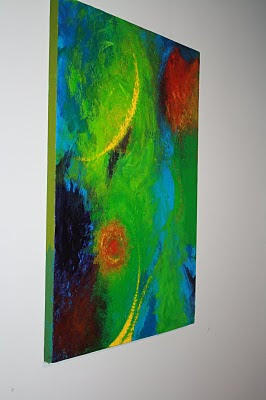
like this one, one of two I painted for my sister Holly's new bathroom.)
But I digress. Again.
As I said, (or have I?)
It is now 1:37 in the afternoon, and I am going to stop writing. It's important, very important, to pace yourself. Writing-wise. It's also vitally important to keep track of TIME, because otherwise, time has a way of slipping away, or collapsing in on itself. Like a dark black hole. [Scratch that adjective "dark."] Just yesterday (the day before the last day of the year 2023) I read an article about TIME. According to some physicists, TIME is "only an illusion."
I laugh out loud at that notion because at this very moment, at 1:39 pm, Poco, my black and white Havanese, is standing at the door barking. She knows it's high TIME to go outside. Into the frozen lawn. Because as most of us know by now, and no less than The Washington Post confirmed yesterday, "The climate future arrived in 2023." Winter, except for the wintry mix, has all but disappeared.
********
A few weeks before Albert Einstein died, in April of 1955, he wrote a letter to a friend in which he said: "For us who are convinced physicists, the distinction between past, present, and future is only an illusion, however persistent." Einstein firmly believed that there is no such thing as TIME.
This is not a new idea. And it has long been debated. To me, it's a rather silly notion, to e n g a g e
in long-winded academic debate about. TIME.
Whether or not it exists?
Oh come on! Be real!
That same article, which I read yesterday in Smithsonian magazine, says the debate among scientists and philosophers dates back to before Socrates. Those learneds (most notably Einsteing) think that TIME, and CHANGE, do not exist. To these so-called 'eternalists,' the universe is simply "the set of all moments at once. The entire history of the universe simply is."
Other scientists and philosophers argue that TIME is real. The debate goes back and forth, as all debates do, and probably goes nowhere fast.
I was thinking about this debate, and the idea that time might just be an "illusion," just now, this afternoon, about 2:07 pm, when I put Poco on her leash and we walked down to the country store, for eggs. And to get today's mail.
There, behind the counter making sandwiches, was the wife of the owner. Joanna. Who used to make meatball grinders, turkey sandwiches and all sorts of hot entrees. Each and every day. Mostly for men (and women) working construction or doing landscaping. Many of these laborers would stop at the country store for lunch.
But about a year ago, Joanna disappeared and no one knew why or was brave enough to ask.
Today, Joanna is back. I am shocked. She has aged twenty years in the one since she disappeared. She is shrunken. Grey. Her once vibrant red hair is now far more pale than the robin's breast. She is missing one of her front teeth.
To be honest, I wasn't sure what to say to her.
“How is your dog?” I said finally, attempting a smile. She has a Jack Terrier. Named. Jack. Of all things.
"Oh, my little Jacky?" Joanna said. Her smile, minus one tooth, made me squirm. "He's just fine. Such a good little boy!" We talked about our dogs a bit more. Thank God for dogs!
As soon as I could gracefully get away, I exited the store and walked home. I opened the front door and at that moment, I realized I was holding my breath!
I quickly got Poco settled, and then sat down at the kitchen counter. I opened my journal and wrote down EXACTLY how I was feeling. Honestly I was feeling a bit terrified.
"How can TIME possibly be an illusion? That idea is preposterous. After all, we get old. My GOD, just take a look at Joanna. What the hell happened to her!?
I don't care what the scientists say. I don't need an expert to tell me what I already know: life proceeds, no doubt about it. We get old and/or we get sick and we die. Anyway it is all so...scary and unpredictable."
I decided that I needed to put on my pajamas, even though it was only 4:05 in the afternoon. Then I went back to my desk, opened my laptop, and called up the story about Leah.
"It is still the same morning. Leah has traded her powder blue bathrobe for her exercise clothes. She is working at home today, putting the final touches on a recruitment brochure for the University of Massachusetts. She reads the content through and then she stands up and looks out the front window. Her iPhone says it's 12 degrees outside. But the thermometer hanging on the back porch says it is seven. [Hey, Claudia, is it the front window or the back porch? Note to self: Decide!]
"She asks herself, 'Is that why I feel so frozen inside?'"
"Leah is thinking again about Noni Natalya and dinner last night and what her grandmother asked her to do. Leah inhales. How can she possibly find out the true story of her great grandfather Pasquale and his mother? 'It's a crazy, nutty idea. Totally impossible,' she says, shaking her head and returning to the sofa, where she writes. She has her laptop propped up on a pillow.
"She reads the brochure for the final time. Then she emails it to her boss and the office copy editor.
"Leah gets up and fixes herself a cup of turmeric tea with honey and milk. Then she returns to her laptop and tries something that she does sometimes when she's feeling like she needs inspiration. Or she needs reassurance that she's still a REAL writer. After all, she spends 50 plus hours a week composing boring drivel at her University job.
"'But I can still write short stories,'" she whispers. She pulls up a fictional short story at random. It’s called “Silver River.” It gives her chills to sit and read what she wrote exactly three years ago.
Moon. To start, Gina is lying there, a fallen angel in a foot of fresh snow. It is deep in the middle of the night. She has wandered out to the darkest reaches of the backyard, out to the furthest row of white pines. Parked as she is in her white parka, in the white snow, she is almost invisible.
She is watching the sky. Waiting. There are stars galore, the sky is splattered. But she is waiting for something more. That email she got early this morning was crystal clear: 'Tonight will see the first full moon to coincide with the winter solstice in 6000 years. The last time this happened, Moses went up to Mount Sinai for the Ten Commandment stones. Don’t miss this once-in-ten-thousand-lifetime event. The moon will be so gigantic, so bright you won’t even need car headlights tonight.'”
Gina is watching the horizon, just above the pines. Her attention is drawn by the soft glow of light gathering above the dark curtain of trees a few feet away. The top edge of the tallest pine has a halo. She goes up onto her elbows. Steadies her gaze. Suddenly the crisp edge of the moon is sliding up behind the tallest pine, the branches outlined. Black fingers. She falls back into the snow. The flood of silvery moonlight is even more exquisite than she had imagined it would be.
She takes in one long slow breath and holds it and suddenly sadness overtakes her and her eyes close. Gina’s breath comes blowing out in one long steamy explosion. She sits up. Peels the gloves off. Sets her hands flat in the snow. Her fingers go numb as she squeezes the snow into a freezing mess in each hand. Warm tears pool and now the moon is almost fully visible and now, holy cow, it is a mighty white disc showering light onto the snow.
Gina? Are you out here honey?
"That’s where Leah stops reading. She covers her eyes with her hands, and soon, her hands are wet with tears. Leah wrote that short story about Gina when she was still living with Brandon, the man who shattered Leah's heart. They talked about getting married and then, only a few months after getting engaged, Brandon (a computer programmer by day and an electric base player in a band on the weekends) blew Leah apart one night, telling her that there was another woman in his life. That young woman had just joined his band as a singer.
"Sniffling, Leah gets up from the sofa, goes into her bedroom where she does some yoga. First. A few sun salutations. Then. Tree pose. Cat and cow. Plough. Fish. Crow. Spinal twist. Finally. Triangle. As she does triangle, she whispers the Sanskrit word for it: trikonasana. Over and over again she whispers because she likes the sound of this word so much.
"What Leah doesn't realize, at least not yet, is that a triangle is a symbol full of meaning. 'The triangle symbol (∆) is a shorthand notation commonly used in physics to indicate CHANGES or differences.' Also, 'the triangle has been used as a symbol of spiritualism and enlightenment since the dawn of human civilization.'
"Leah undresses and takes a very hot shower. In a few minutes she is dressed in wool pants, her emerald parka, heavy socks, a hat, mittens and boots.
"'Come on,' she calls to Bootsy, her caramel-colored Cockapoo. She leashes him and soon they are out the door and headed for the dog park. Leah is not sure why, but somehow reading the short story about Gina has made her feel better. She's not sure why but she thinks she can see her way FORWARD, out of her frozen condition.
So, just for the record, the word FORWARD suggests movement in TIME, i.e. CHANGE. The Greek letter delta (δ, or ∆), means "difference."
The (∆) TRIANGLE --trikanasana -- that Sanskrit word that LEAH loves saying as she is doing her yoga, that is the symbol used in calculus to indicate CHANGE. Aren't you glad I took CALCULUS (2) in college?
*****
The reason for creating the Leah character? I decided soon after I began writing the "FINDING FILOMENA" novel that I needed an outer story to set up the inner (Filomena) story.
Well, so, the Leah story solves that outer story, problem. I think.
TIME. Will tell, as they say.
Meanwhile, I never really explained what my meteorological crisis was, four years ago.
In simple terms, I was blocked. Emotionally. I felt thoroughly frozen, like my crusty lawn [I was hoping I'd get to use that word crusty at some point!] My therapist Mary kept saying that my problem was that I refused to feel all of my feelings.
Oh, and she said that I didn't love Myself. Enough.
Perhaps she was right.
Well, so, I have solved both of those problems too. You might be surprised if I told you that it was, in the end, quite simple. (I was going to write the word "rather" before the word "simple" but my FIRST READER husband RICHARD, told me this morning that I really need to "kill" the word "rather," along with all the adjectives. I do listen to him. And I do use the word rather
rather too much.) Anyway, all I needed to do to solve my meterological crisis
i.e being FROZZZZZZEN
was to.
step.
back.
in time,
to meet my ancestors! Almost immediately, I began hearing from both my Mom, DENA, and my dad, Ric Ricci. Soon enough, I encountered others. Grandma Mish, Grandpa Claude. Grandma Albina and Grandpa Angelo. And before I knew it, I had met Filomena Scrivano, my great great grandma, who was born EXACTly 100 years before me, in 1852. She is my dad's great grandma, his bisnonna. And my bisbisnonna. More recently, I met Filomena's illegitimate (boy oh boy do I hate that word illegitimate) her son, Pasquale Orzo, my great grandfather. Just for the record, Filomena's beloved son was a legitimate person, no matter what that damnable priest or his miserable municipal minions living back then, back in backward Paola, in Calabria, thought at that time.
While writing about Filomena, I also met the man she fell in love with, Giovanni Massiero, the guy I INVENTED TO father my great grandfather. Fi, my nickname for my great great grandma, calls Giovanni, G for short. He is a poet, with a head full of reddish golden curls. I hope you will enjoy his poetry!
As for the rest of it, you will simply need to read on!
As for the debate over TIME. And all that about CHANGE. And the CLIMATE.
I'm not going to worry about any of that.
Or if I have to, word word worry about it,
I have decided that I will do the worrying and sorting out
at some other TIME,
like say tomorrow,
that is, if there is a tomorrow, GOD WILLING, if we don't destroy the planet
first.
*******
NOTES
Here are ALL THE NOTES YOU COULD POSSIBLY HOPE FOR, OR NEED, BUT PROBABLY WISH WEREN'T HERE!!! The nice thing about a work of fiction is that in general THERE ARE NEVER ANY GD footnotes.
However, as this is not only a work of fiction, but also, a work of non-fiction and journalism, as well as a (fictional) memoir, oh, and perhaps also a kind of self-help book, well, so, in this case, footnotes are needed. [I was going to use the word "sadly" after "in this case" until RICHARD first READER said to me, "You don't need to modify everything, it's like you're trying to apologize for everything, it's your parents' defensiveness, they never could assert themselves, they always tried to apologize for themselves." Holy shit Batman. Anyway, the nice thing for you, the reader, is that you don't need to read any of these footnotes [Note, there is no modifier!] LATE BREAKING NEWS: IT IS 9:36 AM ON THURSDAY JANUARY 6, 2024 AND IT IS actualllllllly SNOWING!
Here we go with the notes:
(1) "'The Little Gidding' is the fourth and final poem of T. S. Eliot's Four Quartets, a series of poems that discuss time, perspective, humanity, and salvation. It was first published in September 1942 after being delayed for over a year because of the air-raids on Great Britain during World War II and Eliot's declining health. The title refers to a small Anglican community in Little Gidding in Huntingdonshire, established by Nicholas Ferrar in the 17th century and scattered during the English Civil War."
"Within the poem, the narrator meets a ghost that is a combination of various poets and literary figures. Little Gidding focuses on the unity of past, present, and future, and claims that understanding this unity is necessary for salvation."
(2) "Calculus is the study of how things CHANGE [my caps not MIT's!] It provides a framework for modeling systems in which there is CHANGE, and a way to deduce the predictions of such models."
And now, from MIT, comes something called "Calculus for Beginners." I offer it here, in mostly its entirety, at the end of this story, but I really don't recommend it to you. You will see why the moment you start to read it! So, like I said, you don't need to read it but if you want to try, go right ahead! Oh. I should say up front that I think this itty bitty calculus book was probably almost certainly spit out by an AI creature, ie IT WAS GENERATED BY CHAT BOT. But of course that's not a reason to be prejudiced against it...is it?
0.2 What Is Calculus and Why do we Study it?
Calculus is the study of how things change. It provides a framework for modeling systems in which there is change, and a way to deduce the predictions of such models.
Q: I have been around for a while, and I know how things change, more or less. What can calculus add to that?
I am sure you know lots about how things change. And you have a qualitative notion of calculus. For example the concept of speed of motion is a notion straight from calculus, though it surely existed long before calculus did and you know lots about it.
Q: So what does calculus add for me?
It provides a way for us to construct relatively simple quantitative models of change, and to deduce their consequences.
Q: To what end?
With this you get the ability to find the effects of changing conditions on the system being investigated. By studying these, you can learn how to control the system to do make it do what you want it to do. Calculus, by giving engineers and you the ability to model and control systems gives them (and potentially you) extraordinary power over the material world.
The development of calculus and its applications to physics and engineering is probably the most significant factor in the development of modern science beyond where it was in the days of Archimedes. And this was responsible for the industrial revolution and everything that has followed from it including almost all the major advances of the last few centuries.
Q: Are you trying to claim that I will know enough about calculus to model systems and deduce enough to control them?
If you had asked me this question in 1990 I would have said no. Now it is within the realm of possibility, for some non-trivial systems, with your use of your laptop or desk computer.
Q: OK, but how does calculus models change? What is calculus like?
The fundamental idea of calculus is to study change by studying "instantaneous "change, by which we mean changes over tiny intervals of time.
Q: And what good is that?
It turns out that such changes tend to be lots simpler than changes over finite intervals of time. This means they are lots easier to model. In fact calculus was invented by Newton, who discovered that acceleration, which means change of speed of objects could be modeled by his relatively simple laws of motion.
And so?
This leaves us with the problem of deducing information about the motion of objects from information about their speed or acceleration. And the details of calculus involve the interrelations between the concepts exemplified by speed and acceleration and that represented by position.
[HUH?]
[So, Hey. If by some miracle you are still reading, didn't I tell you that you didn't need to?]
Q: So what does one study in learning about calculus?
To begin with you have to have a framework for describing such notions as position speed and acceleration.
Single variable calculus, which is what we begin with, can deal with motion of an object along a fixed path. The more general problem, when motion can take place on a surface, or in space, can be handled by multivariable calculus. We study this latter subject by finding clever tricks for using the one dimensional ideas and methods to handle the more general problems. So single variable calculus is the key to the general problem as well.
When we deal with an object moving along a path, its position varies with time we can describe its position at any time by a single number, which can be the distance in some units from some fixed point on that path, called the origin of our coordinate system. (We add a sign to this distance, which will be negative if the object is behind the origin.)
The motion of the object is then characterized by the set of its numerical positions at relevant points in time.
[STOP STOP STOP STOP STOP STOP STOP YOU NEED TO STOP READING!!!]
The set of positions and times that we use to describe motion is what we call a function. And similar functions are used to describe the quantities of interest in all the systems to which calculus is applied.
The course here starts with a review of numbers and functions and their properties. You are undoubtedly familiar with much of this, so we have attempted to add unfamiliar material to keep your attention while looking at it.
Q: I will get bogged down if I read about such stuff. Must I?
[YOU MUST BE BOGGED
DOWN BY NOW. NOW JUST STOP READING!
OR AT LEAST SKIM SKIM SKIM SKIM
THIS IS ME, CLAUDIA THE REAL AUTHOR OF THIS BOOK SAYING: JUST STOP READING!]
[OR AT LEAST START TO SKIM SKIM SKIM SKIM!!!! Or as the AI author says below: SKIPPPPP IT!!!] I would love to have you look at it, since I wrote it, but if you prefer not to, you could undoubtedly get by SKIPPING IT, and referring back to it when or if you need to do so. However you will miss the new information, and doing so could blight you forever. (Though I doubt it.)
Q: And what comes after numbers and functions?
A typical course in calculus covers the following topics:
1. How to find the instantaneous change (called the "derivative") of various functions. (The process of doing so is called "differentiation".) 2. How to use derivatives to solve various kinds of problems. 3. How to go back from the derivative of a function to the function itself. (This process is called "integration".) 4. Study of detailed methods for integrating functions of certain kinds. 5. How to use integration to solve various geometric problems, such as computations of areas and volumes of certain regions. There are a few other standard topics in such a course. These include description of functions in terms of power series, and the study of when an infinite series "converges " to a number.
So where does this empower me to do what?
It doesn't really do so. The problem is that such courses were first designed centuries ago, and they were aimed not at empowerment (at that time utterly impossible) but at familiarizing their audience with ideas and concepts and notations which allow understanding of more advanced work. Mathematicians and scientists and engineers use concepts of calculus in all sorts of contexts and use jargon and notations that, without your learning about calculus, would be completely inscrutable to you. The study of calculus is normally aimed at giving you the "mathematical sophistication" to relate to such more advanced work.
So why this nonsense about empowerment?
This course will try to be different and to aim at empowerment as well as the other usual goals. It may not succeed, but at least will try. And how will it try to perform this wonder? Traditional calculus courses emphasize algebraic methods for performing differentiating and integrating. We will describe such methods, but also show how you can perform differentiation and integration (and also solution of ordinary differential equations) on a computer spreadsheet with a tolerable amount of effort. We will also supply applets which do the same automatically with even less effort. With these applets, or a spreadsheet, you can apply the tools of calculus with greater ease and flexibility than has been possible before. (There are more advanced programs that are often available, such as MAPLE and Mathematica, which allow you to do much more with similar ease. With them you can deduce the consequences of models of various kinds
[blah blah blah blah blah]
It makes no difference where I start, because after all these years I know one thing for certain: it always comes back around, always, always, so I might just as well begin the way I did nearly four years ago, a month or so before the pandemic hit. I might as well tell you that I
This is what I need you to see first:
Me simply gazing out the window at the frozen lawn. Me. Standing there at the window, feeling frozen, both inside and out.
Ironically, it was a day in early February, 2020. When there was absolutely
NO SNOW. Not a bit of it. Just a crust of ice.
The sun was throwing long strips of sunlight across the yard.
I was horrified, no, maybe the word is shocked. Because as I unlocked the door to let my sweet little Poco outside to pee, I noticed that a horde of robins had settled on the lawn, over by the meadow. They were, like the song suggests,"bob bob bobbing along," Pecking at the grass. Their rust-colored breasts were the brightest color of the drab winter palette on that gray day.
[Hey did you notice what I just did? I talked about the sunlight spilling across the yard in the first sentence of that paragraph and then, in the last sentence of that paragraph, I said the day was gray.]
I was going to say it makes no difference whether or not it was sunny or gray, as this is all just a pile of words anyway. Or a row of words. Or perhaps a giant, eternally sparkling, infinitely spiralling circle of words, collapsing in on itself. Like a dark black hole.
But actually, now that I think about it, it makes a HUGE difference what the weather is.
It matters to my mood. A sunny day starts a smile blooming inside me, as if a spring daffodil fills my chest. On a sunny day, I am quite certain that pennies are going to fall from heaven, or at least from the blue blue bluebird sky! On gray days, and there are plenty of them in the Northeast where I live most of the time, I feel emotionally sloppy. Soggy.
For my sister Holly, however, a sunny day can actually be devastating. Just now, she texted me quite out of the blue blue [sky,] saying: "The cold light of January is so damn bright in my face, reminding me that the holidays are over, reminding me that we have to start anew. Ugh. The cold bright light of January makes me want to take a nap." I wrote back to her: "I'm sorry you don't like the light, Holl, soon enough it'll be gray again!"
Anyway, it used to be that robins with those pale red breasts announced the lovely joy of spring. But those days are over. On that day, in early February of 2020, just a month before you know what, I found the yard full of robins to be rather a rather frightening sigh, I mean sight.
"What the hell? It’s February for God’s sake, and there hasn’t been any snow since December and now the robins are here?!"
I remember saying those words to myself. Those exact words.
Well, at least I think those were the words that I said to myself. They certainly were the words that were in MY MIND.
Or perhaps I wrote them down somewhere, in a journal or a blogpost or a story, or maybe all three. I also wrote these lines:
"Where did winter go? Why has the snow -- so soft and gentle -- stopped falling? The only thing we get now is that 'wintry mix,' mostly freezing rain that forms a thin white [crunchy?] crust on the lawn."
[NOTE TO SELF: Your FIRST READER and husband, Richard K, says you need to "kill all adjectives" in your writing. He is quoting no less an authority than Mark Twain. So, I guess "crunchy" is out!]
I'm afraid I do use too many adjectives.
I'm also afraid that at some point in this multi-vocal, quasi LOCO narrative I will have to address
climate CHANGE, or more accurately, climate degradation, which is why we have a wintry mix rather than snow. But I am not going to address it. Not here. Not NOW. Not TODAY.
Ironically, it was this very same February day way back in 2020 that I began writing a story about a woman named Leah.
There are many resemblances between me and Leah. In Leah's case, however, the ground is frozen. But also. There is plenty of snow on the ground. Seven to ten. Inches. To be INexact.
"No matter that she is wearing her powder blue bathrobe, Leah decides to go outside without her emerald parka on. Bootsy, her beige Cockapoo, barks and follows her out the door."
"The next thing Leah knows she is lying down on the ground in the white powder. She does a spread eagle. A snow angel. She feels the icy cold snow on her bare neck and head. She holds that position and stares into the grey clouds. In a moment, she is on her feet again, hurrying back into the house. Bootsy scampers after her. Trembling, and rubbing her icy fingers together, Leah sits down on the sofa. Opens her laptop. Her fingers are chilled and stiff as she sets them on the keys and begins typing."
So there I was, without any snow, writing a story about a woman named Leah, who was surrounded by seven to ten. Plenty. Of snow. And who herself was writing a story.
I invented Leah for a very simple reason. I needed her help to tell a story. Not long ago, I began writing a novel about my great grandfather, Pasquale Orzo, and his mother, my great great grandmother, Filomena Scrivano, who lived way back in the 1800s in southern Italy in the richly historied region of Calabria. Why bother telling their story? Because my great grandfather was illegitimate, a word I detest. My grandmother (his daughter) and all of her sisters suffered terrible shame because of their father's situation.
Oddly enough, Scrivano means "scribe" in Italian. At some point, I will explain why I believe that Filomena selected me to be her mouthpiece!
[I had been writing the Leah story for many many months before my long-time writing buddy PEG, who was reading the long-winded LEAH story quite carefully said, quite casually, to me: "Claud, did you realize that if you rearrange the letters in the name LEAH it spells
HEAL?"
I thought that was quite funny
It had NOT occurred to her, PEG, or to ME, Claudia (who is so much like LEAH) that the name LEAH had been selected by my carefully edited subconscious....
"Oh God Peg," I said, dissolving in laughter (I think she and I were sitting together at the counter that day drinking tea.) We often dissolve in laughter over our writing]
But I digress.
Anyway, you get the picture. About Leah. And Me. More or less. (Pictures, by the way, have way more information than 1000 words. One thing I will say upfront: you cannot hang a story like this one I'm writing on a wall the way you do a picture, or a painting,
like this one, one of two I painted for my sister Holly's new bathroom.)
But I digress. Again.
As I said, (or have I?)
It is now 1:37 in the afternoon, and I am going to stop writing. It's important, very important, to pace yourself. Writing-wise. It's also vitally important to keep track of TIME, because otherwise, time has a way of slipping away, or collapsing in on itself. Like a dark black hole. [Scratch that adjective "dark."] Just yesterday (the day before the last day of the year 2023) I read an article about TIME. According to some physicists, TIME is "only an illusion."
I laugh out loud at that notion because at this very moment, at 1:39 pm, Poco, my black and white Havanese, is standing at the door barking. She knows it's high TIME to go outside. Into the frozen lawn. Because as most of us know by now, and no less than The Washington Post confirmed yesterday, "The climate future arrived in 2023." Winter, except for the wintry mix, has all but disappeared.
********
A few weeks before Albert Einstein died, in April of 1955, he wrote a letter to a friend in which he said: "For us who are convinced physicists, the distinction between past, present, and future is only an illusion, however persistent." Einstein firmly believed that there is no such thing as TIME.
This is not a new idea. And it has long been debated. To me, it's a rather silly notion, to e n g a g e
in long-winded academic debate about. TIME.
Whether or not it exists?
Oh come on! Be real!
That same article, which I read yesterday in Smithsonian magazine, says the debate among scientists and philosophers dates back to before Socrates. Those learneds (most notably Einsteing) think that TIME, and CHANGE, do not exist. To these so-called 'eternalists,' the universe is simply "the set of all moments at once. The entire history of the universe simply is."
Other scientists and philosophers argue that TIME is real. The debate goes back and forth, as all debates do, and probably goes nowhere fast.
I was thinking about this debate, and the idea that time might just be an "illusion," just now, this afternoon, about 2:07 pm, when I put Poco on her leash and we walked down to the country store, for eggs. And to get today's mail.
There, behind the counter making sandwiches, was the wife of the owner. Joanna. Who used to make meatball grinders, turkey sandwiches and all sorts of hot entrees. Each and every day. Mostly for men (and women) working construction or doing landscaping. Many of these laborers would stop at the country store for lunch.
But about a year ago, Joanna disappeared and no one knew why or was brave enough to ask.
Today, Joanna is back. I am shocked. She has aged twenty years in the one since she disappeared. She is shrunken. Grey. Her once vibrant red hair is now far more pale than the robin's breast. She is missing one of her front teeth.
To be honest, I wasn't sure what to say to her.
“How is your dog?” I said finally, attempting a smile. She has a Jack Terrier. Named. Jack. Of all things.
"Oh, my little Jacky?" Joanna said. Her smile, minus one tooth, made me squirm. "He's just fine. Such a good little boy!" We talked about our dogs a bit more. Thank God for dogs!
As soon as I could gracefully get away, I exited the store and walked home. I opened the front door and at that moment, I realized I was holding my breath!
I quickly got Poco settled, and then sat down at the kitchen counter. I opened my journal and wrote down EXACTLY how I was feeling. Honestly I was feeling a bit terrified.
"How can TIME possibly be an illusion? That idea is preposterous. After all, we get old. My GOD, just take a look at Joanna. What the hell happened to her!?
I don't care what the scientists say. I don't need an expert to tell me what I already know: life proceeds, no doubt about it. We get old and/or we get sick and we die. Anyway it is all so...scary and unpredictable."
I decided that I needed to put on my pajamas, even though it was only 4:05 in the afternoon. Then I went back to my desk, opened my laptop, and called up the story about Leah.
"It is still the same morning. Leah has traded her powder blue bathrobe for her exercise clothes. She is working at home today, putting the final touches on a recruitment brochure for the University of Massachusetts. She reads the content through and then she stands up and looks out the front window. Her iPhone says it's 12 degrees outside. But the thermometer hanging on the back porch says it is seven. [Hey, Claudia, is it the front window or the back porch? Note to self: Decide!]
"She asks herself, 'Is that why I feel so frozen inside?'"
"Leah is thinking again about Noni Natalya and dinner last night and what her grandmother asked her to do. Leah inhales. How can she possibly find out the true story of her great grandfather Pasquale and his mother? 'It's a crazy, nutty idea. Totally impossible,' she says, shaking her head and returning to the sofa, where she writes. She has her laptop propped up on a pillow.
"She reads the brochure for the final time. Then she emails it to her boss and the office copy editor.
"Leah gets up and fixes herself a cup of turmeric tea with honey and milk. Then she returns to her laptop and tries something that she does sometimes when she's feeling like she needs inspiration. Or she needs reassurance that she's still a REAL writer. After all, she spends 50 plus hours a week composing boring drivel at her University job.
"'But I can still write short stories,'" she whispers. She pulls up a fictional short story at random. It’s called “Silver River.” It gives her chills to sit and read what she wrote exactly three years ago.
Moon. To start, Gina is lying there, a fallen angel in a foot of fresh snow. It is deep in the middle of the night. She has wandered out to the darkest reaches of the backyard, out to the furthest row of white pines. Parked as she is in her white parka, in the white snow, she is almost invisible.
She is watching the sky. Waiting. There are stars galore, the sky is splattered. But she is waiting for something more. That email she got early this morning was crystal clear: 'Tonight will see the first full moon to coincide with the winter solstice in 6000 years. The last time this happened, Moses went up to Mount Sinai for the Ten Commandment stones. Don’t miss this once-in-ten-thousand-lifetime event. The moon will be so gigantic, so bright you won’t even need car headlights tonight.'”
Gina is watching the horizon, just above the pines. Her attention is drawn by the soft glow of light gathering above the dark curtain of trees a few feet away. The top edge of the tallest pine has a halo. She goes up onto her elbows. Steadies her gaze. Suddenly the crisp edge of the moon is sliding up behind the tallest pine, the branches outlined. Black fingers. She falls back into the snow. The flood of silvery moonlight is even more exquisite than she had imagined it would be.
She takes in one long slow breath and holds it and suddenly sadness overtakes her and her eyes close. Gina’s breath comes blowing out in one long steamy explosion. She sits up. Peels the gloves off. Sets her hands flat in the snow. Her fingers go numb as she squeezes the snow into a freezing mess in each hand. Warm tears pool and now the moon is almost fully visible and now, holy cow, it is a mighty white disc showering light onto the snow.
Gina? Are you out here honey?
"That’s where Leah stops reading. She covers her eyes with her hands, and soon, her hands are wet with tears. Leah wrote that short story about Gina when she was still living with Brandon, the man who shattered Leah's heart. They talked about getting married and then, only a few months after getting engaged, Brandon (a computer programmer by day and an electric base player in a band on the weekends) blew Leah apart one night, telling her that there was another woman in his life. That young woman had just joined his band as a singer.
"Sniffling, Leah gets up from the sofa, goes into her bedroom where she does some yoga. First. A few sun salutations. Then. Tree pose. Cat and cow. Plough. Fish. Crow. Spinal twist. Finally. Triangle. As she does triangle, she whispers the Sanskrit word for it: trikonasana. Over and over again she whispers because she likes the sound of this word so much.
"What Leah doesn't realize, at least not yet, is that a triangle is a symbol full of meaning. 'The triangle symbol (∆) is a shorthand notation commonly used in physics to indicate CHANGES or differences.' Also, 'the triangle has been used as a symbol of spiritualism and enlightenment since the dawn of human civilization.'
"Leah undresses and takes a very hot shower. In a few minutes she is dressed in wool pants, her emerald parka, heavy socks, a hat, mittens and boots.
"'Come on,' she calls to Bootsy, her caramel-colored Cockapoo. She leashes him and soon they are out the door and headed for the dog park. Leah is not sure why, but somehow reading the short story about Gina has made her feel better. She's not sure why but she thinks she can see her way FORWARD, out of her frozen condition.
So, just for the record, the word FORWARD suggests movement in TIME, i.e. CHANGE. The Greek letter delta (δ, or ∆), means "difference."
The (∆) TRIANGLE --trikanasana -- that Sanskrit word that LEAH loves saying as she is doing her yoga, that is the symbol used in calculus to indicate CHANGE. Aren't you glad I took CALCULUS (2) in college?
*****
The reason for creating the Leah character? I decided soon after I began writing the "FINDING FILOMENA" novel that I needed an outer story to set up the inner (Filomena) story.
Well, so, the Leah story solves that outer story, problem. I think.
TIME. Will tell, as they say.
Meanwhile, I never really explained what my meteorological crisis was, four years ago.
In simple terms, I was blocked. Emotionally. I felt thoroughly frozen, like my crusty lawn [I was hoping I'd get to use that word crusty at some point!] My therapist Mary kept saying that my problem was that I refused to feel all of my feelings.
Oh, and she said that I didn't love Myself. Enough.
Perhaps she was right.
Well, so, I have solved both of those problems too. You might be surprised if I told you that it was, in the end, quite simple. (I was going to write the word "rather" before the word "simple" but my FIRST READER husband RICHARD, told me this morning that I really need to "kill" the word "rather," along with all the adjectives. I do listen to him. And I do use the word rather
rather too much.) Anyway, all I needed to do to solve my meterological crisis
i.e being FROZZZZZZEN
was to.
step.
back.
in time,
to meet my ancestors! Almost immediately, I began hearing from both my Mom, DENA, and my dad, Ric Ricci. Soon enough, I encountered others. Grandma Mish, Grandpa Claude. Grandma Albina and Grandpa Angelo. And before I knew it, I had met Filomena Scrivano, my great great grandma, who was born EXACTly 100 years before me, in 1852. She is my dad's great grandma, his bisnonna. And my bisbisnonna. More recently, I met Filomena's illegitimate (boy oh boy do I hate that word illegitimate) her son, Pasquale Orzo, my great grandfather. Just for the record, Filomena's beloved son was a legitimate person, no matter what that damnable priest or his miserable municipal minions living back then, back in backward Paola, in Calabria, thought at that time.
While writing about Filomena, I also met the man she fell in love with, Giovanni Massiero, the guy I INVENTED TO father my great grandfather. Fi, my nickname for my great great grandma, calls Giovanni, G for short. He is a poet, with a head full of reddish golden curls. I hope you will enjoy his poetry!
As for the rest of it, you will simply need to read on!
As for the debate over TIME. And all that about CHANGE. And the CLIMATE.
I'm not going to worry about any of that.
Or if I have to, word word worry about it,
I have decided that I will do the worrying and sorting out
at some other TIME,
like say tomorrow,
that is, if there is a tomorrow, GOD WILLING, if we don't destroy the planet
first.
*******
NOTES
Here are ALL THE NOTES YOU COULD POSSIBLY HOPE FOR, OR NEED, BUT PROBABLY WISH WEREN'T HERE!!! The nice thing about a work of fiction is that in general THERE ARE NEVER ANY GD footnotes.
However, as this is not only a work of fiction, but also, a work of non-fiction and journalism, as well as a (fictional) memoir, oh, and perhaps also a kind of self-help book, well, so, in this case, footnotes are needed. [I was going to use the word "sadly" after "in this case" until RICHARD first READER said to me, "You don't need to modify everything, it's like you're trying to apologize for everything, it's your parents' defensiveness, they never could assert themselves, they always tried to apologize for themselves." Holy shit Batman. Anyway, the nice thing for you, the reader, is that you don't need to read any of these footnotes [Note, there is no modifier!] LATE BREAKING NEWS: IT IS 9:36 AM ON THURSDAY JANUARY 6, 2024 AND IT IS actualllllllly SNOWING!
Here we go with the notes:
(1) "'The Little Gidding' is the fourth and final poem of T. S. Eliot's Four Quartets, a series of poems that discuss time, perspective, humanity, and salvation. It was first published in September 1942 after being delayed for over a year because of the air-raids on Great Britain during World War II and Eliot's declining health. The title refers to a small Anglican community in Little Gidding in Huntingdonshire, established by Nicholas Ferrar in the 17th century and scattered during the English Civil War."
"Within the poem, the narrator meets a ghost that is a combination of various poets and literary figures. Little Gidding focuses on the unity of past, present, and future, and claims that understanding this unity is necessary for salvation."
(2) "Calculus is the study of how things CHANGE [my caps not MIT's!] It provides a framework for modeling systems in which there is CHANGE, and a way to deduce the predictions of such models."
And now, from MIT, comes something called "Calculus for Beginners." I offer it here, in mostly its entirety, at the end of this story, but I really don't recommend it to you. You will see why the moment you start to read it! So, like I said, you don't need to read it but if you want to try, go right ahead! Oh. I should say up front that I think this itty bitty calculus book was probably almost certainly spit out by an AI creature, ie IT WAS GENERATED BY CHAT BOT. But of course that's not a reason to be prejudiced against it...is it?
0.2 What Is Calculus and Why do we Study it?
Calculus is the study of how things change. It provides a framework for modeling systems in which there is change, and a way to deduce the predictions of such models.
Q: I have been around for a while, and I know how things change, more or less. What can calculus add to that?
I am sure you know lots about how things change. And you have a qualitative notion of calculus. For example the concept of speed of motion is a notion straight from calculus, though it surely existed long before calculus did and you know lots about it.
Q: So what does calculus add for me?
It provides a way for us to construct relatively simple quantitative models of change, and to deduce their consequences.
Q: To what end?
With this you get the ability to find the effects of changing conditions on the system being investigated. By studying these, you can learn how to control the system to do make it do what you want it to do. Calculus, by giving engineers and you the ability to model and control systems gives them (and potentially you) extraordinary power over the material world.
The development of calculus and its applications to physics and engineering is probably the most significant factor in the development of modern science beyond where it was in the days of Archimedes. And this was responsible for the industrial revolution and everything that has followed from it including almost all the major advances of the last few centuries.
Q: Are you trying to claim that I will know enough about calculus to model systems and deduce enough to control them?
If you had asked me this question in 1990 I would have said no. Now it is within the realm of possibility, for some non-trivial systems, with your use of your laptop or desk computer.
Q: OK, but how does calculus models change? What is calculus like?
The fundamental idea of calculus is to study change by studying "instantaneous "change, by which we mean changes over tiny intervals of time.
Q: And what good is that?
It turns out that such changes tend to be lots simpler than changes over finite intervals of time. This means they are lots easier to model. In fact calculus was invented by Newton, who discovered that acceleration, which means change of speed of objects could be modeled by his relatively simple laws of motion.
And so?
This leaves us with the problem of deducing information about the motion of objects from information about their speed or acceleration. And the details of calculus involve the interrelations between the concepts exemplified by speed and acceleration and that represented by position.
[HUH?]
[So, Hey. If by some miracle you are still reading, didn't I tell you that you didn't need to?]
Q: So what does one study in learning about calculus?
To begin with you have to have a framework for describing such notions as position speed and acceleration.
Single variable calculus, which is what we begin with, can deal with motion of an object along a fixed path. The more general problem, when motion can take place on a surface, or in space, can be handled by multivariable calculus. We study this latter subject by finding clever tricks for using the one dimensional ideas and methods to handle the more general problems. So single variable calculus is the key to the general problem as well.
When we deal with an object moving along a path, its position varies with time we can describe its position at any time by a single number, which can be the distance in some units from some fixed point on that path, called the origin of our coordinate system. (We add a sign to this distance, which will be negative if the object is behind the origin.)
The motion of the object is then characterized by the set of its numerical positions at relevant points in time.
[STOP STOP STOP STOP STOP STOP STOP YOU NEED TO STOP READING!!!]
The set of positions and times that we use to describe motion is what we call a function. And similar functions are used to describe the quantities of interest in all the systems to which calculus is applied.
The course here starts with a review of numbers and functions and their properties. You are undoubtedly familiar with much of this, so we have attempted to add unfamiliar material to keep your attention while looking at it.
Q: I will get bogged down if I read about such stuff. Must I?
[YOU MUST BE BOGGED
DOWN BY NOW. NOW JUST STOP READING!
OR AT LEAST SKIM SKIM SKIM SKIM
THIS IS ME, CLAUDIA THE REAL AUTHOR OF THIS BOOK SAYING: JUST STOP READING!]
[OR AT LEAST START TO SKIM SKIM SKIM SKIM!!!! Or as the AI author says below: SKIPPPPP IT!!!] I would love to have you look at it, since I wrote it, but if you prefer not to, you could undoubtedly get by SKIPPING IT, and referring back to it when or if you need to do so. However you will miss the new information, and doing so could blight you forever. (Though I doubt it.)
Q: And what comes after numbers and functions?
A typical course in calculus covers the following topics:
1. How to find the instantaneous change (called the "derivative") of various functions. (The process of doing so is called "differentiation".) 2. How to use derivatives to solve various kinds of problems. 3. How to go back from the derivative of a function to the function itself. (This process is called "integration".) 4. Study of detailed methods for integrating functions of certain kinds. 5. How to use integration to solve various geometric problems, such as computations of areas and volumes of certain regions. There are a few other standard topics in such a course. These include description of functions in terms of power series, and the study of when an infinite series "converges " to a number.
So where does this empower me to do what?
It doesn't really do so. The problem is that such courses were first designed centuries ago, and they were aimed not at empowerment (at that time utterly impossible) but at familiarizing their audience with ideas and concepts and notations which allow understanding of more advanced work. Mathematicians and scientists and engineers use concepts of calculus in all sorts of contexts and use jargon and notations that, without your learning about calculus, would be completely inscrutable to you. The study of calculus is normally aimed at giving you the "mathematical sophistication" to relate to such more advanced work.
So why this nonsense about empowerment?
This course will try to be different and to aim at empowerment as well as the other usual goals. It may not succeed, but at least will try. And how will it try to perform this wonder? Traditional calculus courses emphasize algebraic methods for performing differentiating and integrating. We will describe such methods, but also show how you can perform differentiation and integration (and also solution of ordinary differential equations) on a computer spreadsheet with a tolerable amount of effort. We will also supply applets which do the same automatically with even less effort. With these applets, or a spreadsheet, you can apply the tools of calculus with greater ease and flexibility than has been possible before. (There are more advanced programs that are often available, such as MAPLE and Mathematica, which allow you to do much more with similar ease. With them you can deduce the consequences of models of various kinds
[blah blah blah blah blah]
Subscribe to:
Posts (Atom)