By Richard Kirsch
Mitt Romney wants voters to blame Barack Obama for mishandling the crisis, but he'd also like you to forget who caused it.
In his acceptance speech, Mitt Romney tried hard to communicate how much he empathizes with the economic squeeze on middle-class families. Last Thursday in Tampa, he talked about a symbolic worker who lost one good paying job and replaced it with “two jobs at nine bucks an hour and fewer benefits.” And twice he emphasized that a majority of Americans no longer believe that our children will do better than we have done.
But one thing was missing. Romney made absolutely no attempt to explain how families ended up in such precarious financial straits. Not a word referring to what happened before 2008, other than “this president can tell us it was someone else's fault.” For Mitt, the recession was a spontaneous event. It just happened; Obama inherited it and hasn’t been up to the task of fixing the crisis. So it’s time to give Romney, the job creator, a chance to fix it.
Romney knows that any reference to the recent past will evoke toxic memories of George W. Bush. The last thing he needs to do is to remind voters that the last Republican president triggered the nation’s economic crash. Instead, he wants Americans to start the script they are bringing into the voting booth this year on November 2008. It’s okay, he’s telling us, to accept our disappointment with President Obama, and give the businessman – who really does understand our plight and what it takes to create jobs – a try. After all, when things are this bad, what do you have to lose?
The missing link in Romney’s story is a huge invitation for President Obama to fill in the blanks. It provides an opportunity for him to convince hard-pressed Americans that they should stick with him through tough times. It is a story that President Obama knows how to tell powerfully. But it’s not one that he has been telling on the campaign trail.
President Obama is not starting the clock in November 2008 like Romney did. He is reminding people that they don’t want to “go back.” But the references in his campaign speeches to the Bush years are fleeting; most of his speeches are contrasts between his agenda and Romney-Ryan vision. He absolutely needs to make that contrast, but the problem for swing voters – those Americans who are feeling the intense financial pressure and loss of hope – is that they don’t have a way of understanding which candidate’s program will work better for them. These are people who aren’t ideological and who respond to personalities, which is why Obama has been attacking Romney’s Bain record so hard and why Romney is telling voters that you can like the president but still not vote for him.
What would help move these voters to embrace the Obama agenda and keep them from voting for Romney out of desperation is a story that links how we got into this financial mess with why the Obama agenda is the better way forward. That is what the most powerful political narratives do. The right has a broad and easily understood story about limited government and free enterprise. But the left has a powerful story too, and when he wants to, as he did last December 6th in Osawatomie, Kansas, the president tells it as well as anyone. Here are sections from Obama’s speech last year that lay out how we got into this mess, and in doing so, set up why we need to go forward with him:
Long before the recession hit, hard work stopped paying off for too many people. Fewer and fewer of the folks who contributed to the success of our economy actually benefited from that success. Those at the very top grew wealthier from their incomes and their investments -- wealthier than ever before. But everybody else struggled with costs that were growing and paychecks that weren't -- and too many families found themselves racking up more and more debt just to keep up….
When middle-class families can no longer afford to buy the goods and services that businesses are selling, when people are slipping out of the middle class, it drags down the entire economy from top to bottom. [Emphasis added.] America was built on the idea of broad-based prosperity, of strong consumers all across the country.…
Inequality also distorts our democracy. It gives an outsized voice to the few who can afford high-priced lobbyists and unlimited campaign contributions, and it runs the risk of selling out our democracy to the highest bidder. It leaves everyone else rightly suspicious that the system in Washington is rigged against them, that our elected representatives aren't looking out for the interests of most Americans.…
Finally, a strong middle class can only exist in an economy where everyone plays by the same rules, from Wall Street to Main Street.
In his acceptance speech this past Thursday, Mitt Romney left a huge hole to be filled in our economic narrative. Let’s hope that this Thursday in Charlotte, President Obama fills it as eloquently as he did in Kansas last December. By doing so, he will tell a powerful story that will show those swing voters that he’s not only a nice guy doing his best, but that he understands how we got into this mess and will keep working to get us out of it.
Richard Kirsch is a Senior Fellow at the Roosevelt Institute, a Senior Adviser to USAction, and the author of Fighting for Our Health. He was National Campaign Manager of Health Care for America Now during the legislative battle to pass reform.
--
Wednesday, September 05, 2012


Thursday, August 30, 2012
Blue Moon Musings

Tonight there is a “blue moon.” Two full moons in one month.
I started to think about ”blue moons.”
Earlier this summer I went to Omega Institute and took a course to train to teach Mindfulness Based Eating Awareness Training (MB-EAT).
I did this for several reasons; the most important one for myself. I had reached a place of disconnection and alienation from my body. I was overweight and out of shape. On retreat in May, I tried to do yoga and it was painful and I felt heavy and old. Aging has been taking a bit of toll especially since it is piled onto multiple orthopedic injuries and surgeries. For many years, I have tried to lose weight and be fit but I always slip back into a place that is neither comfortable nor easy. Meditation and mindfulness have helped my spirit and heart but my body felt left out, waiting at the station watching the happiness train pull out. I decided it was time to try something new while learning skills I could pass on to my mindfulness students.
For five days from 7 AM until 9 PM, including many meals, I learned about hunger signals, fullness signals, leaving food on my plate, making choices at a buffet, savoring food, enjoying food, etc. This was made all the more challenging by the fact Omega serves some of the best food I have ever eaten three times a day buffet style. This was a 5 day mindful eating exercise. I reconnected with my yoga practice and each day felt my body waking up slowly. I had the time to honor my limitations and appreciate what was possible moment by moment.
Many of my classmates had similar histories and had come to learn what they could to go back to places like France, Denmark and Australia to teach their mindfulness students.
This program, MB-EAT, teaches participants over a couple of months to remember what it is like to be hungry, feel full and really enjoy food. Food is not an enemy. I remembered when I didn’t obsess over calories, fat grams and carbohydrates. I experienced the joy of eating because I was hungry and my body felt better after I ate. I loved being able to eat something without guilt and recrimination. I could see an end to days I was “good” or “bad” depending on what I ate. I have had the healthy choice eating thing pretty well down but now I could eat something like ice cream with pure joy. One afternoon I bought ice cream at the Omega cafe, awesome delicious ice cream, and I sat in their lovely garden and enjoyed it with an innocence I had lost long ago. Earlier that week I had shared ice cream with my grandchildren and thought I wanted to eat it like they did; it was just plain yummy.
Since then, it has not all been easy. It took almost 2 months before I could really feel hunger and fullness. I had literally lost the ability to really experience these things over the years. I have been exercising regularly and I feel so much better. I monitor all the negative self-talk and see it for what it is. I imagine it as the witch in the Wizard of Oz melting away. I have gone out to dinner a couple of times and really savored and enjoyed the meal without all the negative thinking that often followed. I have lost weight.
Once in a blue moon, I find a new and true path that brings ease to my day. Approaching eating and food in this mindful way has been such a path. It has been harder to let go of chastising myself over the fact as a mindfulness teacher of 20 years I should have been able to do this long ago. But then I am reminded that it is all about this moment.
Our deepest self-knowledge resides in the body, which a great deal of the time does not speak the same language as the mind.
Annemarie Colbin “Food and Healing”

Lenore Flynn teaches mindfulness classes in Albany and will be teaching an MB-EAT program beginning September 12th. Please go to www.solidgroundny.org for detailed information. This post appeared first in the Holistic Health blog at the Albany Times Union.
Wednesday, August 08, 2012
The Journey We Take Alone -- Part 22
By Alexander "Sandy" Prisant

We’re not exactly DIY royalty. In our house, there’s a missing nail here and a broken wire there. Cleaning is an extra challenge because you never know what’s going to collapse. Or when. But sometimes you see Susan hurdling through the air like an All-American fullback, saving something irreplaceable left us by our grandmothers.
So it was with naïve optimism we saw a trim box less than two feet square loaded into our car. The whole grill was in there. How hard could assembly be?
A few hours later we began to find out. Talk about shock and awe. This must be what the Germans felt like when the dawn lifted and all those D-Day ships were pounding the beach. With a bottle of wine firmly in hand, Sandy was laying out dozens of parts on the terrace. It was starting to look like an auto parts store doing inventory. There were odd metal plates, round rings of rubber and lots of instructions.
With all this stuff spread as far as the eye could see we quickly got serious. Like a surgical team preparing for a marathon procedure. Sandy held out his right hand: “Left Cart Lower Brace. Part 30.”
Susan, on her knees, desperately scanned the floor for Part 30, a three-sided, two-holed piece of metal that looked just like a half-dozen other parts in the Assembly Instructions.
And then…jubilation. First piece found. Fitted. And forgotten. We were on the way.
Cautiously we began rummaging for the second piece—a Wheel Axle Bolt (Part 36). After an hour and a half turning over every part laid out on the floor, we came to a profound conclusion: This Wheel Axle Bolt could not be found. And who needed it anyway?
So the clinical surgery approach was quickly replaced by a treasure hunt. We scanned the instructions and the array of nuts and bolts and parts. Why was everything so small? At one point we had to get tweezers just to pick one up,..
After four hours we needed another new strategy. We wound up with something between a market stall search and military reconnaissance. Out on the terrace, we groped through rows of unidentifiable bits and pieces. They began to look like bobby pins and hair slides at a garage sale.
After eight hours we wished we hadn’t seemingly cornered the market on everything in this “sale”. But it was too late to take it back. We soldiered on into the night, finally collapsing over a dinner of corn flakes.
We faced the morning with a fresh outlook. All we needed was new outfits—like military camouflage. Control panel support brackets, valve fixed plates and tank retention brackets were not going to beat us—the people who launched the Walkman in Europe.
We just needed a boost from new outfits—maybe military camouflage? Dressed to kill, we marched out back to the terrace and huddled amongst the rows of parts. There were one-hundred-and-eighteen to go. Risking DIY Disqualification we had choose between going AWOL and achieving our mission. It was daunting.
And then suddenly, we found one piece that matched a crude picture in the instructions. It was not a bobby pin! More jubilation, followed by a breakthrough. Parts 11, 49, 21, 84 and 66 all fit. Together!
Our basic training was serving us well. We looked at parts 51, 17 and 96. We looked at the half-built object and the three parts and decided: Who needs them? With military precision, they were drummed out of service.
On it went, through the second day. We couldn’t see a barbecue yet, but they swore that’s what we were building. We only got the baby barbecue with lots less pieces. Yet somehow we were heading into the weekend. Before we’d started, a friend said, “45 minutes and you’re done.”
But we were now on Hour 23. It was daunting. Again.
And then we came to this mystifying instruction:
“Attach tank brace by inserting the carriage belt through the keyhole, slide down and then use the wing nut to secure.”
What?
By Sunday night we could see the outline of something, which if you sat there squinting, you could jus-s-s-s-t about make out the beginnings of a cooking device.
Was a hamburger really worth all this?
It was 1:38 AM Monday when the instructions said this:

More American than the New York Yankees,
More American the Red, White and Blue,
Oh Hail our Constitutional Right
To Choose Home Depot for a new Barbecue!
We’re not exactly DIY royalty. In our house, there’s a missing nail here and a broken wire there. Cleaning is an extra challenge because you never know what’s going to collapse. Or when. But sometimes you see Susan hurdling through the air like an All-American fullback, saving something irreplaceable left us by our grandmothers.
So it was with naïve optimism we saw a trim box less than two feet square loaded into our car. The whole grill was in there. How hard could assembly be?
A few hours later we began to find out. Talk about shock and awe. This must be what the Germans felt like when the dawn lifted and all those D-Day ships were pounding the beach. With a bottle of wine firmly in hand, Sandy was laying out dozens of parts on the terrace. It was starting to look like an auto parts store doing inventory. There were odd metal plates, round rings of rubber and lots of instructions.
With all this stuff spread as far as the eye could see we quickly got serious. Like a surgical team preparing for a marathon procedure. Sandy held out his right hand: “Left Cart Lower Brace. Part 30.”
Susan, on her knees, desperately scanned the floor for Part 30, a three-sided, two-holed piece of metal that looked just like a half-dozen other parts in the Assembly Instructions.
And then…jubilation. First piece found. Fitted. And forgotten. We were on the way.
Cautiously we began rummaging for the second piece—a Wheel Axle Bolt (Part 36). After an hour and a half turning over every part laid out on the floor, we came to a profound conclusion: This Wheel Axle Bolt could not be found. And who needed it anyway?
So the clinical surgery approach was quickly replaced by a treasure hunt. We scanned the instructions and the array of nuts and bolts and parts. Why was everything so small? At one point we had to get tweezers just to pick one up,..
After four hours we needed another new strategy. We wound up with something between a market stall search and military reconnaissance. Out on the terrace, we groped through rows of unidentifiable bits and pieces. They began to look like bobby pins and hair slides at a garage sale.
After eight hours we wished we hadn’t seemingly cornered the market on everything in this “sale”. But it was too late to take it back. We soldiered on into the night, finally collapsing over a dinner of corn flakes.
We faced the morning with a fresh outlook. All we needed was new outfits—like military camouflage. Control panel support brackets, valve fixed plates and tank retention brackets were not going to beat us—the people who launched the Walkman in Europe.
We just needed a boost from new outfits—maybe military camouflage? Dressed to kill, we marched out back to the terrace and huddled amongst the rows of parts. There were one-hundred-and-eighteen to go. Risking DIY Disqualification we had choose between going AWOL and achieving our mission. It was daunting.
Our basic training was serving us well. We looked at parts 51, 17 and 96. We looked at the half-built object and the three parts and decided: Who needs them? With military precision, they were drummed out of service.
On it went, through the second day. We couldn’t see a barbecue yet, but they swore that’s what we were building. We only got the baby barbecue with lots less pieces. Yet somehow we were heading into the weekend. Before we’d started, a friend said, “45 minutes and you’re done.”
But we were now on Hour 23. It was daunting. Again.
And then we came to this mystifying instruction:
“Attach tank brace by inserting the carriage belt through the keyhole, slide down and then use the wing nut to secure.”
What?
By Sunday night we could see the outline of something, which if you sat there squinting, you could jus-s-s-s-t about make out the beginnings of a cooking device.
Was a hamburger really worth all this?
It was 1:38 AM Monday when the instructions said this:
“Place cooking grate on support ribs directly above heath distribution plates.” (Why couldn’t they just say ‘put the grill on top and you’re done’ ?)
But it was true. We were done. The thing stood on four legs. It opened and closed. And it made fire. Wow.
At American labor rates, we racked up assembly costs of $540 for a grill retailing at $99. Throw in the tongs, spatulas and basting thingies and we wound with costs equivalent to the annual GDP of a small village in Gabon.
When we talk about the American Dream, surely this it.
But what looks like a blow to efficient free enterprise can still be averted if we can somehow compile the outdoor cook’s answer to Julia Child. Before Labor Day.
But it was true. We were done. The thing stood on four legs. It opened and closed. And it made fire. Wow.
At American labor rates, we racked up assembly costs of $540 for a grill retailing at $99. Throw in the tongs, spatulas and basting thingies and we wound with costs equivalent to the annual GDP of a small village in Gabon.
When we talk about the American Dream, surely this it.
But what looks like a blow to efficient free enterprise can still be averted if we can somehow compile the outdoor cook’s answer to Julia Child. Before Labor Day.
Sandy Prisant and his wife, Susan, live and write in Florida. Sandy is writing a long series of pieces for MyStoryLives about his struggle with a life-threatening kidney disease. He is currently awaiting a kidney and heart transplant.
Wednesday, July 25, 2012
A Painting for Rebecca and Mike: HAPPY HAPPY WEDDING!!
Dear Rebecca and Mike,
As you know, unforeseen circumstances make it impossible for me to be at your wedding this weekend. That is the sad part. But the part that makes me happy is that I have a gift for you that I know Rebecca has long wanted: a painting.
This one, like most of my paintings, emerged in a surprising way. I had no idea it would end up the way it did, with what vaguely appear to be two figures facing each other (one female, one male.) At the beginning, (like I always do,) I was just throwing paint on the canvas to see what shape the painting wanted to be.
I don't know if I've told you about my rather unorthodox method of applying my acrylic paint. I use a credit card as a kind of painting "knife," layering the paint on thick.
But then, when it doesn't have the right look or feel, I scrape off said paint. If I still don't get the desired effect, I sometimes take the painting into the backyard and hose it down and dry it off and then apply more paint.
With this painting, maybe because it was to honor a major life event for a dear friend, I was starting to get nervous. Nothing at all was coming "right." So I went even further. I gave the painting a ritual bath! Yes, I slid the painting right into the pond in the backyard, let it lay there for a few seconds, and then I took it out and removed more paint. I was still looking for contours that would make sense to my eye.
Finally, I was ready to give up. I decided if this was a throw away, I may as well have some fun and do a crazy-looking painted frame. And in painting the frame I began to see the composition emerge.
I realized that this was a painting that was, like any good marriage, composed of two things at once: a set of vertical images divided into two, but also combined into one seamless whole. By the way, the painting stands about three feet wide and four feet tall.
May this painting always bring happiness and joy and dreams come true to your home together. I will smile every time I think of it hanging above your sofa or dining room table or your bed. (Or even if it lands in the garage, that's ok too.) I had great great fun painting it for you, and I send it on its way now, with blessings and big wishes for health and happiness forever.
Loads of love and hope to see you soon with painting in tow,
Claudia
As you know, unforeseen circumstances make it impossible for me to be at your wedding this weekend. That is the sad part. But the part that makes me happy is that I have a gift for you that I know Rebecca has long wanted: a painting.
 |
| Happy Wedding Rebecca & Mike |
I don't know if I've told you about my rather unorthodox method of applying my acrylic paint. I use a credit card as a kind of painting "knife," layering the paint on thick.
But then, when it doesn't have the right look or feel, I scrape off said paint. If I still don't get the desired effect, I sometimes take the painting into the backyard and hose it down and dry it off and then apply more paint.
With this painting, maybe because it was to honor a major life event for a dear friend, I was starting to get nervous. Nothing at all was coming "right." So I went even further. I gave the painting a ritual bath! Yes, I slid the painting right into the pond in the backyard, let it lay there for a few seconds, and then I took it out and removed more paint. I was still looking for contours that would make sense to my eye.
Finally, I was ready to give up. I decided if this was a throw away, I may as well have some fun and do a crazy-looking painted frame. And in painting the frame I began to see the composition emerge.
I realized that this was a painting that was, like any good marriage, composed of two things at once: a set of vertical images divided into two, but also combined into one seamless whole. By the way, the painting stands about three feet wide and four feet tall.
May this painting always bring happiness and joy and dreams come true to your home together. I will smile every time I think of it hanging above your sofa or dining room table or your bed. (Or even if it lands in the garage, that's ok too.) I had great great fun painting it for you, and I send it on its way now, with blessings and big wishes for health and happiness forever.
Loads of love and hope to see you soon with painting in tow,
Claudia
Sunday, July 22, 2012
Hear it, My Rain Dance
By Claudia Ricci
Those lilies I planted by the driveway
are bent over, orange blossoms drooping into powdery soil.
The Lady's Mantle is shriveled and and the grass is crisp,
and the leaves of the White Gooseneck Loosestrife look fragile and limp.
All day I hear the gardens crying. There is no way to satisfy their thirst for water.
 As the pond shrinks into an oversized green puddle, I miss swimming. Moreover, I get nervous every time I turn the hose on to water.
Will the well hold up through this awful drought?
I decided this morning I ought
to do a raindance.
Chanting, singing, shaking orange and green rattles,
I would wear a bright blue and purple and green cloak
around my shoulders and tie beads around my ankles.
I'd wear a costume fit to beg the heavens for beads of water.
A headdress of dead ferns, tied
together with the wilted vines of
 my thin and wilting Morning Glories.
I would send up my chant to Mother Nature,
over and over:
Sssayayayayyure, saayayyayayayyeeeee
waaahaahaahaaahaaataaaaaarrrrrrrr.
pulllllleeeeeeeez.
Wet me. Wet us. Wet the world.
Fill us to drench and slurping.
Send all of your thirsty nations
A long steady downpour
so we can begin to restore ourselves to life.
Those lilies I planted by the driveway
are bent over, orange blossoms drooping into powdery soil.
The Lady's Mantle is shriveled and and the grass is crisp,
and the leaves of the White Gooseneck Loosestrife look fragile and limp.
All day I hear the gardens crying. There is no way to satisfy their thirst for water.

Will the well hold up through this awful drought?
I decided this morning I ought
to do a raindance.
Chanting, singing, shaking orange and green rattles,
I would wear a bright blue and purple and green cloak
around my shoulders and tie beads around my ankles.
I'd wear a costume fit to beg the heavens for beads of water.
A headdress of dead ferns, tied
together with the wilted vines of

I would send up my chant to Mother Nature,
over and over:
Sssayayayayyure, saayayyayayayyeeeee
waaahaahaahaaahaaataaaaaarrrrrrrr.
pulllllleeeeeeeez.
Wet me. Wet us. Wet the world.
Fill us to drench and slurping.
Send all of your thirsty nations
A long steady downpour
so we can begin to restore ourselves to life.
Friday, July 20, 2012
An Immigrant's Voice
By Camincha
We are a voice that screams,
tearing the silence of conformity.
We are a voice that screams,
revealing our talents: contributions
to progress, peace, innovation, solidarity.
Like a magenta flower, an aphrodisiac,
we seduce with ideas, the perfume
wrapping you in bright elixir, in swaying
opinions with a maddening scent.
We are a voice that screams
memories brought with our luggage
from other lands: flower petals hidden
between pages of a book. Letters
turned into dried-up-ink-flakes on worn
out paper. Broken doll, childhood
companion. Mother’s watch with worn
out silk band. Father’s moment of glory
in faded yellowed photo. Veil and
ribbons of most Sacred Day of her
First Holy Communion. Prayer book
with blessed stamps of Guardian Angel
wings spread out protecting little girl.
We are a voice that screams,
revealing our talents: contributions
to progress, peace, innovation, solidarity,
We are a voice that screams,
tearing the silence of conformity.
Camincha is a pseudonym for a California-based writer who was born in Peru. Her work can be seen on her website at caminchabenvenutto.com.
Wednesday, July 18, 2012
Humbled by Skyscraping Sequoias


But nothing begins to make them comprehensible. How can you take in a tree that is every bit as wide as your kitchen or living room? And so tall that you cannot photograph the whole thing at once.

Tuesday, July 10, 2012
Chapeter 55: Sister Mysteries, He's There in the Rocking Chair
By Claudia Ricci
Every morning, he made his way onto the porch while she was
still asleep and while it was still dark and the moon was but a silver curl of a sliver within the dark pines. He would creep quietly into the porch and remain there until she woke up. He had shown her every
kindness, every form of polite and respectful behavior, and he gave her every
reason to believe that he was kind and considerate. Still, she had her doubts. She still had not really begun to trust him.

She slept each night, buried deep in the blankets on the
porch, her arms squeezing what would have been a pillow if it had been more
than a second small blanket stuffed with straw and tied, just like the mattress
was, with twine.
She never saw him come in. She would fall asleep watching
the starlight, and wake up to the creaking of the rocking chair across the
porch, the chair he had chiseled and shaped out of fir and aspen and blood red manzanita.
He said nothing at all, but the chair began squeaking and it mixed with the
sounds of the throaty birds coming to life in the marshy area behind the
woodland.
The early morning air was cool and fresh and misty and when
it moved across her face it tempted her awake. But then she heard his rocking
and squeaking and immediately she resented the fact that he was there in the
porch rocking in the chair. Why did he insist on intruding this way on her
morning routine? It had been a week that she’d been there, and she had not
worked up the courage to tell him that it had to stop.
It wouldn’t be easy to tell him. He did everything
imaginable to please her, including placing a glass of red poppies at her
breakfast table each morning. He refused to let her cook a thing. He made her
pancakes or scrambled eggs for breakfast. He fixed hot soups for lunch, and he
skewered a rabbit or a chicken for dinner.
He had offered to hide her indefinitely in his woodland
cabin. How he would possibly manage to keep her there, when the authorities were
looking for her everywhere, she wasn’t sure, but he had ideas. “We could shave
off the rest of your hair and dress you up as a farmhand,” he said at one
point. She frowned at the thought, and said in a quiet voice that it suited her
to remain a woman.
“Well then, maybe we could move you out of here.” He offered
that he would risk taking her by wagon to San Francisco, “where you could catch
a train east all the way to New York.”
Renata’s stomach tightened at the thought of leaving her
beloved golden hills, her blue California skies. And running from the
authorities? That squeezed her stomach even worse.
“How would I elude them? You yourself said they have my
photo pasted in every building that stands.”
“And so, maybe you would have to become part of my baggage,
maybe I could cover you up with a blanket and claim you as a chair.” There were
other silly ideas, but all of them were evidence that he seriously cared to try
to help her.
Meanwhile, her own thoughts focused on how she could move on
from the woodland cabin on her own power. With each hour she remained at the
cabin, she knew she put herself in ever more danger of being found.

Sister Mysteries is an on-line novel that can be found at http://www.renata1883.blogspot.com.
Thursday, July 05, 2012
MyStoryLives Taking a Break for a Few Days

MyStoryLives is taking a break for a few days while we vacation in California. See you when we return!
--CR
Sunday, July 01, 2012
The Flowers of Summer
July brings so many gorgeous flowers to the backyard.
I love them all.
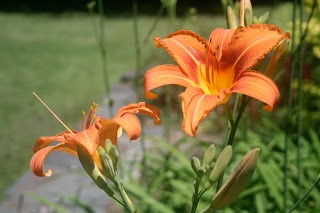
The orange lily.
The red red rose.

The amazing morning glory, purple and blue.


The divinely yellow primrose.

And the white rose. What it lacks in color it makes up for in fragrance. The smell of this wild rose makes your nose dance with joy.

I love them all.
The orange lily.

The red red rose.

The amazing morning glory, purple and blue.


The divinely yellow primrose.

And the white rose. What it lacks in color it makes up for in fragrance. The smell of this wild rose makes your nose dance with joy.

Subscribe to:
Posts (Atom)