Monday, July 03, 2006

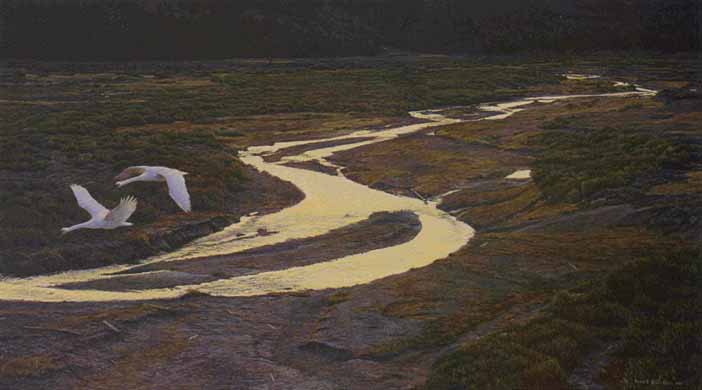
“River of Swans”


By Michael Ryan

It’s 2:30 a.m. and I am staring at the ceiling,
wishing for the arms of an old friend.
She had eyes that could rest a weary mind,
and a smile that could ease every terror in my head.

Once we were desert soldiers
who got caught up in a desert storm.
Children deemed old enough to kill and be killed,
but not old enough to drink alcohol on a bar room floor,
we both saw things that no one should see and hear at any age,
a bloody play that no one should see on any stage.

But those days seem so far away as I paddle this river of swans,
where the spray is cool and wet and not metal hot,
and the only planes are jet liners coming in and taking off,
and the only screams are the swarms of cockatoos,
taking this tree then the next,
and not the screams of girls and boys too young to down a beer in a bar,
but old enough to take a bullet in the chest.

And while some friends sleep for ever,
I hardly sleep at all,
I just lie here staring at the ceiling,
waiting for the sun and the kookaburra’s call.

Michael Ryan lives in Perth, Australia. He works as a contracts analyst from nine to five and spends his free time kayaking, attending to ten fish tanks and doing a lot of underwater photography. He also has a talking parrot that always says the wrong things at the wrong time.

Sunday, July 02, 2006

"Falling Down"

By David Seth Michaels

I’m not the first 59-year old man who’s been arrested for something other people think is stupid. And I’m not the first by any means to fake remorse, or to say with false contrition that what I did was wrong. But the truth is something entirely different.

For my entire life I have been afraid of heights. As a kid, I’d only climb to the first big limb of a tree, and only then if the branches were low. I didn’t like climbing over fences. Later, I’d stand back an arm’s length from wobbly railings that overlooked motel parking lots. I’ve studiously avoided the Empire State Building observation deck, though I’ve lived near it for my entire life. I once ate at the Windows on the World Restaurant once, but I sat with my back to the view. I did walk across the roof of the Duomo in Milan and climb up a tall ladder at Bandilero in New Mexico, but I don’t understand how I accomplished these aberrations.

So when the 200 year old church in town decided to repair its steeple, I paid no real attention to it. I did notice that the steeple seemed to be tilting ever so slightly, probably because of rotted timbers, and that some day it might decide to plunge through the abyss and into the tiny town square below it. But considering the few people who live in our town, the even smaller number who ever enter the park, and the remote chance that anyone would actually be hit by the plunging, 2 century old steeple, I didn’t think the repairs were needed for at least another decade or two. There was no real emergency. The members of the church apparently felt differently.

About a month ago, they put up a gigantic, metal scaffold that towered in front of the church and extended to the middle of the high steeple. And it wasn’t like those ones you see in cities with narrow ladders and thin walkways. No. It had metal stairs that ascended from the sidewalk all the way to the top. And, more amazing, when the workers went home for the day, they didn’t remove the stairs, or post signs, or hire a cop to prevent access to the Tower of Babel. Any lunatic who wanted to could climb to the top and jump.

A couple weeks ago, I drove past the tower in the early evening. The windows of my car were down. Birds were singing, the breeze was warm. There was a bearded man standing near the entrance to the scaffolding. I wondered whether he would be the person to shatter our sleepy town’s tranquility by diving from the steeple into the park. I wondered if he would leave a note explaining his despair. I wondered whether there might be literary allusions in his suicide note to the painting of a similar steeple in Empire Falls, or cinematic ones to the climbing of the water tower in Gilbert Grape. Or whether he was so impatient to embark on his final swan dive that he would leave only incoherent rambling on the envelope of an overdue electric bill. Or worse, no note at all. I didn’t think he looked particularly distressed, I didn’t stick around to see how his suicide would unfold.

That night I had a dream. In the dream I learned that there were “portals” I could enter, and that in them I’d find various stories. In some, I’d find just shreds of a story, a snippet, a paragraph. But in others I’d find stories so elaborate, so complete, so ingeniously constructed that all I would have to do was pull gently, as if the story were wool yarn, and I would receive a complete novel. It would be easy. If I found the first sentences in the portal, and pulled on them, the next 120,000 words attached to it were sure to follow.

And where are these portals? They’re everywhere. I found one walking in a field with the dog, and I found another in the city while I was waiting for a light to change. You just step into them and see what story is in them. You have to remember the first sentences when you leave the portal, so you can retrieve the complete story. I don’t know whether the portals move around, or whether you can find them at the same place at a later time, if you forget the first sentence, or the strand somehow breaks.

Yesterday in the early evening, I went for a walk to search for some portals. I didn’t find any good ones near the house, so I thought I’d walk into town and look around. I was carrying with me in a backpack my 10-year old laptop. The idea was that when I found a really good portal, I’d take down the first 3 or 4 sentences before the ancient battery gave out. Later, I’d have access to the entire story, and I’d have a new book, a novel, in record time and with little effort.

When I got to the Tower, I thought I might as well step over the three pieces of ratty duct tape blocking access to the stairs and sample the portals at the front of the 250 year old church. I had no intention of climbing higher than 10 feet. In fact, the prospect of climbing higher than the middle of the first floor windows filled me with dread. But I didn’t find any portals I liked on the first level of the scaffold. So I continued on.

Eventually, on the top floor of the scaffold, I found a portal that was simply incredible. It held an amazing, long, complicated story of love, sorcery, intrigue, devotion and enlightenment. I had been crawling on my knees on the metal for what felt like hours before finding this portal. I was afraid to look down from the scaffold: I was high in the air, next to the leaning Tower, the earth was far, far below. When I tried to get out my laptop to record the first few sentences of the story, my laptop slipped out of my backpack, slid across the metal floor of the scaffold, and fell into the open space. I watched as it plummeted to earth, and I watched as it crashed through the front windshield of an SUV belonging to the Sheriff’s Department.

The deputy was standing outside the SUV looking up at me when the laptop hit. He, apparently, had been summoned by neighbors who called 911 to say that a lunatic, me, was climbing on the scaffold and might be planning on jumping to his death. How anyone could believe that someone, in this case a 59-year old man, who was afraid to stand up and was crawling on the scaffolding, was going to jump is beyond me. Nor do I understand why the deputy may have felt that I was trying to drop a heavy, decade old laptop computer on him. Or trying for some bizarre reason to destroy his patrol car. Everyone knows I have no animosity toward law enforcement and despise acts of violence.

The worst part of all of this isn’t my embarrassment at being arrested, or the arrest report in the local police blotter, or having to appear before the town judge, or appearing to dispassionate observers to be a crackpot or eccentric or lunatic. No. The worst part is that tonight I have to sneak back to the portal, this time with a Moleskine notebook and a pencil, to retrieve this astounding story. And I have to do it before they move the scaffold or disturb the portal. So tonight, Saturday night, even though it’s raining and cold, I have to wait until after dark, again pass the duct tape, again climb the scaffold, again crawl on my hands and knees to the portal, and take down the first paragraph.

David Seth Michaels is a writer and lawyer who lives and works in Spencertown, Columbia County, New York. He is not acrophobic. Repeat after me: he is not acrophobic.
Friday, June 30, 2006

"Her Heart, Pressed Between My Fingers"


By Karen Campbell

I told her “if your heart had been stronger, you would still be alive.” She didn’t answer.

I see her again, day after day. In her hand she holds a flower. She gives it to me. It is the only one I’ve ever had.

I try to think if she is better off. It doesn’t matter. I used to hold her heart in those days, press it between my fingers to keep it beating. In those days, I thought I could will anything to happen.

Now my thoughts are here: her nose wrinkling, her brown eyes. The carrying on of everything, while all that I’ve ever known is falling away. Is this flower supposed to help? It’s the most fragile thing of all. Talk to it. It withers and decays and falls away like dust. Am I supposed to love it? Why would I want to if I’m going to lose it anyway?

Because the sun is on it and it is beautiful. If you don’t know that much by now, forget it.

I said recently that I wasn’t sure about the resurrection. I don’t know if that’s true or not. Not the resurrection, but what I said. As I said, I don’t know anything. Douglas is gone, too. And Tom. I keep thinking of what Willis said: how bad can it be?

Karen Campbell is a writer living in Troy, New York. She works for the New York State Department of Labor. We

Thursday, June 29, 2006

"Dora Lee"

By Allen Ballard

It was early of a fall Carolina morning, and the sky was blue as could be. Dora Lee got out of her bed, put on a pair of slacks and a blouse, started a pot of coffee to percolating, and walked out of Boatwright's house as she often did when she was troubled to the point of despair.

She began walking down the long dirt road that led to the main highway. The trees were full of singing birds, and Dora Lee saw one squirrel running along a power line, balancing itself like a trapeze artist. He seemed to want to keep pace with her. When she stopped, he did too and rose up on two legs. Then she'd begin walking again, and the squirrel would drop back on all fours and keep up with her.

The dust of the road was very red here, reminded her of all the blood shed over the years in the city where she’d grown up laughing and playing hopscotch on hot sidewalks with Jewish, Puerto Rican, Irish, and Chinese children. Dora Lee felt just like she did when Obie got called up to serve in the Persian Gulf war and the Iraq war. Like she was a wife on the home front, waiting for the battles to be over up there in New York.

With Boatwright driving the van, Teshina had been safely delivered to Oberlin College. And here they were back in Carolina with Henry's first day of classes coming up tomorrow. It would also be Dora Lee's first day as a secretary at a hospital in Durham. She'd even managed to buy an old Dodge Colt to get her back and forth to the job. But she had no peace in her soul.
So as Dora Lee walked along the red dirt road she began to sing a hymn she loved:

Are you weak and heavy-laden,
’Cumbered with a world of care?
Precious savior, still my refuge
Take it to the Lord in prayer.

As at so many other times in her life, a sense of fullness and satisfaction began to replace the heaviness and emptiness in her chest. She talked out loud, first telling God about her situation, how torn up she was, how frightened….

And so this tall, ebony-colored woman walked on and on down the road with her hips moving slowly back and forth in a timeless African rhythm, asking that God somehow reunite her with her husband, remove the danger that pervaded all their lives, assuage her desperate, sickening fear.

Allen Ballard, a Phi Beta Kappa graduate of Kenyon College, received his Ph.D. in Government from Harvard University. Currently a professor of history and Africana Studies at the University at Albany, SUNY, he has published one previous book, “Where I'm Bound,” a novel about African-American troops during the Civil War. “Dora Lee” is an excerpt from his novel, “Carried by Six.”

Friday, June 23, 2006

"Silent Spirits"

By Karin Ludewig

When I return to the house, it is as if a stage set is in place-stage props coming to life painfully ornate: the mahogany table, ostentatiously set, reflected in its surface a tinkling chandelier, the candelabras on the sideboard. I sense the ghost-like quality of Maab and Harold serving each guest in turn, the delicate operation of separating fish from bone, the meat sliced and arranged on a serving platter, juices already congealing, the silver heavy, outmoded, yet beautifully extravagant amid the constant attention to refilling glasses.

Maab, silent as a spirit, moves slowly. Tonight she wears a dress darkly appropriate with long sleeves and a single piece of jewelry adorning its lapel. My father wears a bathrobe that retains an unhealthy heat like the sweat of disease in a low-ceilinged room on a hot day, a room where the doors and windows remain sealed.

The wine is sweeter than I am used to and as blood red as raspberries. He refills my glass, settles back nursing his drink and listens to a nightingale, one of the last in England, sing from the mulberry tree next to the kitchen. The heat rises from the table like perfume. Through the windows, I watch the light fade, and with it, the outline of the horses on the hill behind the garden.

He coughs, readjusts his bathrobe, runs the fingers of his hand under his robe and across his chest. In spite of the warm drowsiness brought on by the wine, I feel a sudden chill, as if a wall has opened and the air outside is rushing in. Then, as if on cue, Maab pokes her head around the door. “Fog's something terrible tonight. If it’s all the same...I'll be on my way.”

Without looking up, he waves her off, still intent on the wine. But there is someone else standing in the shadows-a lank, dark-haired teenager. Maab pushes past her, retreating back into the hall, leaving the girl alone in the doorway, looking at us. “I know that girl. Where did she come from?” My father nods gravely, as if what I say comes as no surprise. But then the girl, too, retreats. I thought he might. But no, instead he fixes his gaze on someone else.

We laugh as if at a shared joke. “Good!” He gestures for her to join us. I pick up my wine and watch his new wife. Sated, I propose a toast, delighted at the horrified expressions of my family, our friends, and the few neighbors who now join me, their glasses raised, each face magnified, held for a moment at a stupefied angle, some close, others extended to catch the light from the candles.

This excerpt comes from the last chapter of the
novel, “The Animal God.” The excerpt was published as a short story in the literary magazine, HOTEL AMERIKA. The author is currently working on a new novel, “The Art Dealer’s Son,” which is set in Old Chatham, New York not far from where she lives.

Thursday, June 22, 2006

It's Never Too Late to Apologize

By William Rainbolt

To Carlton, I was just a potential customer. I had called the day before to say we had been in high school together more than thirty years before, had played football on a great team, Someone from the past, a good connect for any salesman.

“Hey, great to see you,” he said, grinning, as he led me to a chair facing his cluttered desk. “Geez, thirty years ago--”

“That’s right, and I can still see that tackle you made at the goal in the Garland game.”

“Hey, really?! Geez.” He looked toward the window and smiled as if he could see the play on a screen.

“Me,” I said, “I was mostly kicking teams, and mop-up duty.”

“Hey, that’s great, Jimmy. Is it Jimmy, or Jim, or James?” Time to get back to business. “So are you moving back?” he asked, patting the homes booklet on his desk.

“I’m here to apologize.”

Carlton nodded, his smile now as stiff as one of his “For Sale” signs.

“It’s been thirty-five years,” I continued. “The summer between our sophomore and junior years in high school.”

He stared at me.

“It was a really hot and dry July,” I explained, eagerly, “and I was running sprints at the football field, I don’t know why since I knew those coaches would never give me a chance since my dad was long gone. Anyway, you asked for a ride because you were meeting some of your friends at Greenview Drugs. So I drove you there in my white-over-yellow `57 Ford with black vinyl seat covers, and you played with the radio, even though you hadn’t asked to.” I glanced down. “I’m sorry, that last comment is a cheap shot.”

He tensed his hands, palm down on his desk as if he were about to launch himself. “What the hell--”

“Anyway,” I said, leaning forward, “when we got there you said, `Thanks,’ and I said, `Call me anytime you need a taxi.’ Honestly, Carlton, I said it to be funny, but it was very rude of me. So, I apologize.” I paused. “I have no idea why I remember this,” I said, just as I had told each of six people before Carlton. Only one had been gracious about it.

“Shut up!”

“I have a list of over thirty names,” I continued, “and you’re number seven. I guess more will come to me as I think about it. Things keeps gnawing at me, some things even more than thirty-five years ago.”

“Jesus! I’ll tell you the damned truth, I meant to look at the yearbook and figure out who the hell you were but I got busy, you understand, you weren’t important enough. I don’t care who you are now or who you were then.”

“Anyway, I feel better now, and I wish you did, too, but if you don’t, that’s okay.”
I took out my small black notebook, opened to the page with the list, and crossed through Carlton’s name.

Willim Rainbolt's historical novel, “Moses Rose,” was published in 1996. He is an associate professor of journalism and English at the University at Albany, SUNY.

Tuesday, June 20, 2006

"GUN"

By Ryan Connery

He felt the cold sweat run down his back merging with the brick wall behind him, the shirt clinging to him his only defense against the harsh red rock that massaged his spine. He rested the heel of his hand against the side of his head, wondering if he had it all wrong, if he had missed something so important that the life he had cut so short could have lived on had he just paid attention.

It never changed for him, it always came like this the moment afterwards, that moment of recollection. That few seconds after the blood stopped rushing through his veins he’d curse himself for being so damn careless, his memories played the same tricks his emotions seemed to enjoy afterwards.

“Was that a gun he had?”

He couldn't tell, it seemed a moot point rationally, but he knew it was going to gnaw on his brain for a while, like the cold ego dissolve of the cocaine in his nasal passages. He cursed himself again. “What was I thinkin’ getting this way seconds before a job? I'm a professional.” He straightened his tie and stood up, the still night air provided no respite from the sweat pooling in the small of his back. Steadying himself with a hand against the opposite wall, he finally got to his feet. “He had a gun, and he would’ve used it on me just to wound me, hunt me like a dog as I ran bleeding.”

Ryan Connery, who recently earned his bachelor's degree in philosophy, is a water spirit who spends much of his time dreaming and working on conjuration via multiple mediums. He can often be found arguing with inanimate objects for no apparent reason.
SEND YOUR WRITING TO MyStoryLives!
Email: STARROOTPRESS@TACONIC.NET TODAY.

Sunday, June 18, 2006

"Love and Lunacy"


By Andrew Davis

She didn’t expect it. No one did. The only way anybody could tell what happened was by reading the note left on top of the empty box. “Sorry, but I couldn’t help myself - Bev.”

Halfway through her nine-hour shift, all Kaitlin wanted to do was escape to the break room and eat the precious Moon Pies she’d left on the table. She hadn’t had them in years. In college she would quietly eat some in the middle of the night, praying her roommate didn’t wake up when she noisily opened the plastic wrappers. Yesterday she came across some in the supermarket and couldn’t resist spending some time with an old flame. The way the chocolate smeared in the corner of her lips, how she would gently use her thumb to wipe it off. Deep down, she loved it when that happened. The marshmallow inside was her favorite part. She often teased herself by nibbling on its outer edges, sometimes taking twenty minutes to finish only one.

“Is this a joke?” she asked no one in particular. “I mean, she obviously could help herself if she took the time to get a pen and paper.”

Other co-workers sitting at the table tried controlling their laughter, but the hilarity of the note was too much.

“Hey, screw you, guys. It isn’t funny. I paid $3.29 for this,” Kaitlin said, holding up the flimsy cardboard with a note on it. “I mean, who leaves a note like ‘sorry, but I just robbed you?’”

Somebody answered, but Kaitlin couldn’t hear a thing. Her ears were clogged with rage.
After throwing the box in the garbage and walking out, she headed into the Yankee Candle room to use the Public Address phone. The overwhelming stench of “Meadow Mist” didn’t help her mental state.

***Attention, shoppers: Hi, my name is Kaitlin. First, before anybody else comes up to me and asks if I work here, I would like to let everyone know that, no, I do not. I just have an uncontrollable nametag fetish. Second, if you see a rug that you’re considering, just look at it - you need not step on it. Surprisingly most rugs do, in fact, feel the same. Third, if you ever happen to eat someone’s Moon Pies, do not leave a note saying you did it and the reason why. Don’t take away their ability to wonder, ‘hey, who the hell ate my food?’ Victims prefer mystery. It’s all they have. Thank you.***
Andrew Davis is a writer born and raised in Harlem, New York. He currently lives in Albany and is working towards becoming a English teacher...I mean an English teacher.

Friday, June 16, 2006

A Song From the Beginning of Time

By Clai Lasher-Sommers

Excuse my wandering.
But how can we be orderly with this?
It's like counting leaves in a garden,

Or the song notes of black birds,
cheepers, frogs,
I listen to them singing this night.

I sit near the beginning of time,
knowing that the deeper the grief
the more expansive and open
tomorrow morning.

To sit near the end of time,
is to witness angels coming together
to gather a celtic hero
back to his homeland.

In each time I must sit with any god
and remember it is such a cycle that brings us
to a purity and certainty of all that is real
of all that matters.

Annointment of oils, and whispers of songs,
are my connection to winds of beginnings and
ripples of knowings.

What it is, this life.

Clai Lasher-Sommers is a writer living in Canaan, New York with her two children. She works for the North Chatham Library and adores books, but gets tired of people thinking that librarians read all the time.

SEND YOUR BEST WRITING TO
STARROOTPRESS@TACONIC.NET!

Some Thoughts on Motherhood

By Lori L. Cullen

The other day, I met a young woman sitting on a park bench a few feet away from the jungle gym where my three children were playing. She was wearing thin cotton overalls. The fabric was striped in pastels against a white background, and the stripes caught my attention. Not just because they were twisted, like pink Twizzlers, like pink candy canes, like the poles which carousel horses ride, but because at regular spaced intervals the stripes were decorated with satin bows. The outfit was cutesy. I couldn't imagine what would posses a grown woman to wear such an outfit. Without making it apparent that I was staring, I let my eyes follow the twisted canes from the collarless neckline, over her tremendous breasts, down and around four plastic buttons in the shape of butterflies, all the way to the place on her round belly where I saw that her belly-button had popped. Ah ha, I thought to myself. Pregnant.

Perhaps she felt my eyes on her belly because she looked at me suddenly, too suddenly for me to avert my own eyes. She'd caught me staring.

"I have three of my own," I told her and distinguished my children from an otherwise undecipherable tangle of limbs hanging from, wrapped around, and jumping from every and any available straight edge of the climbing gym. Then it was okay that I had been caught staring; I too was a mother.

She slid slowly down against the bench, her belly rising in air like yeasted dough. "First one," I asked.

“It is,” she said, and then there was silence even though through the silence this web of children--my three and hers yet unborn--knitted us together like two paper dolls.

"So, how hard is it," she asked.

"Oh, you'll be able to handle it," I replied.

A few minutes later she was picked up by a white Ford Escort on whose sides copper colored iron bubbled and hardened into a foamy looking rust, covering huge patches of paint like dirty lace. As she was driven away, something inside of me realized that I had lied. I wanted to run after her yelling, "I’m sorry. Mistake. You won't be able to handle it, but you will grow into something that can. You will become a different beast altogether. She will handle it."

Becoming a mother is not like becoming a butterfly from a caterpillar. A mother is not the end point of a girlhood that ends its stasis with the birth of a child. Motherhood is a beautiful thing, but it is beautiful exactly like a butterfly. A butterfly's beauty lies solely in its wings. It is the butterfly in flight that is beautiful, or a butterfly at rest. It is that elegant fluttering that resembles two pansy petals borne high by a summer breeze.

But pick the wings from the butterfly and see the disgusting, insect beneath. See the creeping body, the elongated body, the fur-covered body of the ridged caterpillar. See the larvae that it was before. See how it steps when it is not in flight, the awkward, bumbling, self-conscious steps it takes. See the butterfly.

Mother is the total butterfly from the time it is a creeping caterpillar to the time it is a something else. It is elegance and grace; it is bumbling awkwardness. It is not the butterfly that has emerged from the cocoon. It is the emergence from the cocoon. It is the self in transformation. A woman will be becoming a mother from the moment she gives birth until the moment she dies. She will always be in process, constantly wrestling with all the selves she will become whether she grows in conjunction with these changes or in spite of them. Sometimes as identical twins and sometimes no more related to the one before or the one that follows than simple siblings, these selves will be connected to the other only by that ribbon of motherhood.

As her child grows, a mother will be struck and awed by the appearance her own curls hanging like scribbles about her daughter's face, or the child's fathers freckles strewn across the mother's nose on someone else's face. Moments like these will come at first, as cute and shocking, until the moment when they are recognized as something else, moments where the mother begins to grow, having recognized her descent down the same mountain up which her child ascends: your life is not about you. This, she thought she knew, thought she knew when she realized that she was pregnant.

This life is not about you. This is a simple enough idea. You were at the center of your own world until your child came along. You may have been prepared to move over, to make way. Maybe you were not prepared to, but you will move over nevertheless. But, one day, for whatever reason, you will realize that it is not as simple as that either. You have moved over. You have made way. You have accepted your wings and you have accepted the furry parts beneath.

Above all, you have accepted your place in a string of paper dolls. But, the real moment comes, the real emergence from the cocoon comes at a later moment. This is not when you realize that you are not at the center of the universe because you now have a child. It is the moment when, because you have a child, you realize that you never were.

Lori Cullen is a writer living in Schenectady, New York.