Sunday, February 11, 2007

"Hooked"

By Al Stumph

The writing assignment was very simple. “In three paragraphs reflect on a hang up you have about the computer.”

Since I have been using various computers to compose for over 25 years, I believed I would have no problem finding a hang up to write about. But, I reflected, I like the computer as a writing tool so I don’t really have any hang ups about writing at it, except those occasional distractions that arise when I take a break and surf the net.

I do have hang ups, though, regarding computerized cash registers in supermarkets and the way manufacturers use computers in cars. When a mistake has been made at the supermarket checkout, no one can correct it without a “manager’s key.” Often the checkout person does not even know what the mistake was. It is just that the register has frozen up thereby bringing everything, and everyone, to a halt.

Computers in cars bother me because I used to be able to do simple engine repairs such as changing the oil or filters. Now I have no comprehension of what I see when I open the hood or what needs to be done when a “check engine” light comes on. And no mechanic is able to diagnose the problem without first attaching a diagnostic computer to the car. Maybe, as Andrei Codrescu implies, the virtual world of the computer demands so much information from us that we are permitting it to consume our relationship to the real world.

I decided to compose my three paragraphs for this assignment while covering my wife’s store during her absence. Often I fill in the time between serving customers with reading a book or writing at the computer. As I prepared to write my assignment I realized that if I sat at the office computer I would not be able to see the store entrance and watch for someone to enter. Usually, to overcome this problem, I would take the laptop and place it next to the cash register and work there. But Kathy had taken the laptop on her trip so it was not available. No problem, I would just write notes with pen and paper and transcribe them later on the home computer. I sat for two full working days with a pen on blank paper. After 25 years, I can no longer think in longhand.

Writer Al Stumph, of Chatham, New York, is a retired social worker and trainer whose specialty was adoption and foster care issues. During the 1960s, he was a Mariel priest working in Hong Kong. Today, he mows lawns, builds furniture and helps out with his wife Kathy's antique store, called "Welcome Home."

Thursday, February 08, 2007

"Prologue"

By Coral Coons

She pulled her hood over her head and continued down the cobbled streets of Camelia.

It was pouring rain, not a good sign.

The street ahead of her was dark, yet it seemed to light up. White and light gray houses stood in a straight line, the torches on the corners blazing. Nobody was awake at this time of night, the silence echoed in her brain.

She turned and opened the door to a small shop, with dusty windows and a very large oak door. This building was so very different from the others, it had a certain air about it that made the hair on the back of her neck stand up. It was tall, tilting slightly to the left. A dark brownish color, it stood out like a single star in the night sky.

It was her own shop -- she had inherited it from her mother, Nala. For about a thousand years, every woman in her family had been a seer, and her grandmother, Narcisa, had opened this dingy little fortune telling shop as a source of income when her uncle Nandu was born.

To be honest, it was not very successful, and they got an average of one customer every month. But it was a family business, and she was expected to carry it on.

She pulled off her soaked cloak and hung it on the knob by the door. Shivering, she walked towards the front room, the only place in the house with a fireplace. It was also where she conducted her services, so it was hardly ever used. She opened the door and looked around the room -- almost everything was perfect.

The scratched wood floor was as pale as ever, the walls still their musty gray. The makeshift rack of hideous violet teacups stood straight in the corner. The tall bookshelves on the far side of the room were a little crooked, but every book was still there. A gray stone fireplace stood majestically on the right side of the room, probably the only beautiful thing in the whole shop. A door, closed and locked tightly, stood opposite the fireplace.

A small oak table stood in the center of the room, a pearly white table cloth covering the stains of age. A large crystal ball sat on a cracked glass pedestal on top of the table, and two matching oak chairs were arranged carefully on either side.

As her eyes scanned the room, they froze at the table. A young woman was sitting on one of the chairs, reading intently from a small red book. As she stepped forward, the woman stood up quickly, dropping her book, a surprised look on her face. Something in her eyes spoke for her, she hadn’t come here to have her fortune told.

She clenched her fist beneath her skirts, and looked at the woman, recognition kicking in. An air of silence hung between them for several minutes-the young woman was the first to speak.

“I am terribly sorry if I’ve frightened you. I know it’s late, and I shouldn’t be here, but I desperately need your help. As you can probably see, I am with child and quite a few months along. I have been having these unusual visions, and I think they are caused by the pregnancy. I do not remember anything from the craft, and so I have resorted to coming to you. I need to know what these visions mean.” She did indeed look desperate, and, definitely pregnant.

“Listen, Sorina, I know you need my help, but it’s late, and the shop is closed. I’m tired and I need sleep. Would you mind coming back in the morning?” She took Sorina by the hand and led her towards the door.

“But,” Sorina protested as she neared the door. “You don’t understand! I need help now! You can’t just throw me out, I’m your sister! Voria! Please!” She pushed Sorina through the door, and before closing it in her sister’s face, said: “Good luck with the baby!”

She leaned against the door and breathed out deeply. How could Sorina have returned, especially when she was the one who left in the first place? As she considered this, she noticed a tiny red book lying beside the chair. Thinking it was hers, she carefully picked it up and slipped it between two other books.

She retreated to her bedroom above the shop and fell into a deep sleep. Many dreams came that night, none very good. Thoughts raced through her unconscious mind, ones that she hoped would never come again.

The next day Voria was terrified that Sorina would come back, but she never did. Days passed, and, slowly, Sorina left her thoughts. Voria forgot everything that had happened, and continued her life peacefully.

She never saw her sister again. Never did she know that her refusal would cost her sister her life, and, in a while, possibly her children’s also. And she never knew that the little red book her sister had left behind was a diary that held the accounts of a war that wouldn’t happen for sixteen years.

Coral Coons is a sixth grade student at Howe Magnet School in Schenectady, New York. She is currently writing a novel called 'Zayla's Fire;' this is her prologue.

Tuesday, February 06, 2007

"Ageless"

By John Grey

I'm not getting any older.
These creases lie.
There's just the two ages of man.
Life and death.

I'm with the former.
The dancers. The divers.
The ones who read the newspapers.
The ones who don't.

Yes, there's evidence all
around me that the
years must factor into something.
Old men with canes.

Old women nodding off in church.
But that's their story.
Mine says I can do what I please.
And whoever saw pleasure with a cane.

I'll even fall in love next week.
I'll hear a new favorite all time song.
I'll finally get around to
James Joyce's "Ulysses."

You know, the dead guy
whose book is still alive.
I'll even beat my best time
for the hundred yard walk

to the comer store for bread.
I love ice cream, listen to loud rock music.
I slather over twenty five
year old minxes in the movies.

There's only one life
and it's called living.
Just the one death
It's out of breath.

Poet John Grey, of Providence, Rhode Island, is widely published. His latest book, "What Else is There?" is from Main Street Rag. His work has also appeared recently in Agni, Hubbub, South Carolina Review, and The Journal of the American Medical Association.

Sunday, February 04, 2007

"The Loneliest Girl in the World"

By Irene Lew

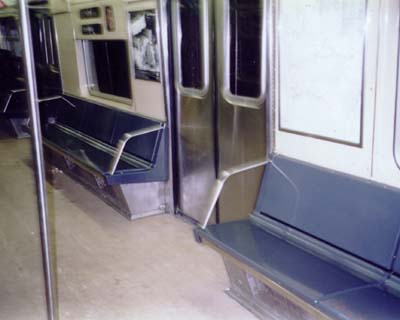
At 5 a.m., a man and a woman entered the same subway car at the Astoria Blvd station, but they did not see each other.

The woman had barely made it, running breathlessly up the two short flights of stairs to the train as the conductor was advising everyone to “stand clear of the closing doors please.” She slid into a seat and plopped her bag onto her lap, relieved that she wasn’t going to be late for work. The man had already taken a seat and watched with amusement as the woman dashed into the car.

They sat on opposite ends of the subway, the only two people in it. They were united by a mutual preference for privacy, an opportunity that many New Yorkers wait for on the subway, but rarely get.

The woman took out a notebook and a pen. She often wrote on the subway as she rode to work, but today she had difficulty concentrating. She was self-conscious, aware of the man sitting nearly a full-car length away from her. It seemed like a long distance, but the emptiness of the car shortened that distance so it was as if he was sitting right next to her.

A Snapple bottle noisily rolled from one end of the car to another, until he finally stopped it with his foot and set it upright under his seat. The man found it strange that he was in the subway car with only one other person. Even at 5 a.m., there were always at least a few sleepy construction workers in paint-splattered jeans cradling cups of coffee.

He was a lanky young man with dark, wispy hair and a dancer’s body that still managed to stay thin despite eating at all hours of the night and his predilection for McDonald’s fries. He wasn’t a model, but as a teenager, had been on several covers for those store catalogs you send away for in the mail, like Sears or JCPenney. This morning, he was running downtown to a friend’s studio.
This woman, the woman that was sitting across from him, was completely covered in an oversize winter coat, and he was disappointed that he couldn’t imagine the body that was hidden underneath all those layers.

By Irene LewSome of his friends joked that he was perverse and a “sex addict,” but he just enjoyed a woman’s body…sweaty flesh sliding over his, soft, full breasts that he could cup in his hands. When he looked at her, felt no sexual desire at all and this intrigued him. He felt a strange pull towards her, a curiosity about this woman whose head drooped lower and lower onto her notebook, like a ventriloquist’s dummy.

The woman stared at the page in front of her. The page was still blank. She glanced over in his direction, trying to appear as nonchalant as possible. He was good-looking, and one of those men who knew it. His arms were draped casually over the back of the seat and his eyes were focused on a subway ad for a school of philosophy. Suddenly, he turned his head and caught her staring. Shit. Her eyes returned to the page before her, burning. She wanted to be someone else, someone unlike the girl she was used to seeing in the mirror every morning. She wanted to be uninhibited, lusty, confident but not too brazen, sexual and desirable without even trying. She imagined that this was the type of woman he dated. Model-thin leggy blonde with clothes that draped over all the right places. Women who took their beauty for granted and carried it off effortlessly. A sharp pang of loneliness jarred her.

“May I sit here?” The question startled her, and she glanced up, pen hovering above the page. The man loomed over her, leaning against the pole.

“Oh, go ahead,” she said, flustered.

To his surprise, she was rather beautiful, the kind of innocent beauty that would’ve gone unnoticed had he not looked for it underneath her waterfall of wavy black hair, delicate fingers peeking from a large coat, calm, brown, almond-shaped eyes that unnerved him as she peered up at him.

“Why are you taking the subway so early?” he asked.

“I’m going to work,” she said, closing her notebook. “I work at the concierge desk in a hotel.”

“Oh I see,” he said. “I’m going downtown to a friend’s recording studio.” The train had just pulled out of Queensboro Plaza and was going underground. The city skyline slowly sank out of view, and they were plunged into darkness.

Silence fell again. She didn’t know what to say to this stranger, didn’t understand why he wanted to talk to her, what he wanted from her. “Do you miss someone?” he blurted out. As soon as he said it, he instantly regretted it.

She was taken aback. “It’s not really someone I miss,” she said slowly. “It’s more like someplace.” And suddenly, she thought of home, thousands of miles away, in California. “And this city…even though there’s so many people in it, sometimes, I feel like the loneliest girl in the world.” She took a deep shuddering breath.

He felt the need to comfort her, a great need, something he had never felt the urge to do before. He wasn’t the consoling, cry-on-my-shoulder type of guy, but the wetness of her eyes unnerved him. At the same time, a part of him understood exactly what she was talking about,

“I think every single damn person in this city feels that way at some point,” he said.

* * *

The morning after spending a night with yet another curvy stranger, he rolled over and got out of bed as quietly as he could without disturbing the sleeping figure next to him. He grabbed a lighter and cigarette and padded barefoot outside to his outdoor terrace. It was still dark, and very faint streaks of pink light nudged the rim of the horizon. Leaning against the railing, he surveyed the scene before him. Rows of dilapidated warehouses that had stood abandoned for decades, the shape of the elevated train tracks. He could see the Astoria Blvd. station from his window, and he was reminded again of her-“the loneliest girl in the world.”

Writer Irene Lew graduated from the University at Albany, SUNY, in May of 2006. She is working for a trade publication in New York called “World Screen,” writing about the international television and media industry.

Saturday, February 03, 2007

"The Ride to Port Antonio"

By Bill Ackerbauer

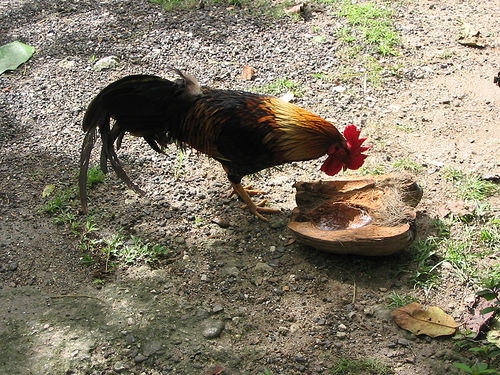
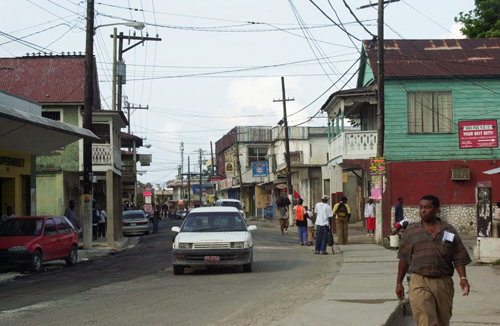
It was a remarkably well-behaved chicken. Plump and massive, it sat like a glossy-feathered black Buddha in the lap of its owner, watching me with one unblinking eye. The bird neither clucked nor fussed, content to be stroked occasionally by the old woman as we sat side by side on the crowded bus that would take ten hours to reach the other side of Jamaica.

I’d picked a bad weekend to visit friends on the North Coast. Mudslides from a recent tropical storm had made a mess of the main road across the mountains, so buses traveling from the south had to take the coastal route around St. Thomas Parish on the eastern tip of the island. From where I was staying, in May Pen, the trip to Port Antonio would have taken half the time if the road hadn’t washed out. But I was an 18-year-old exchange student on a break from school, and there was nothing better to do than spend a day on a cramped, hot bus beside the woman with her bloodshot eyes, her toothless smile and that fat fowl.

It was 7 a.m. on a Friday when I left the house and walked down the dirt track and over the bridge into downtown May Pen, pausing to let a small but menacing herd of goats trot across my path. I caught a mostly full bus to Kingston: mostly full is better than empty, because the buses don’t roll until the seats and every square inch of standing room are filled with passengers. Choose a seat on a mostly empty bus, and you’re liable to wait an hour for it to start moving. A person in a hurry can always pick a bus that appears to be filled to capacity, or even jump onto one that has begun to move. The greedy thugs who wrangle passengers and collect the fares are always able to find room for one more, even it means pulling a rider in through a window in a tangle of sweaty limbs.

That particular morning, I was lucky to get one of the last open seats on a bus that was filling up fast, as the ones bound for the capital usually do. It headed out of May Pen, past the bank and the post office, past the drugstore and the Kentucky Fried Chicken and on its way to Spanish Town and then Kingston. I got off at the chaotic terminal near Trench Town, a desperate, flyblown section of the capital where a few months later I would witness a riot — from the safety of another bus — whose purpose I never learned, but whose burning tires and outraged screams are indelibly etched into my memory.

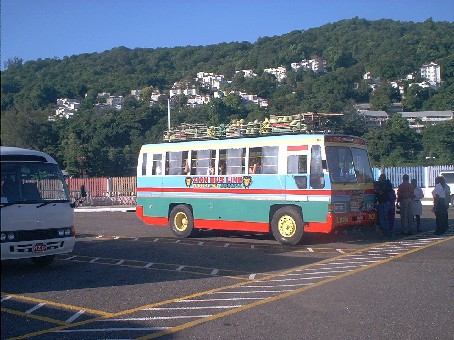
The terminal was a slightly more peaceful place the day I jumped off the bus from May Pen and quickly spotted one headed around the big bend to Port Antonio. This vehicle, a baby-blue former school bus, was nearly empty, so I grabbed a seat and settled in for some downtime. A man reached in through the open window next to my head and, like an angel of vice, promptly sold me a pack of Craven ‘A’ cigarettes and a mercifully cold Red Stripe.

The beer, combined with the long wait and the oppressive heat, must have lulled me to sleep, because when I awoke, the bus was bumping along a pot-holed stretch of country road. Sunlight was winking off the dirty pastel squares of houses and the corrugated metal roofs of the ramshackle rum shops.

And to my left was the chicken.

There’s nothing quite like waking up on a moving bus in a foreign country and being startled by the reptilian gaze of a chicken just inches from your face. After a moment of shock, I looked up to see the face of the person carrying this strange cargo. Her smile was wide enough to reveal discolored gums, and her tongue clicked with amusement – tch, tch. I said hello, and she nodded and mumbled something I couldn’t make out.

We sat together for hours, the bus crawling up and barreling down hills, but there was no conversation. When we reached Port Antonio and passengers started to stir, I realized with some alarm that my legs had both gone numb from the long hours in a seated position. The old woman must have sensed my problem, because she sprang up from her seat, tucked the chicken under one stringy arm and helped me stand with the other.

I thanked her as we climbed off the bus, and she nodded, mumbling again. She carried her bird off toward the waterfront, and I stumbled up the hill toward the Bonnyview Hotel, shaking pins and needles out of my legs.

Bill Ackerbauer is a writer, editor and one-man jug band who teaches journalism at the University at Albany. He lives in Johnstown, N.Y.

Thursday, February 01, 2007

MARTI ZUCKROWV "Dance On Paper"

Marti Zuckrowv, of Oakland, California, begins a monthly column today.

My mother hid chocolate bars in her closet. Not the
small bars, but those big, family size Hershey bars.
How did I know this? I was a snooper. Like most kids,
I longed to discover the secrets of who she really
was, and therefore, who I was. And another thing:
once I got my nerve up and climbed into the closet, I
felt protected from the rest of the world, as if the
billowy fabrics brushing against me were shields of
armor. I'd be safe.

My father shared that closet with my mother, but his
side held little interest for me. Boring gray suits,
a blue one for special occasions and the dozen or so
long and short sleeve shirts my mother ironed for him
on Saturdays when she returned from the laundromat.

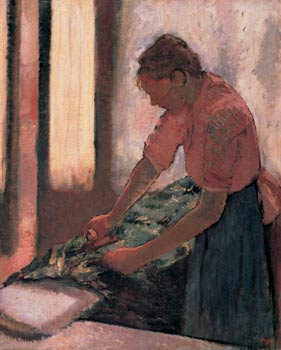
I ironed his handkerchiefs, a chore I came to enjoy for the meditative quality of sliding a steaming iron
up and down the ironing board. Magically, the wrinkled
white cotton square stretched out and lay flat and
flawless, ready to be made into perfect quarters. An
imaginative child, I'd pretend I was this flimsy piece
of cotton. I'd let my body go limp; my arms sagging
like elephant trunks, my legs as wiggly as overcooked
spaghetti. I'd roll up sequentially, vertebrae by
vertebrae, my spine transforming from a horseshoe
shape into a young oak tree.

I'd do it again, and again, often adding choreography that included
creating grand arcs with my arm, the iron heavy in my
hand, the stream from the iron hissing in musical
accompaniment. Little did I know I was embarking on my
lifetime passion as a dancer. Needless to say, my
ironing chores took forever.

It was my mother's side of the closet, though, that intrigued me.
I'd sneak in to the closet when I came home from
school. Both my parents worked in Manhattan and didn't
get off until five so I had ample time to do my detective
work.

I'd slide the thin wooden sliding doors open, forever
intrigued by the novelty of sliding doors (all the
other closets had doorknobs with key holes beneath
them) I'd peek around the room, (just in case a
burglar or a murderer happened to be there) before
stepping in and leaning against the rack of her
clothes.

I'd press my face into her quilted pink
bathrobe. I loved the cool silky feel of the fabric
next to my skin and the faint scent of her Jean Nate
spray that lingered there. Like a caress, the soft
fabric comforted me when the waves of guilt at being a
snoop threatened to drown me. I'd imagine I was
Rapunzel letting down my long golden hair. My handsome
prince would arrive and carry me off to far away
places where we would live happily ever after.

I'd be safe from that bad man, Mc Carthy, who my parents and
their friends talked about when they thought I wasn't
listening. I'd fold in like a pretzel, hug myself
greedily, then extend my arms and legs to become as
large as possible in such a confined space. I'd feel
the transformation of my body contracting, expanding,
contracting expanding. I'd be free of this world and
enter the world of movement.

I'd found home. I'd poke around my mother's handful
of fancy dresses, her royal blue taffeta box like frock,
her wedding and bar mitzvah outfit, her rose colored
velvet dress with it's thick soft sash that tied
in the back and draped down over her broad hips,
a lime green silky shirtwaist with tiny pearl buttons, and my least
favorite, the black long-sleeved narrow dress she wore
to funerals.

That dress, when I spotted its darkness, got my heart racing.
The Rosenbergs. Maybe my parents were next. I'd will myself
to breathe, make myself as small as possible and scrunch down to
investigate the few boxes of high heeled shoes lined
up on the bottom of the closet. (That's where I'd find
the chocolate bars, stashed away in an otherwise empty
box.) I'd step into my favorite pair of black suede
pumps, secure them to my feet with the thick ankle
strap that wrapped around, back to front, and imagine
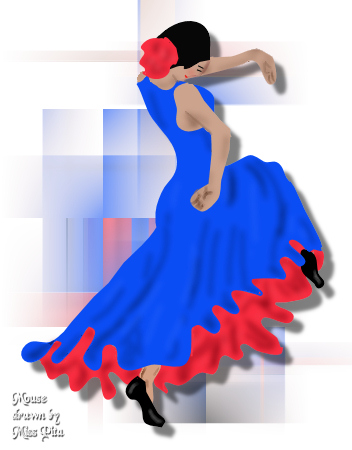
myself a flamenco dancer.

I'd uncoil my body, stand up and walk out of the closet.
I'd pose before the mirror over the dresser. Taratata,
taratata,
I'd suck in my belly, throw out my ribs,
arch my back, position my arms to frame my face and
snap my fingers. Taratata, taratata, I'd whirl
and twirl, unsteady on the high-heeled shoes but
committed to my dance. I'd see the girl in the mirror
and know that was me, a dancer.

Writer Marty Zuckrowvia is a lifelong dancer and performance artist who teaches movement classes to people with disabilities.

Tuesday, January 30, 2007

"Maybe We Will Talk About the Shotgun"

By Cecele Kraus

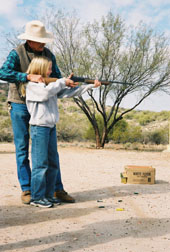
My daddy and I are going out in the car to spend some time together. My mother says we should. It is early evening and starting to get dark. We head out to downtown Tuscaloosa, near Bryce State Mental Hospital. Daddy is a chaplain there. This is our time. Maybe we will talk. Football. Maybe Boy Scouts. Well, maybe about that shotgun he gave me. Grandpapa’s shotgun. I can’t wait to go hunting. Daddy doesn’t hunt but I can go hunting on Papa’s land. Maybe Daddy will come to my next football contest. Sometimes he does. But I don’t know. Sometimes he is off on trips with his choir. But now we are going to get something to eat. Together. Without my sisters. Without my mother.

I glance at him sideways. He is a little quiet. I don’t know what to say. I am wondering when we are going to Papa’s so that I can use that shotgun.

Papa Allen taught me how to shoot. Daddy doesn’t have time to go out in the woods. But Papa does and sometimes my cousins. And sometimes I just go by myself.
Sometimes I shoot a coon and leave it in Micaville with my cousins. Daddy did play football in high school and Papa traveled seventeen miles to town to watch the games and cheer. Daddy has told me about this. Papa would run up and down the sidelines cheering them on. I wish Daddy would run up and down the
sidelines at my games.

It gets quiet in the car. Daddy puts the radio on. Nat King Cole is singing. Daddy tells me what a good voice Nat King Cole has. He loves his voice. Daddy sings too but I don’t sing.

We are here now. We stop at the diner. Daddy says, “Philip, go in and get yourself a hamburger and a Pepsi.” I ask, “Aren’t you coming too?” Daddy is quiet. “No, just get what you want.” Confused, I go in and sit at the counter. I eat my hamburger. Out the diner window, I see a tall, dark-haired woman get into our car. It is getting darker. She only stays a few minutes. She leans over to kiss my daddy and then leaves. I feel sick. My stomach is hurting. I get back in the car. Daddy changes the radio station. A gospel quartet is on. I don’t say anything. Daddy is quiet.

Writer Cecele Kraus works as a psychotherapist in Chatham, New York. She is working on a collection of poems and short fiction.

Saturday, January 27, 2007

"Cadavere"

By Noah Kirsch

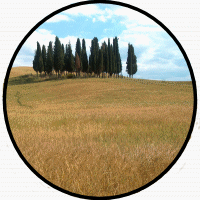
The landscape was brown and dry, void of any redeeming features except a shack near a tree in the distance. The leaves ruffled like chicken feathers underneath the midday Tuscan sun. A dirt road sliced through the countryside, dividing the picture in two.

Underneath a tree in the distance sat a decrepit man. His teeth had rotted away. His face was wrinkled like a raisin in the sun. The man had been hardened by eighty years of torment; by eighty years of weather so dry that the slightest wind brought real cotton to the mouth. He looked at the shack. The roof sagged like the middle years of his life. The boards had weathered away, leaving stark holes open to the elements. He blinked. Out of the corner of his eye a younger figure of himself walked out of the dark cabin. The young man’s eyes were wooden. He looked straight at the old man.

“Morto. Cadavere per un uomo.” He spat. “Mi fa venire il vomito.” (Dead. Corpse for a man. You disgust me). The old man made for a captive audience. He stared right into the young man’s uncompromising eyes. The old man tried to drop his head. He tried to look away. He tried to tell himself that this was all a dream. Not that he was imagining himself sixty years younger. Rather, the old man was trying to tell himself that he had not wasted his life on the desolate Tuscan field. He was unconvinced. The lightest breeze came across the man’s forehead and for a second he felt relief. He blinked and the young man before his eyes had vanished. The slightest tear trickled down his cheek.

Noah Kirsch lives in Spencertown, New York.

Thursday, January 25, 2007

"Hunca Munca in My Cupboard"

By Ellen Zunon

Little mouse feet scurry between the cans of scouring powder and silver polish while the Big Ones snore unaware above. It’s a hardscrabble life for a little soul, squeezing oneself in and out through cracks where the wind whistles through and swats your behind and tweaks at your tail and whiskers, and while the wind chimes flail furiously in the winter garden. Once inside the house, it is dark as a whale’s womb, but at least it is warm.

If your night vision is good enough, you can find a feast on the sideboard, perhaps the remains of a piece of marble birthday cake or the crumbs of an almond biscotti on the saucer of the hot chocolate mug left behind by one of the younger Big Ones. But be ready to dash into hiding behind the oatmeal canister if the snoring stops and the Biggest One staggers down the stairs toward the Room of Running Water. Alas, too late, unthinking, you go for a morsel on a wooden plate, and make it to Mouse Heaven.

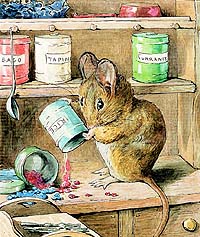
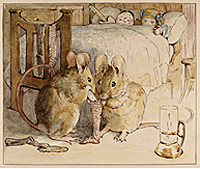
Besides the Tale of Peter Rabbit, Beatrix Potter wrote many other stories for children about charming little creatures whose human clothing could not hide their mischievous animal natures. One of my favorites, read many times over when my children were young enough to want bedtime stories, was "The Tale of Two Bad Mice," who invaded a dollhouse at night and carried off such loot as a chair, a cradle, a bookcase and a bird cage. The culprits were named Tom Thumb and Hunca Munca.

I always got great amusement from this story with its anthropomorphic protagonists, and I especially liked the pictures of the pair sitting down at the dining room table and trying to carve a plaster ham with tiny tin knives, or trying to drag a bolster pillow down the dollhouse stairs and through their mousehole. I also like their descriptive names: Tom Thumb, a very fitting name for a mouse; but Hunca Munca? A musical rhyming name, perhaps after a pet mouse that Beatrix and her brother kept as children.

And so when a mouse (or mice) moved into the cupboard under my kitchen sink, I could not help thinking of Hunca Munca and her diminutive better half. They reminded me indeed of a pet white mouse my own brother had had when we were children, but who escaped from its cage one time and got loose in the basement, much to my mother’s consternation.
This new Hunca Munca must have gotten into our house through a chink in the foundation, pushed aside a square of insulation and leaped onto the basement floor. Perhaps she was shown the chink in the foundation by the chipmunk who lives under the front porch.

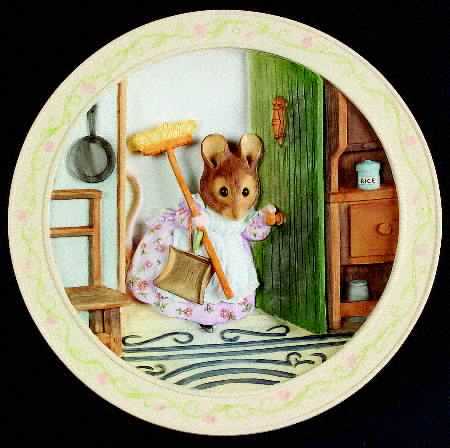
This Hunca Munca took up residence in the kitchen cupboard, but she ignored the canisters marked Coffee and Rice, which in Potter’s story turned out to have nothing inside but red and blue beads. Instead, she went on foraging forays in the basement storage room, chewing through an imported tapestry and leaving mouse droppings on the pristine white shelves where my daughter’s paintings are stored.

I could not bear the thought that she might try to make a meal out of a masterpiece.

In the story, the owner of the dollhouse declared that she would buy a doll dressed like a policeman. In real life, my sister asked me whether I would like to borrow a cat. She has four. But my husband and I decided somewhat reluctantly to use a conventional mousetrap.

Our first attempt was not successful.

“Did you set the traps?”

I asked my husband as he climbed into bed the first night.

“Uh huh.”

“What did you use for bait?” I asked.

“Huh?”

“What did you use for bait?”

“Nothing. I just set the traps.”

Not surprising at all, we caught nothing that first night. After all, Hunca Munca and Tom Thumb are not stupid. It was a cat that was killed by curiosity, not a mouse. I knew we had to lure the invaders not with bare wood and wire, but with a tasty morsel.

Don’t let anyone tell you that mice like cheese. That didn’t work either. They weren’t interested.

On the third try, not wanting to strike out, I suggested peanut butter (no jelly, please!) on a piece of bread crust. We set two traps.

Bingo! The sight of a dead creature on my basement floor was distasteful, but I consoled myself with the thought that the animal had died a quick death. And I further justified the trap by telling myself that the bacteria that cause Lyme disease lurk in the digestive tracts of mice and squirrels.

So we were better off rid of this rodent after all.

And what of the trap set under the kitchen sink? Yes, there too, behind the wastebasket we found a sprung trap and a diminutive victim. There too, we emptied the trap and swept up the last of the mouse droppings (we hoped).

In Potter’s story, the two Bad Mice were “not so very naughty after all,” because they paid for everything they broke. They found a bent coin (the proverbial crooked sixpence, I presume) under the carpet in the dollhouse, and on Christmas Eve they stuffed it into one of the dolls’ stockings.

I found no such recompense in any of our stockings on Christmas this year.

But shortly after the New Year I began to see again tiny black specks of mouse droppings on the clean white basement shelves.

Stick around and maybe I will tell you the Tale of the Third Bad Mouse and how he met his demise.

Writer Ellen Zunon has taught English as a Second Language in the U.S., France and Cote d'Ivoire. She now hangs her hat in Guilderland, New York.

Tuesday, January 23, 2007

"The Vain Woman and the Bird"

By Robert G. Willner

Have I forgotten?
A shameful thing to do to a vain woman.
Perhaps I will create or recreate you.
Pretty, dark hair, curling round.
Bright lips, dark eyes
Absorbing, exuding intelligence.
Throw your head back and
Laugh with gusto.
So sure are you.
Yet, you look at me as a mirror.
You seek confirmation.

Look at the toucan
Vivid, majestic,
Bright red, yellow and blue.
How could you dream
She is no match for you.
You stare and she takes flight
Beautiful, beautiful!
You would like to imitate
Alas,
A vain woman cannot fly.

Robert G. Willner lives in Chatham, New York. He has been an attorney and president of a drama company called StageWorks.