Wednesday, March 07, 2007

"Mr. Collins"


By Alan Rowland

When was the last time you tuned into any of the 'Law & Order' or 'CSI' franchises on TV?

If so, you've likely read or heard the words: "Ripped from the Headlines."

The network lawyers may have insisted on the disclaimer...'No person or events depicted here.........', and then, you know the story has been, in fact, ripped from the headlines of newspapers around the world. Or, perhaps, you're a Luddite and have actually read a book... a novel by Agatha Christie, Dorothy Sayers or even Sue Grafton or P.D. James!

Well, allow me to introduce you to Mr. Wilkie Collins, a writer and close friend of Charles Dickens in 19th Century England. Time has not been so kind to Mr. Collins, while his friend has reaped endless good fortune's love and admiration.

Mr. Dickens has been 'musicalized,' modernized, and reinterpreted; his work has won Oscars and every literary award known to men of letters. There are, quite likely, more words written about Mr. Dickens, than he could have ever written himself.

Wilkie Collins, meanwhile, sits in the somewhat more frayed, William Morris upholstered wingchair in the back of the smoking room. Collins wrote more than 35 novels; tracts on laudanum and literature; he wrote plays (more for amusement than anything else), and acted in many productions with his dear friend Dickens.

But today Wilkie Collins' more modest reputation rests upon two books: "The Moonstone" and "The Woman in White." These novels, and the major canon of Charles Dickens, were serialized, as was the fashion for the hungry reader of the day, in a weekly called "Household Words."

Readers raced for each installment, until later, when the books were published in their entirety, often illustrated by artists who came to be identified with a particular writer. Collins' books were then known as 'sensation novels', or as books 'ripped from the headlines.'

Many of his plotlines were indeed inspired by sensational headlines, often dealing with 'women's issues' like primogeniture, marriage, employment and other women's rights.

Today, Wilkie Collins is credited with 'inventing' the modern detective novel. Agatha Christie to P.D. James and countless other writers owe their debt to Wilkie Collins, and the detective stories, characters and villains he so deliciously created.


Artist and writer Alan Rowland, who lives in New Jersey, is a huge fan of Wilkie Collins' work. Once, on a visit to London, Rowland searched out and bought every book that Collins wrote which was not available in the states. The illustration of "Moonstone" is one done by Rowland, who worked as a graphic artist before he became disabled.

Saturday, March 03, 2007

"In Defense of One British 20th-Century Poet"

By Judy Staber

You Say,
from your pantechnicon of knowledge
and from your well-honed opinion,
You Say,
That ALL the major modern,
ALL the great con-tem-por-ary
Twentieth century poets
are American.
You Pound,
into our unschooled,
un-metered minds,
Their names - One By One.

And I,
Who know far less of such meters [sic] than you,
cannot intellectually disagree.
But I ask you,
please, consider
the librarian from Hull,
Who captured,
in a few well-chosen words and rhymes,
The lives and times
of the little-known and less-loved people,

Who live, like Eliot's Prufrock,
Ordinarily,
Who pass their humdrum years
Uneventfully,
on housing estates;
In the council houses and tenements
in a land that is never boasted
in those "SEE BRITAIN NOW" posters.

They exist,
not in castles, nor in thatch and beam quaintness,
but in the flat Mid Lands.
They talk,
not in cockney nor with pear-shaped vowels.
but in dull mono tones.

And if you ever,
As I, once often did,
Ride on British Rail
Through that dull, flat,
middle part of England,
You will know
that "The Whitsun Weddings"
is a brilliant portrait
of those gray lives
Caught in passing.
Read "Here" or "Dockery and Son,"
And you will know them too.

You Who are so American,
Can praise your poets profoundly
(and justly so).
But I,
who am split across the sea,
in both my culture
and my loyalty,
I find sad memory,
Deep meaning
and exaltation
in reading Philip Larkin.

Poet Judy Staber, of Chatham, New York, formerly with the Spencertown Academy, dedicates this poem to the poet Michael Gizzi: "he taught me to love poetry and encouraged me to write, but being American was very biased in favor of American poets."

Thursday, March 01, 2007

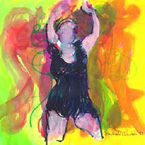
MARTI ZUCKROWV "Dance on Paper"

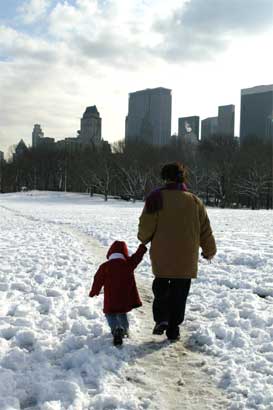
Late 1940's. The East Bronx streets, midnight on a school night, the first snowfall of the season. We'd bundle up in winter coats, wrap woolen babushkas around our heads, pull gloves on our hands, slip into galoshes and head out for Bronx Park East.

My mother and I would be the only ones out. The neighborhood was sleeping, except for us, or so it seemed to an 8-year old. We'd step out into the cold, excited as two kids, my mother already reminiscing about her short happy childhood in the streets of Odessa, Russia, before her father died and she was unable to accompany her mother to America because of failing health.

She rarely talked about that part of her childhood, the years in an orphanage, the years living with relatives who didn't want her. Bound by all our clothes, we plodded along while the snow fell as soft as cotton. It was magical to walk through the vacant lot at the end of our block,the trash and litter, the broken bottles and empty cans shimmering under the light coating of snow.

We'd make our way under the El. Even the filthy platform above our heads glistened with specks of virginal snow. Snowflakes spotted the parked cars along the curb and the fire hydrants looked statuesque, dotted with white. The bulky clothes originally weighing me down seemed to lighten on my back as we trudged ourway to the beginning of Bronx Park.

Snow would be falling faster by now and I'd lift my face to they sky and catch the flakes in my mouth. Oh, the thrill of being part of the night, the snow. I stepped out of myself and became one with something so much bigger,indefinable, but clearly in another dimension, far from everyday life. The graceful snow transformed the ordinary to spectacular.

We didn't talk much, my mother and me, as we neared the park. We didn't arguethe way we did most other times. We came close to liking each other. A blanket of snow covered the ground.

The surrounding trees and tall bushes were outlined in white, as if they'd been sprinkled with sparkly white powder. No longer were they the bare naked trees of winter, they became magnificent wonders of nature, proud and tall, the bushes beside them billowy forms of elegance.

Not daring to enter the park at night, we walked along Bronx Park East, a wide boulevard-like street that ran parallel to the park. Even the trash cans, by now covered in snow, lent magic to the night. I'd run ahead of my mother, frisky as a puppy, then leap into the air and skip back to her. Free to jump and twirl in the empty streets with the soft snow falling in my face and the cold air invigorating, I'd yank my babushka off and it became an extension of my arm.

I'd wave it over my head, then spin around and use it like a whip, imagining myself riding off into the distance on a wild stallion and I would become that wild stallion, untamed and brave and ready to conquer anything. An energy would build somewhere inside of me and move into my arms and legs and back and chest and even my neck had to find expression for the lightening surges running through me. My mother as well, moved lightheartedly through the cold. Her chunky legs and her thick peasant torso carried her down the block and away from the drudgery of her existence.

In the morning she'd drag herself out of the house and take the hour subway ride into Manhattan, standing smashed against the other garment workers bound to their factories. She'd return home each night exhausted and spent. Day after day, week after week. Year after year.

But on our walks on the snowy cold nights, she, too, could be carefree. Here it is now, 2007. My children are grown and mygrandchildren are older then I was when I walked in the snow with my mother. Now, I am the one who gets to be carefree in a child's presence. I watch my granddaughter play basketball, my little shy girl block a pass or dash across the court and make a basket and my body once again remembers the amazing feel of spontaneous movement. I stand cheering my grandson on as he wrestles his opponent down to the ground, applauding the magnificence of these two young athletes. I applaud the brilliance of the human body, the miracle of movement and kinesthetic wisdom, and the soul living within.

Writer Marty Zuckrowvia is a lifelong dancer and performance artist who teaches movement classes to people with disabilities. She lives in California.

Tuesday, February 27, 2007

Produce and Prose and Poetry...


Calling all Albany-area Authors with Published Novels and Poetry Chapbooks!

As part of their annual Earth Day celebration, the Honest Weight Food Coop in Albany, New York, is inviting authors to take a table where they can display and sell books. Earth Day will be celebrated Saturday, April 21, 2007. So if you have a published novel, or a book of poems, and you want to display them that day at the Coop, please contact My_Story_Lives@yahoo.com. We will ask each author to shepherd the table for an hour or two that day. Here’s a great way to sell a few books, and to help support a wonderful organic and local food operation in Albany.

P.S. If you aren’t a member of Honest Weight, think seriously about it. In a world faced with global warming, the need to buy our food from local farmers is URGENT!!!! The food at Honest Weight is awesome, wholesome and affordable!

Monday, February 26, 2007

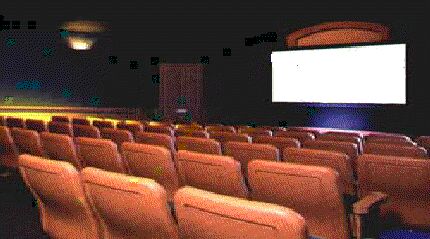
"A Life of Crime Begins Two-Thirds of the Way Through the Movie"

By John Grey

One after another,
they sneak into the movie theater.
They don't even care what the show is
or if it's half over.
It's the thrill they're after.
Once inside,
I'm sure a film
of their own cleverness
is what they'd much rather see.
Forget the car chase,
the gunfight,
the romance,
when there's a door
wedged open at the back of the cinema,
and a bunch of unabashed new stars
make their entrance from the bathroom door.
Snug in their seats, their heads
are full of trailers for coming events.
So many ways of trespass to come,
of getting something without paying for it.
And always their names above the title.
On a rap sheet, if nowhere else.

Poet John Grey lives in Providence, Rhode Island. His latest book, "Where Else is There," is published by Main Street Rag.

Thursday, February 22, 2007

"It Was a Backwater Beach"

By Cecele Kraus

It was a backwater beach in a backwater country, before the drug trade in Colombia; it was festival time in the beach towns of the Caribbean, festival time in Cartegena. Peace Corps volunteers, we traveled by bus from the inland city of Barranquilla to dance the cumbia, drink rum and coke. Foreigners with no advantage in this night of music and rum, Dan could pass for Colombian, but my red hair and freckles allowed no chance for passing.

Dan and I left the throngs to sit on the beach and as we listened to the distant steel drums, a man came upon us. Methodically, he unwrapped a gun from tissue paper, but spoke so rapidly, I could not understand. Dan understood and his words to me were firm:

You get up and walk back to the hotel. Do not look back. Do not run. Just keep walking unless I tell you to stop.

As he talked steadily to the stranger, I walked into the night, slipping down the beach toward the hotel. As I passed the revelers, the music dropped away, the dancers blurred. I steadied my eyes on the lights of the hotel, taking strength in Dan’s voice sounding over the beach, Keep going!

Now memory fails me. I arrived at the hotel safely. Dan joined me, we drank rum at the bar, but I do not remember what he said to the stranger with the gun.

A few weeks later, Dan said he could not give me what I needed and we stopped trying to fall in love. He could not give me a future. Maybe he gave me my life.

Writer Cecele Kraus works as a psychotherapist in Chatham, New York. She is working on a collection of poems and short fiction.

Tuesday, February 20, 2007

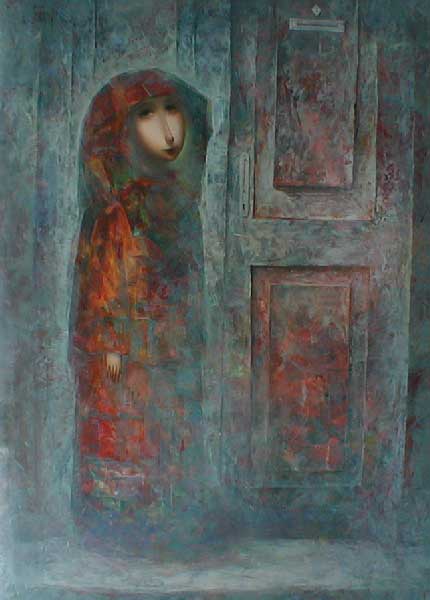
"The Door"

By Alan Rowland

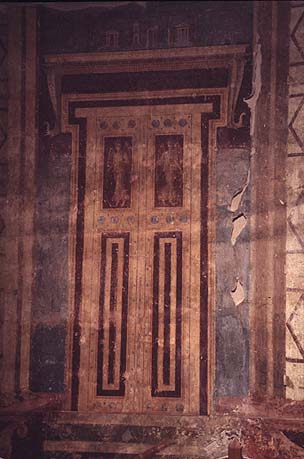
The door stood at the end of a long, dark hall. It was closed and locked to all prying eyes and curious minds. I was afraid of the chipped paint and broken pediment, as though it might crumble and splinter to sharp pieces on the bare floor below.

No one ever mentioned the door or what lay beyond its insistent silence and dust. But silence may speak, and dust may cover a secret. The light of day through high windows and reflected off even higher mirrors never reached the door in its quiet darkness. No sound echoed from footsteps misguided to a wrong part of the church-like house. A pet never investigated; children showed no interest.

The door was merely 'there' - mute, imposing, with the threat -- or promise-- of something unknown.

To start it was only a door, but it became THE DOOR over time, as I grew to manhood. 'Curious,' I thought, and the door remained shut, locked and unpainted throughout years of painting and repainting the rest of the house. Eventually an armoire was lifted and dragged ungracefully down the long hall to cover the door, until it faded in mind, like old, stained wallpaper.

The house was an imposing structure, lovingly restored across a family's years to its original gothic beauty, with every modern convenience of the day. My mother fancied she had 'taste': 'That's one thing I always had,' she would boast, 'taste...eclectic, but taste.' The house was a testament to her modern sensibilities and style. The high-ceilinged rooms were painted a warm white, as a perfect environment for a mid-century modern decor, one that had seen its day pass, and return again to fashion, an affirmation of mother's 'good taste.'

The main rooms were large and connected to one another by French doors, with glass always sparkling. Twice a week mother would have 'help' come in for $45.00 a day. She would do her 'spot cleaning' each night before 'the help' would come to help keep up with a demanding, old house. Mother loved color, or 'colour,' as she might spell the word.

Textured color, vivid 'atomic' prints that even a child could love; color on drapes, upholstery and in the Picasso, Braque, and Cezanne prints that covered the walls - even in the 'commode', as I imagined she thought of it. Faded Persian color washed the floors, and rich, ceramic color lined shelves throughout the kitchen. The old Zenith color T.V. was banished to the huge kitchen, the obvious hub of the house, especially for the children.

It could have had 'rabbit ears,' but I might be imagining that. My brothers and I each had our own spacious room. I, the youngest of six, was relegated to an old butler's pantry in the long forgotten servant's quarters, nearest THE DOOR. The room had one Gothic window, with its four walls a platoon of closets and shelves, lined up neatly and ready for God's battle with the Infidel. A generation grew, with Dad and then, tastefully, Mother 'passing on,' as people used to say.

I inherited the house, as the sibling closest by - my brothers spreading out across the country, indeed the world. I moved to the heart of the house, and married within a year of my mother's death. Another generation began. My beloved wife Emily and I bore three sons, if you counted the first -- still born. Our hearts broke, until later, with hearts aglow, Emily gave birth to those two sons, five years apart. They were like twins. They looked alike and spent all their time together, exploring the house and sharing its mysteries.

The armoire, dragged so awkwardly to hide the door so many years before, had never left its spot as sentry. The door, now in its second generation of memories and buried under six coats of Benjamin & Moore's Linen White, held its silence, kept its secrets.

My sons raced together into manhood. We lost the first in a pipeline explosion in Kuwait, and the second on his first night's deployment in Iraq. The deaths shocked us to the core, and seemed to happen overnight, "...and then there were none."

Emily's sadness slowly killed her; an aching, gnawing grief that embraced a loving heart and turned her soul black with pain and anger.

And then there was one. Me rattling about a house too large for me, too full of memory and grief; my own faith slowly ebbing. Consulting my brothers around the world, we agreed finally to sell the house and its furnishings - lock, stock and armoire at the end of the dark hall.

My gay friend Arthur leapt with flamboyant joy at the prospect of owning the house he had coveted in secret for... forever. He, weary of 'all those dusty, old putti,' as he put it, a confusion of Gothic and Renaissance architecture, ripped the house to its old bones. As each Gothic detail was rudely torn from the house, I seemed to lose one more vestige of the faith which had brought me a peace across the years.

Soon my faith had deserted me to but once a year, watching Cecil B. De Mille's "The Ten Commandments" on High Definition TV, and getting a tickle of 'faith' - until monday morning. Arthur's demolition of the prized Gothic house slowly worked its way up flights of stairs, down halls and into rooms all barely even recalled. Finally the wrecking ball and hammer found their way to the top floor and my room as a boy, blessedly left alone.

Arthur's armoire, now 'one old painted whore, with too, too many facelifts,' would turn her last trick.' Arthur would need my help. It's amazing what the efforts of two men at opposing ends of enthusiasm can accomplish. Arthur played 'HRH Elizabeth I' and I reluctantly feigned obeisance. Fifty years of a Mother's 'gift' for 'tasteful' color and 50's 'Buck Roger's' wallpaper, peeled off in huge sheaves, as though they were fleeing the door. Arthur trilled with pleasure.

We used scrapers and hammers. We used a clever gadget that removed rusted screws from their old iron foundry tombs. The lock and three hinges were removed with much difficulty, and just a bit of melodrama. The door was finally, irrevocably free from its prison, and it toppled like the Titanic in two giant slabs. We leapt back and waited for the huge dust storm to clear and reveal... nothing!

The door collapsed in a groan to reveal insulation and pipes, and cables for the Zenith and HBO. The insulation revealed older insulation and some older than the last. Arthur tore at the insulation, the newer a 'Pink Panther' pink; the older - damp and faded in some moldy, spectral brown/grey. Scotch taped to the oldest of the insulation was a page torn from an old newspaper bearing the image of Siddhartha, sitting cross-legged beneath the Bodhi tree. His eyes, once heavy with kohl, were now heavy-lidded, in acceptance of Nirvana.

The figs of the Bodhi tree lay rotting at the feet of his frail body. Next to this fading page was taped another, a gravure picture of the smiling Buddha, fat with promise and good luck. Some Chinese newspaper was crumpled into balls on the floor, behind the door that led nowhere. It had never occurred to Arthur to wonder why the door was there. 'It'll make such a fab niche,' he said, and if fact were told, I had to agree with him.

I never did find the real truth about the door myself. But I came to believe my - our - first born, still, lifeless and mute as the door itself, had the answer. He might have had all the answers.

And then, there was one.

Writer and artist Alan Rowland lives in southern New Jersey. For many years, he worked in New York City as an illustrator and art director until a seriously debilitating illness robbed him of the use of both hands. Five years ago he moved to the countryside in southern New Jersey, where he began to write poetry and prose about health, illness, art and loss.

Sunday, February 18, 2007

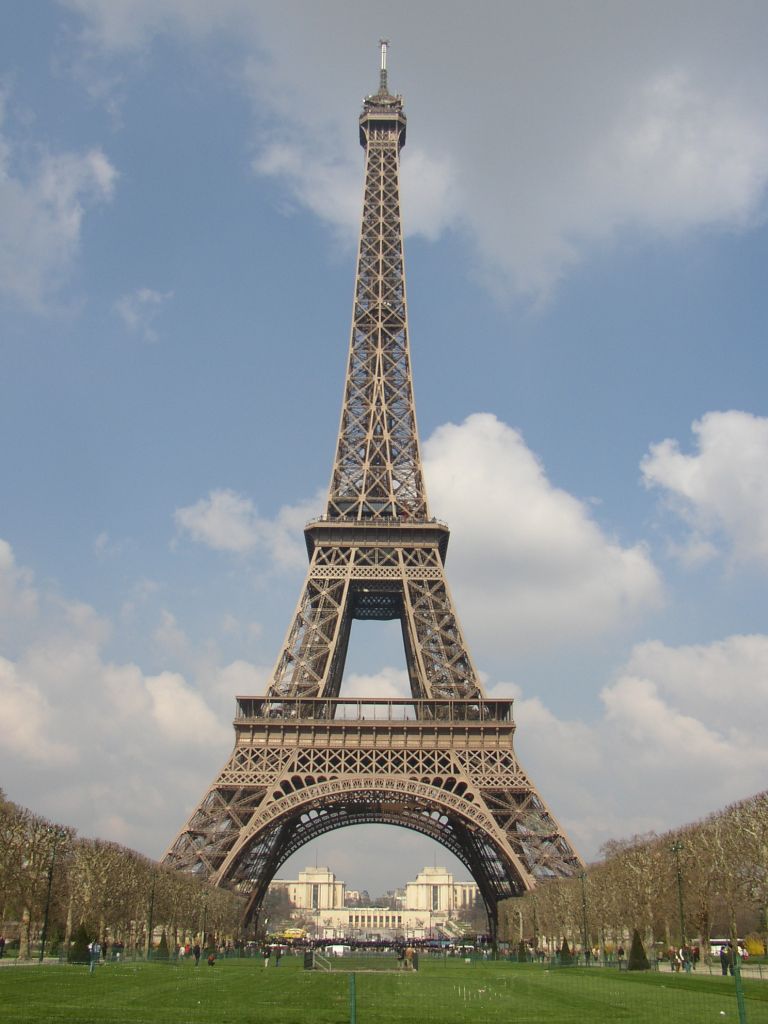
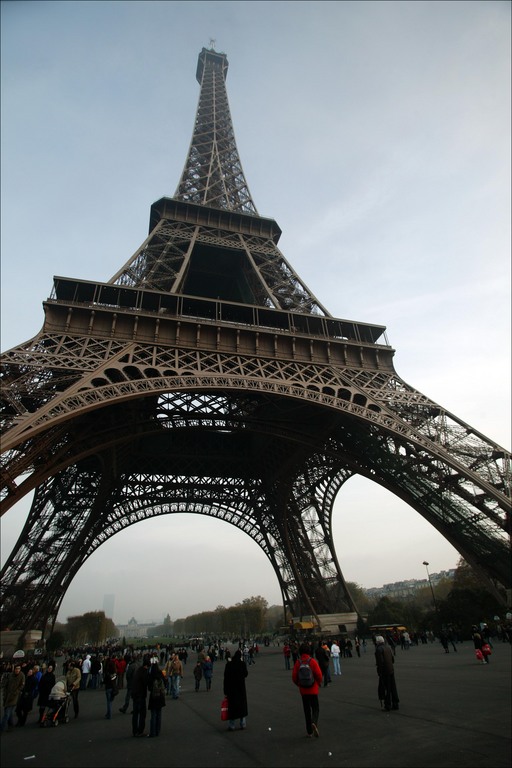
"Practicing for Paris"

By Ellen Zunon

During my student days many years ago I spent a summer in Paris studying French; since then it has always been my dream to return there for a few weeks, and perhaps to write some short stories set in my favorite spots around the City of Light.

In “The Writer’s Paris,” Eric Maisel suggests taking a day now and then to practice for a writing retreat in Paris, spending the day writing in cafés or public squares in your hometown.

In this way, if you ever do have a chance to spend some time in Paris just writing, you’ll know what to do. On a recent day off from my day job, I decided to do just that -- practice for Paris.

I left my house for the bus stop at my usual time, my word processor disguised in my plastic lunch bag, planning to get off the bus near a local coffee shop. As luck would have it, a friend was on the bus, with a selection of the 400 photos she had taken during her recent vacation in India.

I oohed and aahed over the few snapshots I studied, and mumbled something about doing an errand before work as I got off the bus way before my usual stop. Step One of my plan involved writing in the café for an hour before taking the bus to the park. I sat at a table with my mocha frappacino and chocolate croissant. But before I could take out my notebook and pen, I noticed a man with pad and pen seated at a nearby table.

He seemed to be furtively glancing around at the other coffee drinkers and taking notes. Was I being targeted by a fellow writer, objectified in red ink on a yellow legal pad? My Muse was not amused. Too embarrassed to pull out my own notebook, I finished my coffee and looked for a bus to the park.

Stepping off the bus, I walked down a quiet street to the park where I used to fish for sunfish as a kid. The red-winged blackbirds were just as I remembered from my childhood. The silence was broken only by the whirring of locusts and the mating calls of two dueling bullfrogs among the cattails -- until a chainsaw joined the chorus from the other side of the pond.

My Muse was not amused. I moved to another bench where I enjoyed a few minutes of sunshine before looking for the next bus. Finally, after an early lunch at another café, I sought out a carrel at the public library. One would think that the local public library would be a nice, quiet place to work.

But no such luck today; behind my carrel was a shelf that the library volunteers had chosen to reorganize. They were not using their quiet voices. And nearby, a mother and her pre-schooler were bickering about whether Pokemon or Spiderman was the better choice for a video to check out. My Muse was not amused. Would the university library be any quieter? I wondered.

As I gathered up my things to leave, the student volunteers were arguing about whether it was better to stay in high school, or drop out and get a GED. “Stay in school,” I wanted to shout out loud. Another short bus ride took me to the university library, where my husband and I had gone on study dates years earlier.

The murals and stained glass windows installed during the 1920’s created a soothing atmosphere conducive to study. I headed for a table under a stained glass panel with the Latin inscription “Post bellum nefandum pax”: “After an unmentionable war, Peace.” Just before I sat down, I caught sight of a sign near the circulation desk that said, “Please excuse the noise. A construction project begun on Monday will continue for several weeks.”

Sure enough, I soon heard a racket of sawing and hammering. My Muse was not amused. I could go on, but you get the picture. Next time I take a day off to write, I’ll do some reconnoitering ahead of time to help me plan my day. I’ll ask myself: What’s my style, noisy or quiet, solitude or anonymous crowd? Indoors or outdoors? A shady bench in the park may be just the thing.

On a different day, I discovered a perfect little park behind City Hall where government workers lunched quietly among the flowerbeds. I sat at a picnic table behind a burbling fountain where sparrows sipped and chirped. Hardly anybody noticed I was there, so I was free to read and write for as long as I liked. If you need to do research, a library may be your best bet; just steer clear of story hour if you would find it too distracting. Or if you’re one of those lucky people who have a laptop with a wireless card, you might want to skip the library and go to a café or bookstore with free wireless access.

You may even find your equivalent of the Café des Deux Magots or Café de Flore, where the existentialist crowd used to hang out. I may not get to Paris this year, or even next year. But when I do arrive in the City of Light, after all my practice I’ll know what to do. There’s an empty bench in the Luxembourg Garden, just waiting for me, near the fountain where the children sail all their sailboats.

Writer Ellen Zunon has taught English as a Second Language in the U.S., France and Cote d'Ivoire. She now hangs her hat in Guilderland, New York.

Thursday, February 15, 2007

"For Reah"


By Jasmon Drain
Reah was a pretty girl living in the big city. Really, she wasn’t that pretty but just pretty enough to be noticed. She spent much time checking makeup in the mirror, checking her blouse, checking whatever she thought made her look better than other girls.

It didn’t matter where she was, the bus stop or work, it didn’t matter, she was always checking her prettiness. People would stop and say hi, she’d turn her head, eyes rolling a full 360. The only reason she would act different when the men said hi was because they smiled when they did it. Reah believed they were just being nice, complimenting her. Men compliment pretty women, she thought. She never noticed that the minute she turned her head they gave one another hi fives, talking loudly.

She had nice short hair, Anita Baker style, and got it done every week. Lonnie paid for it.

“Lonnie ain’t I pretty?” Is what she would ask plucking at the curls. He would answer yes, of course, although sometimes he wanted to say no.

Lonnie: a working man, a telemarketer sometimes, enough of the time that he could keep her happy and coming back home.

Lonnie would bring pizza, free pizza with mushrooms because his sister worked at the restaurant. Reah loved that.

In the beginning, before she knew she was pretty – when she wore bottle thick glasses – the two would sit in front of the small t.v., greasy mouths and all, licking their fingers. Now, after a set of contact lenses and a few of those compliments, that pizza just didn’t taste the same.

During dinner she would tell Lonnie she had the savor for new clothes, blouses, sexier, showing as much cleavage as she could. Had to match that pretty face. Lonnie had no problems with it – at first that is – he wanted her to look her best.
He even suggested a few items.

He was a war veteran, shrapnel accident victim, inconsistent jobs didn’t hurt much because government checks for his amputated leg paid the rent. A little extra money for Reah wasn’t so bad either, she deserved it after all she’d been through. He’d been gone for two years.

They met before the war, when he was a regular man (as Reah would say), at a church revival. They had a good sex life before the war too, could even be called lovemaking. Lonnie could move any way she wanted him to then. He was her first.

She promised to wait for him – she kinda’ did except for those couple of times with Gerome.

Gerome bought those contact lenses, took her to “Snap-o-bee’s” instead of free pizza, and told her she was pretty. That’s where it started. No, it’s not. Lonnie said she was pretty, but he meant it different. By Jasmon Drain
He meant it pretty like a great person. That used to be enough. Gerome meant pretty like I want to fuck you. Lonnie meant that too, but he didn’t know how to say it like that. He was a simple church boy with one leg now.

Reah had to help him do everything when he got back, use the bathroom, move to the table, did all the work during sex. She would call Gerome after he went to sleep and talk all night about their problems. After about a month of this, she started sneaking out late to his house. Lonnie would be sound asleep, or so she thought.
A couple times, he woke when the door clicked. He figured she deserved a complete man. Her leaving didn’t hurt so bad. When she got home, he’d even hug her, overlooking the smell of Gerome’s cologne along her chest, neck, private areas. Lonnie would try to get her to make love to him right away, just to prove she still belonged to him in some way. She’d refuse.

“I need you to pay me some attention!” Lonnie would yell. Reah would just take a shower and put on her night makeup. Yes, makeup to go to sleep in.

“Ain’t I pretty?” She asked him. Of course a yes, with a frown. Reah would peck him on the cheek, off to sleep.

Gerome even started calling the house when his “real” girlfriend wasn’t with him. Lonnie wasn’t quick enough with that wheelchair to get to the receiver before Reah, but knew there was another man on the line. He just knew. In his mind, the voice matched the cologne.

“You need to pay some attention to me!” Lonnie yelled again. Reah fanned her hand. He heard Gerome on the phone telling her how pretty she was.

A kiss, some dinner, a small amount of sex – if there was such a thing – and Lonnie was off to sleep, one eye open.

Reah, eyeliner and shadow, dabble of lip gloss and fresh curls – sometimes paid for by Gerome – snatched her jacket to go.

“Don’t leave, Reah.” Lonnie begged. “Stay with me tonight?”

Reah turned her head to him, a wink, and fanned that hand.

Reah arrived at Gerome’s before the girlfriend she knew nothing about was home.
Gerome moved quickly, not a lot of time, he thought. He pressed his chest to hers, snatched her Lonnie bought blouse off – ripped it a little – and chewed at her body. She didn’t care what he did, as long as she was pretty.

“I’m pretty now," she replied.

“I’m pretty right?” She asked him. Yup. Her panties were down. He on top of her, rough. A key in the door lock. Gerome’s eyes opened wide, her’s didn’t. Alina and Friend. Gerome lifted, said he didn’t know her. Friend held Reah down in the bed, still naked. A shiny knife cut her pretty face in so many places.

Doctors spent hours on her in surgery. Said she would have permanent scars. Two hundred stitches for too much damage. Would be a while before she could function regularly.

She called home, to Lonnie’s house, but no answer. She called again. No answer. Come on, baby! Pick up! I need you right now! Still no answer. She yelled at the nurse to dial, maybe she had the wrong number, but there was never any answer.

Jasmon Drain, a former law student, is now a candidate for a Master of Fine Arts in Fiction at an Illinois University. His goal is to "learn about himself, his life, and his people through the study and creation of literature."

Tuesday, February 13, 2007

"Born Again"

By Camincha Benvenutto

Alba was barely two years old, or so the story goes. She has heard the story many, many times from many different people including her father, mother and her cousins, Julia and Alberto, each contributing a piece, a patch of the quilt. Sometimes one or another has told her the whole story, or as much as they know. So that now she really doesn't know what she remembers, if anything, or what she has been told.

This is a potpourri of memories from cousins Julia and Alberto:

Alba, at two and a half, you had been sick for several months and were way behind in weight and size for children your age. Several childhood diseases had debilitated you and made you easy prey for what came next, the fever that ravished your tiny, frail body. You were depleted of the defenses necessary to fight infections. That is why the sore on your left buttock refused to heal and kept extending over your entire back. No wonder the doctors had given up on you.

The argument between Uncle Alvaro and the doctors took place in an office somewhere off the labyrinth of the clinic's corridors. When he heard what they had to say, he broke out in a rage, would not listen. How dare they! What do they know! Die? She is not going to die!

As Uncle Alvaro charged out of the office where the meeting had been scheduled, the clinic's head doctor tried to follow him. Alba, you caught a glimpse of him as he turned on his heels in front of the opened door of your room, his eyes two dark pools of frustration, compassion. He probably thought he could reason with uncle Alvaro. Perhaps calm him down. It didn't work. Your father never listened to anyone and when adversity hit him turned definitely deaf.

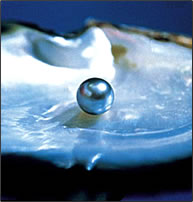
Uncle Alvaro had been to see you a few minutes before. His handsome full face, with eyeglasses and smile, had looked down on his daughter's tiny frame. He was so tall, so big. He knew everything. God, who was God for you then? Your father. Then, and for some years after. Your father, dressed in the impeccable gray suit, silk shirt. As he bent over you, the mysterious black pearl nestling in his tie, seemed to shine with a special glow.
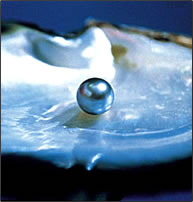
Your father. As he walked back into your room his eyes were full of determination, his lips a firm line as he turned his attention to instructing the persons in the room -- your nurse, your nanny—on how his baby was to be handled and bundled up. Careful there. Gently. Got her? No. No, not like that. To you, his voice softening: All right, my little lady?

Your father did take you home. But not to die. He had a plan.

Somehow Uncle Alvaro obtained reservations on the next ship sailing two days later from Callao to Mollendo, Arequipa. He would not travel by plane. He had with him, to help him care for you, your nanny, a maid and a house boy. When the ship's Captain was informed -- after you were securely aboard—that one of his passengers was a little girl who was deathly ill, another terrible battle ensued. The Captain wanted you disembarked at once. Uncle Alvaro convinced him to let you stay. He signed a document absolving the Captain of all responsibility. Nothing was going to stop him. His destination? Yura, the village in the Sierras famous for its thermal spring waters credited the world round with saving the lives of thousands. More miraculous than Lourdes or Vichy.

Yura. Remember, Alba? Then, and now, a valley in the mountains an hour's plane ride south east of Lima. By ship it took two days and arriving in the port of Mollendo, you traveled by train to Arequipa, by taxi to Tingo where we lived with our grandmother and Aunt Carmen, who was mother and father to us. Julia was thirteen, I was twelve. You stayed the night. In the morning we left by taxi for what was then an all day ride to your final destination.
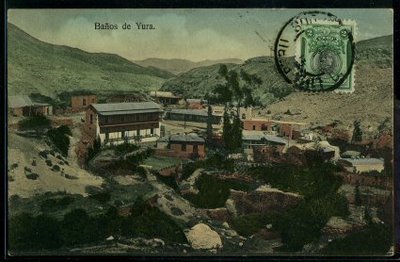
Yura. People, then and now, come from all over the world to recover their health, bathing in its many different medicinal waters that perform miracles. World travelers, honeymooners, entire families, business people. Yura has something for everybody.

They come for the pure mountain air, to soak up the sun, to find peace in the quiet life of the village. And, as an extra bonus, to enjoy the natural beauty of the place, taking long walks, hiking up and down the surrounding mountains. They also find organized tours of the nearby soda factories. Picnics. Luncheons in the picanterías, the open air eateries. Elaborate celebrations of Catholic Holy Days full of pomp and ceremony. Usually starting with High Mass in the morning, then a procession through the main road that culminates in evenings of singing and dancing in the central plaza of Los Baños, adorned with string lights holding colorful lanterns under clear skies laden with bright stars.

When nothing major is going on, the tourists themselves would take over and organize casino tournaments in the ancient Valencia Hotel's dining room‹before the Hotel de Turistas was built across the main road‹where usually at least one player would display uncanny ability at card tricks. And there were also, in private homes, literary and musical evenings in which every member of a family or families would participate.

Yura. A fertile valley nestled in the mountains, traversed by a river that swells dangerously in the winter but is a gentle, useful friend to all the rest of the year. The local residents make their living at cultivating different crops and livestock and catering to the tourists.

Arriving in Yura, your father had arranged to have the house cleaned ahead of time. He exchanged the suit, silk shirt and tie with the black pearl for overalls, faded old shirt, comfortable worn out shoes and went to work in earnest to save his daughter from a sure death.

Although in Yura people were used to seeing signs of illness in different stages all around them, Uncle Alvaro learned very soon that he had to bathe you before or after the baths opened to the public. The first day he bathed you at regular hours, the others in the pool with you were appalled at the immensity of the sore on your back, nauseated by the sight of the dead flesh around it falling from it like dried-old-bread crumbs.

Uncle Alvaro then made arrangements with the baths' guardian to give him a key so he could bathe you when the building was closed to the public. He got up at dawn. Your first bath was at five in the morning. Your last one of the day at six in the evening. That way the guardian could also clean the pools before they opened to the public.

The house Uncle Alvaro had rented was a five-minute walk from the bath house. After giving you the morning bath, he fed you a bowl of oatmeal and warm milk in which floated a pat of rich butter. Then he applied himself to cooking your next meal, a thick soup. The servants he had brought with him-- the house boy, the maid—were kept busy cleaning, washing, peeling, cutting, preparing the meat, the vegetables, the legumes.

Uncle Alvaro designed a rigid schedule that he followed daily: he bathed you, fed you the oatmeal, at mid-morning he fed you the thick soup he cooked you daily. Next, he sunbathed you, making sure there was shade for your eyes while your tiny, skinny body was exposed just enough to the sun on the front, then the back. Then you had a nap followed by another meal. And he made sure that you were forever held, endlessly cuddled. Your every need anticipated. And round and round the next day and the next. For endless months he never deviated from it.

The fact that the family was divided did not quench his zeal. Aunt Laura was alone handling the family business. This was unheard of. The risk tremendous. Aunt Laura was young, delicate. But this was an emergency, he had to trust. And he was trusting the common sense and she had plenty of it. Besides, she had been alongside him in other business ventures. His decision turned out to be a wise one.

After months of sacrificing himself Uncle Alvaro had to return to look after their businesses. He didn't want to take his daughter back so soon to the damp, semitropical climate of Lima so he took you to our home in Tingo, four hours from Yura, and left you in the care of his sister, Aunt Carmen.

It was altogether two years before you, Alba, reunited with your parents. But when you did you were cured, whole!

What a happy pair you were. Uncle Alvaro elegantly dressed, again, in an impeccable suit, silk shirt, the black pearl in the tie. And you, Alba, holding on to his hand, all lace, pink ribbons and shiny patent leather shoes, cut a perfect picture of health and well being when you walked into the clinic. The one who, wide-eyed- and-opened-mouthed seemed about to lose both of those eyes, was the doctor, head of the clinic.

Camincha Benvenutto is from Miraflores, near Lima, Perú. She earned her M.A. in 1987 in Spanish Literature at San Francisco State University. She published her novella, "As Time Goes By," through iUniverse in November, 2005. Her poems,short stories and literary translations have been published in English and Spanish in several literary and e-zines magazine.