Monday, December 04, 2023

Chapter 32: "In the Piazza, I Paint!"

The next time I see her is in late October, a day when the heat feels like a stifling blanket that won't lift. The smooth cobblestones lining the Piazza are glistening in the sun, and just before I arrive, a fierce little thunderstorm sweeps through the Piazza, forcing the outdoor customers at the Gran Cambrinus to hussle inside with their coffee and wait beside the glass cases filled with creamy confections.

By the time I begin setting up my easel, however, all is back to normal, except that there is steam rising from the stones -- I see a million thin feathery spirits all around me. And perhaps I've found my ancestors, in some of those ghostly apparitions!

I am here because I promised everyone back home that I would do this: I would come to the magnificent Piazza and publicly declare myself a painter, in Italy, in the middle of Naples, the land of my ancestors. As I start to assemble the wooden easel, always a first-class pain in the rump, a few tourists are assembling, wondering I suppose what I will do, I nod to them and what goes through my head is "oh dear God in heaven what have I done?"

No one would ever confuse my artistry with the likes of Caravaggio or any other Italian master. But for the past two decades, I've made hundreds of paintings,
enough so that I will, from time to time, among trusted friends, call myself a painter.

But why must I make this particular proclamation, here in the dramatically beautiful Piazza? I mean it's not like anyone is knocking on my door begging for my work. As I explained to my husband when he questioned my motives for wanting not only to paint in the Piazza but also to live here in Naples for several months, on my own, as I've been doing:

"I only live once, at least that's what I believe to this point, and I so the way I see it, my presence in Naples is a way of paying a deeply important compliment to my southern Italian ancestors, all of those I know and so many more I will never know, so many of whom might have picked up a paintbrush if they hadn't had to focus all of their might and their very thin resources on surviving."

I've got an exceptionally tolerant husband and because of this, I flew to Naples two months ago and took a room in an air B&B called Weekend in Napoli; not much can be said of this place EXCEPT the courtyard is alive in ferns and palms and so much other greenery. And here you see me, blissful, one morning recently, balancing my capuccino, one of the two cups I order each morning.

So now the easel is standing, albeit it wobbly and a 24-square inch canvas is in position and what remains is for me to turn it into something that suggests

ART.

The sweat that has been pooling in the armpits of my turquoise shirt is now beginning to trickle down both sides of my chest. Heart bumping, I inhale and open a tube of lime green and squirt a worm of it onto the wooden palette. My modus operandi as a painter is decidedly "intuitive," meaning, as I say in my Artist's statement, I give my paint its free reign, "I LET THE PAINT BE WHAT IT WANTS TO BE!" Mostly, that works for me, except ironically, not lately, not since I got here August 27th. Ever since, I have been trying so hard to

BE THE ARTIST I WANT TO BE, one who is trying to thank her ancestry.

I am reaching for yellow now. I squirt a worm of that onto the palette, too, and there it sits; so why did I think that coming here to the Piazza was going to unglue my artist's block? I am stuck.

"Whatever was I thinking?" I whisper that out loud to no one in particular, and now the crowd is sizable, they are starting to talk to one another, I realize that "whatever was I thinking" is exactly the problem, I AM THINKING TOO MUCH. Somehow I know that my best painting happens when I can proceed as quickly as possible into the thought-free ZONE.

I inhale. Hold my breath. Slowly slowly exhale. Now what?

And suddenly I hear a voice behind me.

"Ciao, Claudia." I turn, blink. She steps forward. Can it be?

"Ciao, Filomena," I say, lifting one hand to my forehead in surprise, thereby implanting both green and yellow paint on my face. The last time I met with her, we sat at the Gran Cambrinas,
I had hired a purple-haired translator, and then, just when things were getting interesting, my dear bis bis nonna Filomena acted like one of the spirits in the Piazza and poof, she just disappeared!

But here she is again, decidedly in the flesh and what's so spectacular is that her hair is falling softly on her shoulders, and she is wearing a perfectly sky blue dress instead of that drab grey number from the photo.

"Oh, Fi, you look lovely today," I say, and she approaches. She gazes at my blank canvas, and then gives me a comforting smile. "Something will come of it, my dear child, I'm sure of that." She crosses one forearm over the other. "Have you thought about closing your eyes when you paint?"

"Closing my eyes?" My eyebrows rise. In all the years that I've been painting, always claiming that I let paint skirt where it wants to, I can't think of a single painting that I have attempted, KEEPING MY EYES CLOSED!

"I think I will try it," I say, "I mean, it can't hurt!" I want to thank her but before I can speak she has stepped back into what is now a rather large crowd. I reach for purple and add a long curve of that to the palette. And then, letting my eyes close, I hold my palette knife and reach into what I hope is the paint.

With my eyes closed, suddenly my hearing is acute; I hear someone ask, "what exactly is she doing?" I put that comment aside, and slide the knife along the canvas. Then I pick up the knife and scoop a second time into the paint.

And then without knowing why, I feel like I need another color. But should I choose one with my eyes open? No. I drop slowly down to my artist's satchel and reach inside. I "decide" on a color knowing full well it could be a disaster.

But hey? What does it matter?

I continue this way, applyng paint in wide swaths around the canvas, reaching for more paint whenever I feel the urge.

After what feels like an hour of painting, I decide to take a look. Very slowly I open my eyes.

What a surprise!

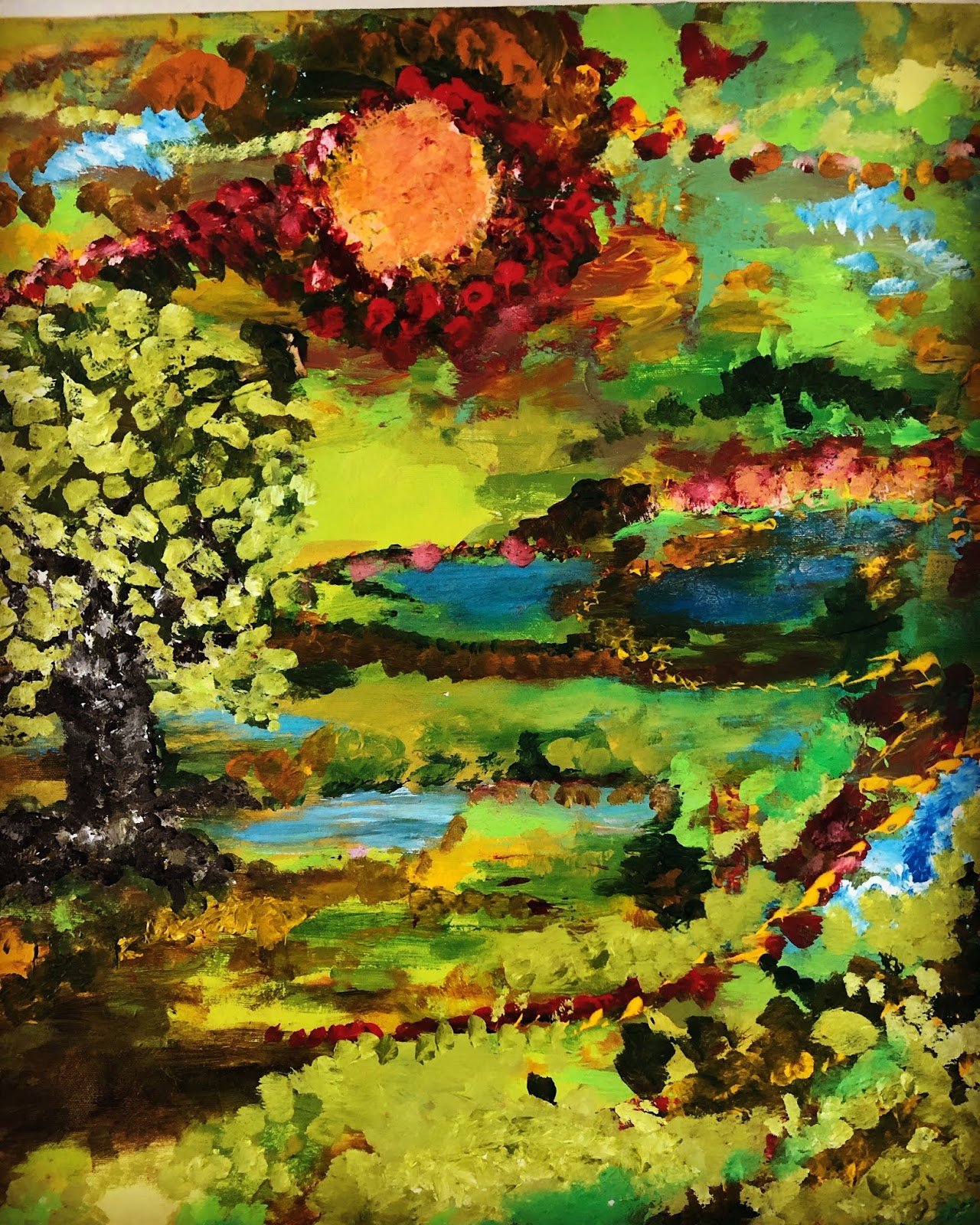
I have produced a rather strange image, circular, more or less, with what looks like orange "arms" holding a small green-horned figure at the center of the painting.

I'm not at all sure it works, but that's not the point. I have painted, and miracle of miracles, I have retained most of my "admirers."

Including the one I love most, that being Filomena, who now starts clapping. Others join in with her; I smile and take a quick bow.

I open my phone to get a quick translation of what I want to say:

"I'm not sure it's finished, in fact, I'm fairly certain it isn't!" I raise my voice so that the whole crowd can hear me speak:

"Non sono sicuro che sia finito, anzi sono abbastanza sicuro che non lo sia!"

A round of "ah, si, si" goes up and people begin murmuring to each other.

I look over at Filomena; with no warning I am suddenly filled with an overwhelming feeling of love for her. I am so greatful that she has come to see me at the Piazza today that I decide I will tell her, publicly! But right now she is talking to someone else.

Meanwhile, that feeling of love inspires me to start painting hearts all over the canvas. Aesthetically I am pretty sure I will ruin the canvas but what can I say, I am an intuitive painter, I give way to whimsy whenever it suits me!

First I paint a red heart, and then a blue one, a small yellow, a red and several dark purple.

Once all of these hearts are drying, and staring back at me, I realize that I don't love this painting nearly as much as I thought I would before I painted the hearts.

The heat and the sun are so intense they dry the acryllic paint in a matter of minutes. And that's a good thing, because now I realize that it's definitely time to paint over the hearts.

Which I do after I mix up a pale purple. Taking my largest brush, I cover the entire canvas with a thin layer of this color, which reminds me of Easter.

When I finish, I step back. I take a clean rag and wipe some of the paint off here and there to reveal the underlying colors. And then I'm staring at something I rather like.

Gone, at least for now, is my artist's block, which is rather like constipation, it isn't until it's relieved that you can say that it wasn't so bad.

At this moment I know exactly what I need to do. I only wish I had a microphone. And once again, I wish I spoke real Italian rather than Google Italian.

"Per favore, gradirei la tua attenzione per un momento perché c'è qualcosa di importante che voglio dire. La mia bis-bisnonna, Filomena Scrivano, è qui oggi, è una donna molto speciale e vorrei riconoscere il ruolo incredibilmente cruciale che ha avuto oggi nella mia pittura.

"Please, I would appreciate your attention for a moment as there is something important I want to say. My great great grandmother, Filomena Scrivano, is here today, she is a very special lady and I would like to recognize the incredibly crucial role she played today in my painting."

I scan the crowd. Fi is rather diminuitive, no more than five feet tall, so I give careful attention to the back rows. When I can't find her, I step away from the easel and move right into the crowd, where I make a slow pirouette, carefully reviewing each face. But she is nowhere to be found.

Back at my easel, I speak once more to the crowd.

"Well, so, all I can say is that my great great grandmother is a rather shy and modest woman, and I'm fairly sure she decided to retreat from the Piazza when she realized that she was going to be publicly recognized."

"Bene, tutto quello che posso dire è che la mia bis-bisnonna è una donna piuttosto timida e modesta, e sono abbastanza sicuro che abbia deciso di ritirarsi dalla piazza quando ha capito che sarebbe stata riconosciuta pubblicamente."

Someone is admiring my painting now. She is wearing a straw sunhat with a wide band of orange ribbon at the brim.

"May I ask how much you are asking for this piece?" She speaks English with a crisp British accent.

I'm quite taken aback. When is the last time one of my paintings has sold? I can't remember.

"Well, honestly," I say to her, "I haven't given that a bit of thought. But I will, and if you wish, I will take your information and get in touch with you, probably in the next day or two." Later, my husband will say to me, "are you crazy, why the hell didn't you sell it to her on the spot?"

The truth is I've gotten to the point where I don't want to part with any of my canvases, with the exception of those I paint "from the heart" for family and friends. "Thank you," she says. "I'll just give you my card." She slips her hand into a large leather satchel, retrieves a card from an inside pocket and slips it into my hand.

And so as the crowd disperses, I pack up my easel, the paints and brushes and palette and knives and watch while the orange sun sinks lower into the hazy blue sky.

As I cross the Piazza, I realize that it has been a practically perfect day. I have generated a decent painting, and I have found a possible buyer. Moreover, I have "performed" in front of an appreciative crowd.

Now if only Fi hadn't pulled her vanishing act again!

I am almost at the Cafe Gambrinus when suddenly I am enticed by the thought of an iced latte, along with perhaps another dish of that tiramisu, which feels like an explosion of cream and supremely delicious chocolate in the mouth.

I stopped. Speaking of my mouth, it has now dropped open. Because sitting there in the furthest corner of the outdoor cafe of that most beautiful of coffee shops is none other than my bis bis nonna Filomena, with...guess who?

That straw hat with the wide orange brim gives her away. But who is this mysterious British woman, my potential painting buyer, and why is she in such earnest conversation with Fi?

When the waiter asks if I am "da sola?" I shake my head no and smiling, I point into the corner. He lead me there, me with all of my gear. I stand before the table, and suddenly I am unable to see Fi's face. Or the other woman's. Is this some kind of a shadow effect?

And now of all the strangest things, a dog begins to whine and whimper. And then she barks out loud. I stand there trying so hard to keep these two women in my field of view.

But to no avail. As the dog is now licking my face, and I hear my husband petting her so boisterously, as he does each morning, ruffling Poco's head in his two hands.

I groan. "I don't want to stop dreaming," I moan. "I was dreaming about Filomena and I did a purple painting after she told me to paint with my eyes closed."

"Oh. Super idea," he says. "How did it come out?"

I chuckle. "It was...quite lovely...a large purple thing, and there was a woman asking to buy it on the spot, and I had a huge crowd of people watching me paint." I am smiling just thinking about my "day."

"Well, so, you have found a way out of your artist's block perhaps?"

My eyes open wider. I yawn. "I guess so. I think I have to do have to try painting with my eyes closed." I pause. "But most of all I have to keep reminding myself that it doesn't matter what I paint, as long as I keep painting."

I reach over and start petting my darling Poco in earnest, with both hands.

Saturday, December 02, 2023

Letter to My Brand New Granddaughter, Dani Marcella!

August 8, 2019


Dearest Dani,
you are only
two days
old and now
the wheel
of time has
come loose
inside your grandmother’s
spinning mind
and suddenly
everything has
kind of come
unhinged, 
fast and past
have moved forward
and backward 
and stopped.
Dani, in my head
I see you
as the sweet
little human
pearl of flesh you are,
but also, quite suddenly,
at the same time,
I'm seeing you as a 
grande dame, a great
grandmother
yourself,
you
even older than me,
you becoming
someone akin
to my dad
who is 93, a great grandfather
living out the twilight of his life.
Such a darling little
divine face you
have today, you are a miracle and a
heavenly blessing and a gem
and honestly
words don’t begin
to capture the
magical mystery
that has brought your
arrival.
I sit here on an
August day
in 2019.
The sun drifts
In and out
between
the clouds.
The air after
the rain is
cool and clean
and breezy.
And I pray
that this poetry may
help me to find
the courage to do
what I need to
do for my dear
father, who is not
having an easy time
of living or dying these days,
it’s so sad and heartbreaking.
He says over and over
that he would like to
die. But I would
rather think
of him living
if only just to meet you.
I would rather
eradicate death
from this moment
from this poem
and do what TS Eliot
did in his famous
poem “The Four Quartets,”
that is, find the “still point” of time:
Time past and time future
Allow but a little consciousness.
To be conscious is not to be in time
But only in time can the moment in the rose-garden,
The moment in the arbour where the rain beat,
The moment in the draughty church at smokefall
Be remembered; involved with past and future.
Only through time time is conquered.

I am
thinking of
you meeting
Dad when time is conquered,
when both of
you are 93, both of you are great
grandparents.
There is something
comforting in
thinking about
that meeting.
It takes life
and death
and tumbles
them together
so that they
come out calm.
It takes the sting
out of thinking
about my father’s death.
Instead, you two
would be sitting
on a wooden bench
in a late summer
garden, the bee balm
past but the roses and
bleeding heart and lilies
and black eyed Susans
still in bloom.
“Hello Ric,” you would say
as you put your cane aside
and sat down beside him.
And he would smile and
reach for your
delicately veined hand
and he would say,
“My darling Dani, did
you know that you
were named for
my beloved
wife, DENA?
Next month, on
September 17, 2019,
we would have been
married seventy, yes, 70
years. Oh that
used to seem
like so much time,
such a long long
ago but now that
I’m 93 and you are too
it isn’t much
time at all.”
And he would set one
hand gently on your head
and recall all the cascading
rolls of black shiny hair
that Dina had back on her wedding day.
And Dani, reaching
into a satin handbag,
you would say,
“Ric, do you remember
the poet T.S. Eliot?
That man would understand
the two of us meeting
like this today, so perhaps
I need to read you just a little from his
famous poem, “Burnt Norton,” the first of
the "Four Quartets."
Ric would smile and lean close to Dani
and he would be able to hear.
“Here is how it begins," she’d say:
"Time present and time past
Are both perhaps present in time future
And time future contained in time past.
If all time is eternally present
All time is unredeemable.
What might have been is an abstraction
Remaining a perpetual possibility
Only in a world of speculation.
What might have been and what has been
Point to one end, which is always present.
Footfalls echo in the memory
Down the passage which we did not take
Towards the door we never opened
Into the rose-garden. My words echo
Thus, in your mind."


Then Dani would smile, and move
a stray gray hair from her forehead
and Ric would reach for her hand again,
just the way my sister Karen has
been doing of late whenever she
visits my father. 

And in those hands grasping,
the generations would
connect and collapse into
one time one place one
space of Infinite LOVE. 
Indeed time would be
conquered as we all
sat in the present moment
reveling in the garden and each other
and wondering
but not worrying where time went without us.

Tuesday, November 28, 2023

Journal Entry, November 28, 2023

I am listening to meditation teacher Jack Kornfield lead a visualization designed to help a person work through a difficult situation or memory. I decide I will use this opportunity to find guidance in writing the healing story that seems to be "present."

What difficulty am I trying to work through?

Well it may sounds ridiculous but I'm trying to figure out how to write or finish writing the healing story I began more than four years ago. As I write these words down I think, "Oh, this is so pathetic. Just let the story come, or not. But don't waste your time or that of anyone else on this."

And then part of me whispers: "But this is important. This is important."

"Identify a part of your body that hurts," Jack says. "Now descend into loving awareness into that pain."

Chest. I feel pain and pressure in my chest. This chest cold I have had the last couple of days came out of nowhere and hit me hard. We had to cancel my birthday party yesterday!

"Allow loving awareness to hold it all," Jack says, "not trying to change anything, just like you would hold a child."

A child?

Me. I am the child. Holding myself, as Mary always used to encourage.

"What happens as you do this?" Jack asks. "What do you feel as you hold this situation in loving awareness?"

Confusion. Panic. Breathing. Feeling pressure and pain in my chest.

"Now let yourself imagine where you are situated with this difficult situation. Remember back to this place of difficulty and tell me where you find yourself."

Always always always always beside her bed. Always afraid. My chest. Burns. Her chest. Wheezes.

Do we ever move beyond these traumatic images?

I called my brother the other day and he told me that Mom's illness was also a source of PTSD for him, Mom's not being able to breathe. He too was afraid she'd die. And because he was the oldest, 22 months older than me, he felt even greater pressure to be "the little man" of the house, to take care of me and my younger sister.

Now I am coughing. I am in the hospital, my chest hurts, I have pneumonia and I am three, maybe four. I am terrified and I want my mother. I am holding the square metal crib bars, painted white. I am sobbing, I have been crying for my mother for a long time.

"All of a sudden, just as you're in the thick of it," Jack says, "the doorbell rings. Someone is coming to the door. You are surprised. This person at the door is a luminous being of great courage and wisdom and compassion. Let yourself be surprised!"

Immeditately I know! It's Filomena!

Yes, my great great grandmother, Fi, the eternal grandmother, she is wearing a different dress today. It's an offwhite print with little blue flowers. She has her hair tied back, but some silver wisps escape at her forehead. And unlike her expression in the photo, she is smiling a very kind smile.

"She has a great heart, she is very wise, she has seen it all, and she is so so loving and tender. And she has a trememendous sense of humor."

Filomena is wearing a luminous white apron, with big pockets, over her dress. She is smiling.

She is strong. She picks me up, holds me. I hear her singing in Italian to me, some kind of lullaby. She is able to reassure me that my mother is going to be OK.

She puts me down, and moves through the house. Into the kitchen. She starts cutting up onions and carrots and tomatoes and celery and parsley for minestrone. She bakes bread.

WAIT.

NOW HERE I HAVE THIS QUESTION AND REVELATION: WHY WASN'T MY GRANDMOTHER ALBINA -- my father's mother and Filomena's granddaughter -- WHY WASN'T "Grandma Ricci" THERE WHEN MY MOTHER WAS SO SO SICK AND BARELY ABLE TO BREATHE? ALBINA WAS SO INCREDIBLY RELIGIOUS -- the other day my brother told me that she went to Mass EVERY SINGLE DAY!!!! AND YET SHE NEVER ONCE STEPPED IN TO HELP MY POOR MOTHER WHO WAS SO ILL, AND TRYING SO HARD TO TAKE CARE OF THREE YOUNG CHILDREN!!!!!

I AM FEELING ANGRY AT MY GRANDMOTHER ALBINA. She lived only a couple of miles away, and yet, I never remember her setting foot in our house!!!

Now I remember, very clearly, my mother saying later in life that she, too, was angry at Albina for never coming to help her.

Meanwhile, I think the reason Albina didn't come was that she was ANGRY AT MY FATHER for a variety of reasons. He was guilty of rebelling against her, about religion, for one thing. Also, he insisted on building a house for us, and his mother was sharply opposed!

But most of all, my father, a self-declared agnostic, challenged his mother over religion. She was a devout Catholic. And ironically, later on, when my family moved to Pleasant Valley, in New York State, my grandmother Albina and her husband, Angelo, CAME TO STAY AT OUR HOUSE TO STAY FOR THE WEEKEND OVER AND OVER AGAIN. My mother was an incredible hostess, making meals and entertaining them.

My mother was an angel. And so was her mother, my Grandma Mish. At some point during that period when my mother was so sick, my Grandma Mish -- who lived about half an hour away -- came to our house, packed us up and took us all home to live with her in her house!

Saturday, November 25, 2023

Oh Monte, You are SUCH a Miracle Baby!

To: My Dear Little Monte Moo,

It is almost exactly one year since you came roaring out into the world! To say that we all love you, Mr. Moo, is such a huge HUGE understatement!

Gma flew out to see you almost every month of your first nine or ten months! And soon Gpa and I will begin to spend our winters out in Denver, at our new condo. Oh we are going to have soooo much FUN!

I want to tell you what an amazing influence you have had on Gma this year. Almost immediately after you were born last November, I started writing a long novel about my great great grandmother; she had a baby in November of 1870 -- 152 years before you made your entrance. That probably sounds like a very long time, like it happened in ancient history, but when you turn 70, time no longer feels long -- it feels like hey I'm getting closer to 100, maybe 1870 isn't actually "ancient history."

But what is so magical is that your arrival put Gma into motion, time-wise. I also turned 70 last November; the combination of my big birthday and your EVEN BIGGER birth - day was to make me see so completely how time is fluid. I wrote you a letter a year ago in which I "saw" you all grown up, living in the woods of Colorado!

That Saturday you arrived, your Mom and Dad called us about 6:30 in the morning, but that was OK because HEY YOU HAD POPPED OUT NINE DAYS EARLY!

And then they told us your wonderful name, MONTE, the word "mountain" in Italian! And that very same day I got a text from my brother Rich because he and his family had made a trip back to Italy to MONTEREALE, the region of northern Italy where many of your ancestors were born.

Wow, what a coincidence that was, but hey many people say there are absolutely no coincidences!

All I know is that I began to slip back and forth in time. In a matter of a few months, I wrote a 335-page novel about your great great great great grandma, Filomena Scrivano. If and when you're interested, I will send you a letter about her that I wrote to you and your wonderful cousins, Ro and Dani (or little Dee!)

GMA is feeling a lot of nostalgia
about the day you were born, and the months that followed. That's very natural, especially for someone as sensitive and caring as your Mom! You two are amazing together, you laugh and then she laughs and then you laugh harder and on and on.

And you and your Daddy have a very special relationship too. We just LOVE all the really imaginative photos Daddy
has taken of you this year. How lucky you are little guy to have such a wonderful father, I'm so SO happy for you!

Oh yes, we are very very grateful to have a little grandson as special as you are, Monte Moo! I told you that in the first letter I wrote to you a few days after you were born.

And so, we are super excited to watch you continue to grow. You took your first steps when you were only 10 months old (like your great great grandmother Dena, my mother!) And now you are running about the house, pushing and pulling toys, emptying laundry baskets, making puzzles, chewing on books and otherwise playing so so well by yourself.

You are a big personality, following in the footsteps of several of your family members, including of course your mom and dad, and your mom's and dad's parents and grandparents.

Have a fabulous birthday darling Monte. The adventure of your amazing life has just begun! love, Gma

Wednesday, November 22, 2023

"The Orzo Ancestors Speak Up!"

Not long after I started "writing" in Italian, the world fell prey to the COVID-19 pandemic.

It was March of 2020. It took me a few days after the quarantine began to go grocery shopping.

When I did, I went to two different grocery stores in search of whole wheat pasta. I couldn’t find a single box. What I finally found on the bottom shelf of the third store, however, were the last two containers of

WHOLE WHEAT ORZO.

Orzo is the smallest form of macaroni. You might say it's the most humble of macaroni's. It resembles rice.

That night, I posted a photo of the ORZO container on Instagram with this caption, "Maybe my ancestors are trying to speak to me!"

I wrote that because my grandmother's -- my father's mother's -- name was Albina Orzo Ricci.

My grandmother’s middle name, Orzo, came from her father, my great grandfather – Pasquale Orzo. Oddly enough, Pasquale was the first person in the family to have Orzo as a last name.

At the time, I thought it rather amusing that all I could find in the grocery store was ORZO.

But a few days later, I was really astonished by what happened.

My sister Holly texted me saying, "Ya’ gotta follow the ORZO FACEBOOK PAGE. Look at this post."

Holly had written a Facebook message to our cousin Donna Ricci, who is the family’s informal genealogist. She lives up in Maine. It was Donna who uncovered the secret about great grandpa Pasquale. She was the one who explained to the family why Pasquale Orzo was the first to have that last name.

My great grandfather was illegitimate. Born in 1870 in southern Italy, he was taken from his unwed mother at birth and given the random name ORZO – the smallest form of macaroni. He was given the name, we believe, by the municipal authorities of Paola, the tiny seaside town in the region of Calabria where he was born. He was raised by a woman named Annunziata Sessa, wife of Raffaelle Signorelli.

His illegitimacy was a source of extraordinary shame for my grandmother (his daughter Albina) and her sisters, and by extension, for the rest of the family. We never knew the truth about Pasquale until well after my grandmother and her sisters had passed.

Back to Holly’s Facebook message. She wrote to Donna saying: "I can't thank you enough for being the caretaker of all this ORZO family history." Donna replied: "My hope is that someone in my lifetime will be interested in writing a book about our ORZO family (hint hint cousin Claudia Ricci????)"

I was stunned. How could cousin Donna possibly know that just in the last few day, as I was starting to write more and more in Italian, I had begun to think about writing such a book?!

I am not a Facebook fan, but the next day I posted a message on my cousin's wall: "I hope you are patient because it takes a long time to write a book.”

Then I wrote in my journal:

“Yes, maybe I have started learning Italian so I can write the stories of my ancestors.”

I write that line in green ink, and then I translate it and write the translation down in purple ink:

“Si, forse ho iniziato a imparare l’italiano per poter scrivere le storie dei miei antenati.”

I am astonished to find that the word “ancestors” in Italian is

“antenati.” Like antenna.

I write in my journal: “I will be happy to be an antenna for the Orzo’s and for any other ancestors interested in speaking to and through me!”

“Sarò felice di essere un’antenna per gli Orzos e per tutti gli altri antenati interessati a parlare con e attraverso di mi.”

Tuesday, November 21, 2023

Journal Entry, February 10, 2020

A NEW DAY!

7:51 a.m. Just keep opening your heart. Just keep staying present, just BE, just keep opening your ART
and your HEART. Just stay calm and don’t panic. From this vantage point nothing seems scary. But when the panic hits I sometimes can sit with it but yesterday I could not. I will pray for a calm day today A NEW DAY in which I am not panicked. I will stay at peace, I will keep opening my heart, the way Mary says to me over and over and over again. I will try a round of tapping to see what happens when I do! 7:56 a.m.

8:00 a.m. Even after tapping I can still feel twinges of panic in my stomach but nothing comes up as the cause. I want to have a good feeling today. I don’t want that EVERYTHING IS BORING AND FROZEN feeling. Mary would say “you have to stay with what comes up. JUST KEEP OPENING YOUR HEART! Just keep opening up your heart. Yesterday when I texted Mary telling her I was in such a panic she wrote back: “Find the feeling you don’t want to name.”

Mary says just let the violet flames take away the fear and the panic! Stay with your open heart.
Have patience and you will find GRACE. Is all of this just PTSD? I will go forward with the day and pray that I can stay calm! Mary says when I’m having this frightened frozen feeling that I am blocking some important emotions.

Wednesday, November 15, 2023

Chapter 31: "Waiting for YOU!"

How ridiculous. I keep saying that, and yet, you keep insisting. So, now, I will go, I will meet you exactly where you told me to be.

I will be there shortly. I am not using a map. Believe it or not, there are no maps to be found anymore, anywhere in Italy! I know. Crazy. I am using my GPS, on my phone, to direct me from the bed and breakfast that sits on the hill. I start walking; I am not at all prepared to walk downhill for so long, and at such a steep descent. But the streets -- all such ancient cobblestone -- just keep going, winding down down down toward the water.

Who knew that Naples is so mountainous?

Along the way I see a couple of young boys, sitting on the edge of a wall. Shirtless in the sun, they look to me almost like statues. And then a group of priests all in long black robes, themselves on tour.

Oh and so many flowers, no matter that it's late October! The bougainvilla, thick and clustered pink. And deep purplish blue morning glories. And buildings painted in lively pastels: yellow, raspberry, turquoise, all with pristine white balconies.

Before long, I am here, now, at the mammoth piazza,
my God, it's immense, bigger than any I have ever seen! At this corner is the Gran Cafe Gambrinus, the oldest and most famous coffee shop in Naples. No ordinary coffee shop!

Opened about 1860, it has been, over the years, a literary salon, an art gallery, a meeting place for kings and queens, politicians, journalists and artists.
And of course, a favorite spot for writers, among them Oscar Wilde, Ernest Hemingway, Jean-Paul Sartre. Filled with gallant, original paintings of neapolitan landscapes, it is decked out in marble and gold leaf and magnficent stuccos. There is a brisk crowd, milling around the cafe and most of the outdoor tables are occupied. Huge potted plants shield the tables from the busy piazza.

No matter that there are crowds. You stand out -- who else is dressed for the 1800s? As you walk, your steel grey dress sweeps the smooth paving stones. And today, you wear that same scarf that you wear in the photo. It crisscrosses over your chest and ties at the waistline. Oh and a shawl, a light shawl crocheted out of that splendid cotton lace, covering your shoulders.

I slip my iphone into my purse. There will be time, I hope, for photos later. I take a few steps, then walk up to you slowly. I remove my sunglasses and smile shyly.

"Bongiorno," I say. "Sei...Filomena?"

You lift your face in what looks like an attempt to strike an aristocratic pose. "Si," you say. You nod, but no smile. "Sono Filomena."

"Good, good, oh so so good to meet you," I stumble in English, thinking I will reach out and embrace you, but then, something in your face tells me not to.

I pull out a small journal where I wrote down certain sentences while on the flight over from JFK. I knew I'd be too flustered to rely on memory:

"Posso offirti un caffe, bisnonna?" Of course, you are really bis bis nonna. Great great grandma. But no matter.

"Si, sarebbe carino." You nod again, but this time, you smile politely.

And now the head waiter asks. "Due, signore?" No, no, I say, holding up three fingers. I ask for seating for three to accommodate me and you and a young woman I met on the internet while arranging my stay in Naples. Hopefully, Sarafina will appear in order to do the translating, as she promised.

The waiter guides us to a table at the furthest corner of the outdoor seating. The sun glows on your shoulders and your iron-colored hair, pulled back in a bun. A few silvery wisps escape at the hairline.

There are so many people yakking away in Italian, all around me. I smile, because, honestly, it's just so exhilerating to be here.

And now, after we sit, I freeze. After all these months and months -- years -- waiting and wanting to meet you, I am suddenly losing my confidence. What if Sarafina doesn't show? By the time I go into What's App and call her, it will be time to leave. And without her, how can you and I possibly speak to each other to talk about all of those questions I have for you!!

I close my eyes, and force myself to inhale slowly, trying to settle my nerves. If all else fails, I will pull out the phone and rely on Google translator.

The waiter appears. "Che cosa desiderate, signore?"

You order a cappucino, and so do I. "E tiramisu!" I add.

"Due?"

"No, tre, signore," I say.

As he walks away, I notice a young woman with cropped hair, fiery red with one stripe of bright purple. Ah. Sarafina, thank God. I'd know that hair anywhere. I raise one hand to wave and she smiles and hurries over.

"Oh I am so so happy to see you, Sarafina," I say, getting up.

"Me too, very glad we are meeting!" We hug briefly, and then sit.

And now it's time. It's that moment I have been anticipating for so long.

I glance over at you -- you have one small hand covering the other on the table. You are so tiny! I feel decidedly like an oversized American! You are holding yourself very still, and now you are staring at Sarafina, of course, at her hair. Honestly, you look a bit terrified. Or am I just imagining that?

Because the next thing I know, the two of you are in animated discussion speaking in such rapid-fire Italian that it's all just a pleasant blur to me.

While you are speaking the waiter returns and asks Sarafina if she wants un caffe. She orders a doppia, a double espresso, and then goes right back to conversing with you.

I want desperately to know what you're saying, but I don't dare interrupt.

Well, OK, after a few minutes, I feel like I will burst if I don't.

"Per piacere," I say, raising one hand slightly. Sarafina turns to me.

"Oh sorry," she says, "It is a lot, we are talking so much I know, I am happy to talk for you, just tell me what it is you want to know!"

I inhale. Squeeze one fist below the table. "So first of all, please thank her for coming, for meeting me here in Naples. Because I know this is not her home, we are such a very long long way from Paola, or San Lucido, whichever she..."

Sarafina begins to speak and soon, you are nodding, very slowly, but then with no warning you smile and I see for the first time that you really are a beauty, those eyes, greenish brown, they sparkle, and those dark lashes, yes, your eyes are indeed exotic.

You speak quietly and with a kind of forceful dignity that I have already noticed in your photo. No matter that you fell into shame when you got pregnant as a young woman, today you command respect, that much is clear.

What you say by way of Sarafina: "Yes, it's a long way but I am glad to be here, to meet you, my dear great great granddaughter, but you ought to know that I am very much at home here in the Piazza Plebescito, because --" and here you gesture across the giant piazza, "here is the grand Basilica di San Francesco di Paola!"

Sarafina explains to me something that I am embarrassed I don't already know. San Francesco di Paola is not quite as famous as Saint Francis of Assisi, but in Italy, particularly in the south, in Calabria, he is very well known. Like his namesake, he was a man of nature, and a humble servant of God, and supposedly a miracle worker. The columned basilica here in the piazza,
inspired by the Roman Pantheon, is a monumental tribute to this beloved saint, who was born in the 15th century in your own town, Paola. Thousands of people come to Paola in early May each year to commemorate Francesco being sainted.

"Please tell her, Sarafina, that there is so much about the home of my ancestors that I don't know. And I am looking forward to going there to Paola directly after I leave Naples!"

Your response: "You will be impressed when you go there with the magnificent Sanctuario di San Francesco de Paola, which is built on the hillside right where the good saint lived like a hermit, in the caves, as a young man, before he began working all of his healing miracles."

The waiter sets down the plates of tiramisu, and now I take my fork and lift a bite to my mouth. I have eaten this confection in the United States before, but back home, it never tasted at all like this, which is something between a pudding -- panne cotta -- and a cake, chocolate, thinly layered with vanilla cream.

"Ah, magnifico," I say, the cake dissolving in my mouth. My companions begin to enjoy theirs as well.

Eating gives me a chance to think. I want to know about the man who fathered your baby. Will you tell me?

"Sarafina, would you explain to her that her ancestors want so much to know all about her life, and as part of that, we want to know who was the man who became her son's father."

I had explained to Sarafina when we emailed, explained what little we know about the circumstances under which you became pregnant.

Sarafina nods. "Maybe I suggest, maybe first to talk to her about what it was like to be a child, of her growing up, and perhaps then the question about the other matter."

"Of course, whatever you think." I take my journal out of my satchel, along with a couple of pens. When you begin to reveal your secrets, I will be ready!

I hear Sarafina's voice become quieter, and more charming. Her Italian is so fluid, the tones so round and full and ever-changing. It almost sounds like she is singing. She speaks for several minutes, and as she does, you begin to warm, you are smiling, nodding, and at one point, you raise one hand and sweep it gracefully above your head. Once or twice, you laugh without restraint. After that, you speak in a low and steady tone for what seems like 15 minutes or more. Oh how I wish I spoke Italian!

When you finally leave off, Sarafina turns to me. "This is, oh yes, a beautiful story she tells us. So, Filomena was born in 1852, and her mother had seven children, but when they are babies, two of them die. Very sad. Filomena was number two in position, the second daughter. They all lived in a tiny home of three rooms.

"They were most fortunate because they owned one white cow...and too, how do you say it in English, they had the grey animal with long ears, in Italian, asina, it is good for carrying everything..."

"Oh, you mean a donkey?"

"Yes, yes, donkey. Because of the donkey, Filomena's father who was a fisherman in Paola could carry fish from the catch early in the morning up and over the mountain to Cosenza where he would sell it for a good price in the market. And because in Filomena's family there was no boy until the youngest child, she was often walking with her father as he travels to Cosenza. Also, Filomena says that she was able to go to school each year from November to March. And so, she learned to read and write."

I nodded. An image of your beautiful handwriting on the back of the photo comes to mind.

"Also, Filomena says that they were eating most of the time bread and polenta and maybe some cheeses, and tomatoes and sometimes other vegetables like scarola and sausages they bought at the market in Paola when the farmers come there."

I look up and you are staring at me. I return your gaze, smiling; it is such a privilege to be sitting here with you. And soon it will be time to ask for the answers that really matter: who was your partner? Who fathered my great grandfather, Pasquale, and moreover, who raised him?

With no warning, however, suddenly your face starts to turn pale. What? Are you ill? And then it happens. You begin to fade altogether, along with the shawl, and the dress and the rest of you. I call out. "OH please Fi, please please don't do this. Please please come back to me!"

I stand, I reach over the table as if to touch you, but your chair is empty. There is nothing. You're gone. I am all alone. I sit down and face my journal, where I have been busy writing for the last hour. I tighten my fist around my pen. Start tapping it hard against the paper.

Sometimes, writing can be so incredibly frustrating. And imagination so elusive and puzzling. I wonder what keeps me coming back, to try writing your story, my dear great great grandmother. Honestly, I thought visiting Italy would help, that it would guarantee I would be deeply inspired. A story would easily pour out onto paper, like all the olio d'oliva that I poured onto bread. I would need only watch the words accrue in a splendid order.

But no. That's not happening. In my mind's eye, where I often first see my stories appear, there is virtually nothing. Niente! The waiter is beside me, asking: "C'è qualcos'altro che posso procurarti?"

I shake my head, slowly. "No, grazie. Per favore, il conto," I say. I am feeling overwhelmed with sadness. I thought I had your solemn promise that if I met you here, at the Gran Caffe Gambrinus, the most famous cafe in Naples, you would stay with me long enough to answer all of my questions. I guess you are not to be trusted.

Slowly, I reread what I have written. It doesn't begin to be sufficient. Feeling bereft, I decide to write some more:

"Little did I know

that you would show up as

you promised

and even begin to reveal yourself, only

to stop

practically in mid-sentence!

Why were you so insistant on meeting me here?

Why did you leave so suddenly?

Clearly, you were disappointed in me? But why?

What did I say or do to scare you away?"

I close my journal and take out a ten euro note, and a five, and leave them on the table.

My walking tour of Naples leaves in half an hour from the Basilica. I walk half-way across the Piazza, and stop. I take a photo, hoping it will capture the Piazza's beauty and majesty.

I whisper to you. "I am here, if and when you are ready."

Sunday, November 05, 2023

Grandchildren, Meet Your Great Great Great Great Grandmother!

6 November 2023

My dear Ro and Dani and Monte, I am sitting here on a cloudy November morning at the age of 70, trying to think clearly about what it is I want to say to you and why. You three children mean everything to me. You are my beloved grandchildren, "i miei amati nipoti!" I am your Gma! "Sono tua nonna!"

It's hard for me to push my mind forward several decades into the future when you three -- today you are ages nine, four and almost one -- will be all grown up. But this is what I want to do, because someday, after I am long gone, you may become curious about your ancestors. If you do, well, then, I think it's important for you to know about one ancestor in particular. Her name was Filomena Scrivano, and she is, are you ready?

your great great great great grandmother! She was born about 170 years ago, in a small seaside town in southern Italy, a town by the name of Paola. (I fully realize that by the time you read this, maybe three or four or five decades from now, it will be well more than 200 years after her birth!)

Filomena's story is heartbreaking.

I will explain why in a moment. But first, maybe you are wondering why I have decided to tell you this story now?

Something happened to Gma this past year, when I turned 70. Suddenly, my mind started skirting back and forth in time. When you get to be my age, you realize just how quickly time passes! To a child, and even a young adult, 100 years seems like forever and people who lived "back then" are part of ancient history that doesn't seem to matter very much. But just wait! When you get to be 70, I'm telling you, 100 years doesn't seem like such a terribly long chunk of time at all -- maybe because you are a lot closer to 100!

Filomena was born in 1852. And I was born in 1952!

So maybe that explains why I suddenly became deeply interested in my great great grandmother, and her son, my great grandfather, Pasquale Orzo. He was born to Filomena in 1870, when Fi (my nickname for her) was about 18.

Pasquale died at the age of 70 in 1940, only 12 years before I was born. All this made me stop and think. A lot. About him. And about his mother too.

And so why is Filomena's story so sad?

Because after giving birth to her beloved son, poor Filomena was forbidden to raise him. Perhaps you already have children (I hope you do!) Knowing how fiercely you love these children, can you imagine how excruciating it must have been for poor Filomena to have to give her brand new baby up to a stranger?

Why was it that Filomena had to do such a difficult thing?

You may think it is quite silly or strange, and hard to comprehend, but Filomena's baby was taken away from her because she wasn't married to the baby's father!

I KNOW. I can hear you saying, so what's the big deal? Why should that matter at all?

It mattered because in 1870, in Italy, a strict Catholic country, to be unmarried and pregnant was a great scandal!

I know, I know. Even in my day, that idea sounds preposterous. Single mothers are everywhere in 2023, as are single fathers.

But in those days, it was considered sinful and deeply shameful for a single woman to get pregnant. Of course, that doesn't mean babies weren't born "out of wedlock" anyway. Women got pregnant in spite of the rules. Even though it was forbidden, it still happened quite often.

And so, thousands and thousands of infants were taken away from their unmarried mothers throughout Italy, as well as in other Catholic countries in Europe like Spain and France.

, Where did these so-called "abandoned" babies go?

In Italy, the infants often landed in orphanages, known as "ospizios." These ospizios were dirty and decrepit, and diseases were rampant. Wet nurses, hired to feed one baby after another, ended up transmitting illnesses from one infant to the next.

Tragically, in most cases, these abandoned babies died before their first birthday! One researcher, at Brown University, found that in my great grandfather's area of Italy, more than 90 percent of the "illegitimate" babies born in 1870 perished!

Can you imagine? What a terrible tragedy! And so unnecessary!

So now maybe you're wondering this: how did my great grandfather Pasquale manage to survive? If he didn't go to the orphanage, where did he go? Who raised him?

And how is it that his mother, Filomena, managed to keep in touch with him well into his adulthood?

We know that she stayed in contact with her son because of a single photograph of Filomena that has survived from this time! (Imagine having only one photograph!!!!) Yes, well, we are lucky to have this one! Here it is:

On the back of this photo, in a flourishing handwriting, Filomena dedicated the photo "al mio caro figlio," to my dear son, Pasquale. The photo is dated 23 Octobre 1919. Quite coincidentally, it was almost exactly 104 years later, to the day, on October 21, 2023, that your Gma and Gpa traveled to Italy to the little town of Paola to see for ourselves what it was like. AND to see if we could find out more information about Filomena and her son.

The day we were there, only two weeks ago, it was warm but rainy. Heavy downpours fell off and on all day. Holding our umbrellas overhead, we walked through the village with a delightful young man named Antonello, who grew up in Amantea, a town a few kilometers away. We hired him to give us a tour of Paola, and to do that, he took us back in history hundreds and hundreds of years.

He described to us at length the history of the town's patron saint, San Francesco di Paola, who was born in March of 1416. At a young age, Francesco Martollila, described as most humble, decided to become a hermit, secluding himself in the caves on the rocky wooded hillside above the town. He did this to come closer to God! The caves sit beside a river that to this day tumbles down the lush valley.

In time, Francesco built a chapel and a hermitage. He became a healer, and he was credited with working many miracles. The Church conferred sainthood on Francesco in 1516.

We visited the Sanctuary dedicated to San Francesco, which was only minutes away from the bed and breakfast where we stayed. We saw the original church, as well as a large modern church that can accomodate a thousand visitors or more. Many people make a pilgrimage to the Sanctuary in Paola in the early days of May each year, to commemorate the date when sainthood was conferred on Francesco.

Antonello also took us into the center of Paola, where there are two churches that sit quite close to each other.
As we strolled through the streets of Paola, I tried to picture Filomena's house.
After lunch, we drove a few kilometers south to the beautiful town of San Lucido. There, in a lovely little church
on a cliff overlooking the crashing waves, my great grandfather married Caterina Amendola, my great grandmother in January of 1898 (Gma and Gpa married 80 years later, in 1978!) Standing in the church in the very spot they exchanged their vows was such a thrill! And I will never forget what happened when we emerged from the church late in the day. The sun had already disappeared into the Mediterranean. But somehow, there was bright pink and yellow light glowing over the church. The light shined on and on!


Perhaps some day you will visit this church, San Giovanni Battista.

Sometime during the day, Antonello shared his background. He worked as a reporter for local newspapers before he became a certified tour guide. He also has a deep interest in geneology, and so he has begun researching family histories for others, like me, who are interested in knowing more about our ancestry.

The more we talked, the more it made sense to me to hire Antonello to search through official birth, death and marriage records in Paola, and perhaps surrounding towns, to see if he can come up with more information about Filomena and her son. As of today, November 6, 2023, Antonello has officially begun our ancestry research!

One other thing: several months ago, Gma began writing a novel about Filomena. In this book, I have imagined the way Filomena may have fallen in love with the man who would become Pasquale's father. I'd rather not tell you any more about it. Instead. If you're interested, you can read the e-book. Here.

Tuesday, October 10, 2023

Filomena Writes a Letter to Her Unborn Son

I am sitting here holding a magnificent glass pen, writing to you, my son, wondering when, if ever, you will read this letter. I am helpless to guarantee that you will get it. But no matter, I want to tell you in writing that you are loved beyond words, even before you are born!

I want you to know, too, that you are the product of two very loving parents. Your father and I fell in love and were married for a very short time before we learned that our marriage was not legal. Please know that your father married me in good faith. And before he fell ill and passed away a few months ago, he was terribly excited about meeting you.

I miss him deeply. Giovanni Masiero was a poet, born near Florence, to a family known for fabricating very fine wool and also, for producing some of the best wine in all of Italy. Your father had the soul of an artist, however. As a wedding gift, he bought me a set of these very beautiful glass pens, handcrafted in Venice!

He was walking on the beach in Paola, carrying a notebook of his poetry, on that beautiful day that we met. It didn't take long for us to fall in love. We spent countless hours writing together and we were married in a magnificent ceremony and celebration just before Christmas of last year, 1869.

According to the laws of the church and our municipality, I am forced to give you up for adoption, as I am not legally married. But my dearest friend Annunziata Sesta has helped to locate a loving family in Amantea who will take you in. That is a miracle, because the alternative would be to give you up to the ospizia in Cosenza, where so many newborns do not live until their first birthday! I will be able to stay with this family in Amantea for your first two or three months of life, and after that, it is my greatest wish that I be able to visit you as often as possible.

A great ocean of sadness awaits me, as I anticipate the loss I will feel on the day I am forced to give you up. I dread the day that will happen. How will I possibly be able to leave you behind? The thought of it wrenches me. But remember this, my darling boy (because I am certain that you will be a boy!), I will always be your first mother, and I will never stop loving you or coming to see you in Amantea.

I pray that you may be a happy child, and that you will keep your heart open to me as you grow older. I know I have to make room for the family in Amantea to care for you on a day-to-day basis. But as God is my witness, you will know me as your mother as long as I shall live.

Can you feel my hand resting on what feels like your shoulder? I can't wait to fold my arms around you, and set my lips to your delicate head. Will you look like me, with dark eyes and hair, or will you be fair, with curly blonde hair and blue eyes like your father?

It doesn't matter a bit what you look like. I will love you no matter what!

Your loving mother!